












Ultrasensitive electrochemical detection of ochratoxin A based on signal amplification by one-pot synthesized flower-like PEDOT–AuNFs supported on a graphene oxide sponge
Literature Information
Publication Date
2019-08-23
DOI
10.1039/C9AN01288E
Impact Factor
4.616
Authors
Pengxiang Wang, Luyan Wang, Mei Ding, Meishan Pei, Wenjuan Guo
View Original
Abstract
To enhance the sensitivity of an aptasensor, a novel strategy was designed to develop an electrochemical aptasensor based on poly(3,4-ethylenedioxy thiophene)–gold nanoflower (PEDOT–AuNF) composites supported on a three-dimensional graphene oxide sponge (GOS). GOS with a three-dimensional sponge-like porous structure, exhibiting excellent electrical conductivity and a large surface area, provided the first amplification of the electrochemical signal for ochratoxin A (OTA) detection. PEDOT–AuNFs, synthesized by an ionic liquid-assisted one-pot method, presented a peculiar hierarchical flower-like structure, a high electroactive surface area, and more binding sites for immobilizing the aptamer molecules by the Au–S bonds. When PEDOT–AuNFs were supported on the surface of GOS by the interaction of the π–π packing between PEDOT and graphene oxide, a synergistic effect was produced to provide the second amplification for the aptasensor. PEDOT–AuNFs/GOS provided an ultrasensitive detection technique by multiple signal amplification for the electrochemical sensing of OTA. Consequently, this strategy not only endowed the aptasensor with high sensitivity but also needed no complicated signal amplification. The electrochemical sensor was fabricated successfully on a glassy carbon electrode to detect OTA with a linear response in the range of 0.01–20 ng L−1 and a limit of detection of 4.9 pg L−1. Moreover, it displayed good specificity, reproducibility and stability. The utilization of the proposed aptasensor for the quantitative determination of OTA in wine indicates that it can find promising applications in detecting OTA and even other mycotoxins in foodstuffs.
Recommended Journals
Related Literature
Plasmon-mediated dehydrogenation of the aromatic methyl group and benzyl radical formation
Govinda Ghimire, Alexander M. Mebel, Shuai Chang
2023-11-28
Edge Article
DOI: 10.1039/D3SC05847F
Towards routine organic structure determination using Raman microscopy
Jason Malenfant, Lucille Kuster, Yohann Gagné, Kouassi Signo, Maxime Denis, Sylvain Canesi, Mathieu Frenette
2023-11-14
Edge Article
DOI: 10.1039/D3SC02954A
Improving the potential of paraCEST through magnetic-coupling induced line sharpening
Xin Guo, Jiesheng Hu, Meng Yu, Gyula Tircsó, Jun Tao
2023-11-21
Edge Article
DOI: 10.1039/D3SC04770A
A β-barrel-like tetramer formed by a β-hairpin derived from Aβ
Tuan D. Samdin, Chelsea R. Jones, Gretchen Guaglianone, Adam G. Kreutzer, J. Alfredo Freites, Michał Wierzbicki
2023-11-28
Edge Article
DOI: 10.1039/D3SC05185D
A general approach to stereospecific Pd-catalyzed cross-coupling reactions of benzylic stereocenters
2023-11-24
Edge Article
DOI: 10.1039/D3SC04519F
Endogenous metal-ion dynamic nuclear polarization for NMR signal enhancement in metal organic frameworks
Ilia B. Moroz, Yishay Feldman, Raanan Carmieli, Xinyu Liu, Michal Leskes
2023-12-02
Edge Article
DOI: 10.1039/D3SC03456A
Facile synthesis of 1,2-aminoalcohols via α-C–H aminoalkylation of alcohols by photoinduced hydrogen-atom transfer catalysis
Joaquim Caner, Akira Matsumoto
2023-11-16
Edge Article
DOI: 10.1039/D3SC05305A
Optimizing copper nanoparticles with a carbon shell for enhanced electrochemical CO2 reduction to ethanol
Ting Yao, Wei Xia, Shitao Han, Shuaiqiang Jia, Xue Dong, Min Wang, Jiapeng Jiao, Dawei Zhou, Jiahao Yang, Xueqing Xing, Chunjun Chen
2023-11-24
Edge Article
DOI: 10.1039/D3SC04061E
Supramolecular “baking powder”: a hexameric halogen-bonded phosphonium salt cage encapsulates and functionalises small-molecule carbonyl compounds
Hatem M. Titi, Yong Teoh
2023-11-28
Edge Article
DOI: 10.1039/D2SC04615F
Dipyrrolonaphthyridinedione – (still) a mysterious cross-conjugated chromophore
Bartłomiej Sadowski, Daniel T. Gryko
2023-11-10
Perspective
DOI: 10.1039/D3SC05272A
You might also like
Compound Q&A
What precautions should be taken when handling 4-(2-Furylmethyl)thiomorpholine 1,1-dioxide (CAS: 79206-94-3)?
When handling 4-(2-Furylmethyl)thiomorpholine 1,1-dioxide (CAS: 79206-94-3), it ...
79206-94-34-(2-Furylmethyl)thi...
Compound Q&A
What precautions should be taken when handling 4-Chloro-N-[2-(4-morpholinyl)ethyl]benzamide (CAS: 71320-77-9)?
When handling 4-Chloro-N-[2-(4-morpholinyl)ethyl]benzamide (CAS: 71320-77-9), it...
71320-77-94-Chloro-N-[2-(4-mor...
Compound Q&A
How should waste containing 2-[2-(2-Methoxyethoxy)ethoxy]ethyl 4-methylbenzenesulfonate (CAS: 62921-74-8) be handled?
Waste containing this compound (CAS: 62921-74-8) should be handled according to ...
62921-74-82-[2-(2-Methoxyethox...
Compound Q&A
How should waste containing (S)-Methyl 2-amino-3-cyclohexylpropanoate be handled?
Waste containing (S)-Methyl 2-amino-3-cyclohexylpropanoate should be collected i...
40056-18-6(S)-Methyl 2-amino-3...
Compound Q&A
How is 5-({4-[(2S,4R)-4-Hydroxy-2-methyltetrahydro-2H-pyran-4-yl]-2-thienyl}sulfanyl)-1-methyl-1,3-dihydro-2H-indol-2-one (CAS: 166882-70-8) typically synthesized?
This compound can be synthesized using a multi-step process involving the conjug...
166882-70-85-({4-[(2S,4R)-4-Hyd...
Compound Q&A
Are there alternatives to (2E)-3-(3,4-Dichlorophenyl)acrylic acid (CAS: 7312-27-8) in synthesis?
There are several alternatives to (2E)-3-(3,4-Dichlorophenyl)acrylic acid in syn...
7312-27-8(2E)-3-(3,4-Dichloro...
Compound Q&A
How should Ethyl 6-(2-nitrophenyl)imidazo[2,1-b][1,3]thiazole-3-carboxylate (CAS: 925437-84-9) be stored?
Ethyl 6-(2-nitrophenyl)imidazo[2,1-b][1,3]thiazole-3-carboxylate (CAS: 925437-84...
925437-84-9Ethyl 6-(2-nitrophen...
Compound Q&A
How should waste containing 2-(1,3-Thiazol-2-yl)ethanamine (CAS: 18453-07-1) be handled?
Waste containing 2-(1,3-Thiazol-2-yl)ethanamine (CAS: 18453-07-1) should be coll...
18453-07-12-(1,3-Thiazol-2-yl)...
Compound Q&A
How is Methyl 5-iodo-2-methylbenzoate (CAS: 103440-54-6) typically synthesized?
Methyl 5-iodo-2-methylbenzoate can be synthesized through the iodination of meth...
103440-54-6Methyl 5-iodo-2-meth...
Compound Q&A
How is 5-Chloro[1,2,4]triazolo[1,5-a]pyridine (CAS: 1427399-34-5) typically synthesized?
5-Chloro[1,2,4]triazolo[1,5-a]pyridine is commonly synthesized via the condensat...
1427399-34-55-Chloro[1,2,4]triaz...
Source Journal
Analyst

CiteScore:
7.8
Self-citation Rate:
5.6%
Articles per Year:
653
Analyst publishes analytical and bioanalytical research that reports premier fundamental discoveries and inventions, and the applications of those discoveries, unconfined by traditional discipline barriers.
Recommended Compounds
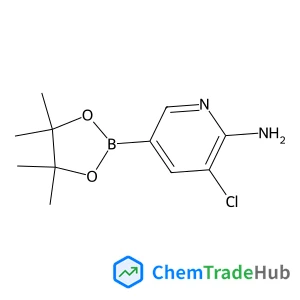
3-Chloro-5-(4,4,5,5-tetramethyl-1,3,2-dioxaborolan-2-yl)-2-pyridinamine
CAS Number:
1032758-99-8
Molecular Formula:
C11H16BClN2O2
Recommended Suppliers





Disclaimer
This page provides academic journal information for reference and research purposes only. We are not affiliated with any journal publishers and do not handle publication submissions. For publication-related inquiries, please contact the respective journal publishers directly.
If you notice any inaccuracies in the information displayed, please contact us at support@chemtradehub.com. We will promptly review and address your concerns.