












Facile synthesis of triphenylenes and triphenylene/phenanthrene fused heteroaromatics
Literature Information
Publication Date
2018-09-14
DOI
10.1039/C8OB01930D
Impact Factor
3.876
Authors
Vijay Gupta, Satish K. Pandey, Ravi P. Singh
View Original
Abstract
In the recent past, development of milder, safer and comparatively less toxic methods in organic synthesis has received great attention. We report a simple and facile method for the synthesis of substituted triphenylenes and their heteroaryl analogues using ceric ammonium nitrate (CAN) via oxidative biaryl coupling. We describe the structural and photophysical properties of these unique heteroaryl fused triphenylenes.
Related Literature
Chemoenzymatic synthesis of prodigiosin analogues—exploring the substrate specificity of PigC
Suresh R. Chawrai, Neil R. Williamson, George P. C. Salmond, Finian J. Leeper
2008-02-05
Communication
DOI: 10.1039/B719353J
Remote substituent effects on the photooxygenation of 9,10-diarylanthracenes: strong evidence for polar intermediates
Werner Fudickar, Torsten Linker
2008-02-14
Communication
DOI: 10.1039/B719637G
Photo-responsive gel droplet as a nano- or pico-litre container comprising a supramolecular hydrogel
Shinji Matsumoto, Satoshi Yamaguchi, Atsuhiko Wada, Toshihiro Matsui, Masato Ikeda
2008-02-25
Communication
DOI: 10.1039/B719004B
Layer-by-layer assembly of single-charged ions with a rigid polyampholyte
Suobo Zhang, Zhaohui Su
2008-03-14
Communication
DOI: 10.1039/B801784K
Stabilization of cobalt oxyhydrate superconductor
Zhi Ren, Cao Wang, Xiang-fan Xu, Guang-han Cao, Zhu-an Xu, Yu-heng Zhang
2008-03-03
Communication
DOI: 10.1039/B800378E
A new enantiopure unsaturated dicarboxylate as a 4-connected unit in a flexible homochiral PtS-type framework
Jian Zhang, Xianhui Bu
2008-02-11
Communication
DOI: 10.1039/B719368H
Functionalized polyesters from organocatalyzed ROP of gluOCA, the O-carboxyanhydride derived from glutamic acid
Olivier Thillaye du Boullay, Colin Bonduelle, Blanca Martin-Vaca, Didier Bourissou
2008-03-17
Communication
DOI: 10.1039/B800852C
One-pot synthesis of reverse type-I In2O3@In2S3 core–shell nanoparticles
Zhaoyong Sun, Amar Kumbhar, Kai Sun, Qingsheng Liu
2008-03-18
Communication
DOI: 10.1039/B719176F
Rapid formation of metal–organic nano-capsules gives new insight into the self-assembly process‡
Nicholas P. Power, John E. Warren, Jerry L. Atwood
2008-02-27
Communication
DOI: 10.1039/B719769A
You might also like
Compound Q&A
What is the market or research trend for N-(4-Methoxybenzyl)-2-pyridinamine (CAS: 52818-63-0)?
N-(4-Methoxybenzyl)-2-pyridinamine (CAS: 52818-63-0) is increasingly being used ...
52818-63-0N-(4-Methoxybenzyl)-...
Compound Q&A
What precautions should be taken when handling Ethyl 4-(2-chlorophenyl)-1,3-thiazole-2-carboxylate (CAS: 1050507-06-6)?
When handling Ethyl 4-(2-chlorophenyl)-1,3-thiazole-2-carboxylate, appropriate p...
1050507-06-6Ethyl 4-(2-chlorophe...
Compound Q&A
What regulatory guidelines apply to diethyldiselane (CAS: 628-39-7)?
Diethyldiselane (CAS: 628-39-7) is classified under the Globally Harmonized Syst...
628-39-7Diethyldiselane
Compound Q&A
What is the market or research trend for oxocopper (CAS: 12053-18-8)?
The market for oxocopper (CAS: 12053-18-8) is primarily driven by its use in cat...
12053-18-8oxocopper; oxo-(oxoc...
Compound Q&A
What is the market or research trend for 5-{[(2-Methyl-2-propanyl)oxy]carbonyl}-5-azaspiro[2.4]heptane-7-carboxylic acid?
The market for 5-{[(2-Methyl-2-propanyl)oxy]carbonyl}-5-azaspiro[2.4]heptane-7-c...
1268519-54-55-{[(2-Methyl-2-prop...
Compound Q&A
What is 2-(1-Pyrrolidinyl)-4-pyridinamine (CAS: 35981-63-6)?
2-(1-Pyrrolidinyl)-4-pyridinamine is a chemical compound with the CAS number 359...
35981-63-62-(1-Pyrrolidinyl)-4...
Compound Q&A
What are the physical and chemical properties of 2-(3-Pyridinyl)-1-azabicyclo[2.2.2]octane (CAS: 91556-75-1)?
2-(3-Pyridinyl)-1-azabicyclo[2.2.2]octane (CAS: 91556-75-1) is a crystalline sol...
91556-75-12-(3-Pyridinyl)-1-az...
Compound Q&A
How is (S)-Alpha-allyl-proline hydrochloride (CAS: 129704-91-2) typically synthesized?
(S)-Alpha-allyl-proline hydrochloride is usually synthesized via a Wittig reacti...
129704-91-2(S)-Alpha-allyl-prol...
Compound Q&A
What is 3-Methyl-1,2-oxazole-5-carboxylic acid (CAS: 4857-42-5)?
3-Methyl-1,2-oxazole-5-carboxylic acid (CAS: 4857-42-5) is an organic compound w...
4857-42-53-Methyl-1,2-oxazole...
Compound Q&A
How is Lys-SMCC-DM1 (CAS: 1281816-04-3) typically synthesized?
Lys-SMCC-DM1 is synthesized via a multi-step process involving the coupling of S...
1281816-04-3Lys-SMCC-DM1
Source Journal
Organic & Biomolecular Chemistry

CiteScore:
3.4
Self-citation Rate:
10.3%
Articles per Year:
1041
Organic & Biomolecular Chemistry (OBC) publishes original and high impact research and reviews in organic chemistry. We welcome research that shows new or significantly improved protocols or methodologies in total synthesis, synthetic methodology or physical and theoretical organic chemistry as well as research that shows a significant advance in the organic chemistry or molecular design aspects of chemical biology, catalysis, supramolecular and macromolecular chemistry, theoretical chemistry, mechanism-oriented physical organic chemistry, medicinal chemistry or natural products. Articles published in the journal should report new work which makes a highly-significant impact in the field. Routine and incremental work is generally not suitable for publication in the journal. More details about key areas of our scope are below. In all cases authors should include in their article clear rationale for why their research has been carried out.
Recommended Compounds
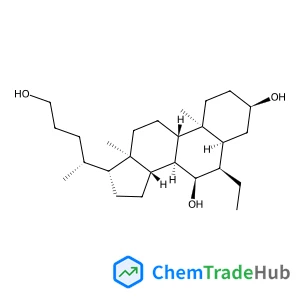
(3alpha,5beta,6alpha,7alpha)-6-Ethylcholane-3,7,24-triol
CAS Number:
1537866-49-1
Molecular Formula:
C26H46O3
![5'-Fluoro-[2,3'-biindolinylidene]-2',3-dione structure](https://static.chemtradehub.com/structs/251/251903-00-1-9cb1.webp "5'-Fluoro-[2,3'-biindolinylidene]-2',3-dione structure")
![1-[6-(1H-Imidazol-1-yl)-3-pyridinyl]methanamine structure](https://static.chemtradehub.com/structs/914/914637-08-4-8825.webp "1-[6-(1H-Imidazol-1-yl)-3-pyridinyl]methanamine structure")
Recommended Suppliers





Disclaimer
This page provides academic journal information for reference and research purposes only. We are not affiliated with any journal publishers and do not handle publication submissions. For publication-related inquiries, please contact the respective journal publishers directly.
If you notice any inaccuracies in the information displayed, please contact us at support@chemtradehub.com. We will promptly review and address your concerns.