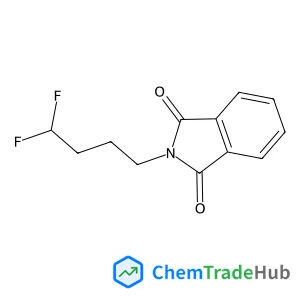
2-(4,4-Difluorobutyl)-1H-isoindole-1,3(2H)-dione
CAS Number:
1265341-14-7
Molecular Formula:
C12H11F2NO2
Gaia Scalabrino, Xiao-Wen Sun, John Mann, Anne Baron
Synthesis of (1R,5R,6R)-2-(6-hydroxymethyl-5-isopropyl-2-methylcyclohex-2-enyl)-N-methoxy-N-methylacetamide 8 from R-(−)-phellandrene in six steps, and (3aR*,4S*,6R*,6aS*)-(6-hydroxymethyl-4-methoxy-2,2,6-trimethyltetrahydrofuro[3,4-d][1,3]dioxol-4-yl)acetic acid methyl ester 17 from tetrabromoacetone and 2-methoxy-5-methylfuran in six steps, provided two key fragments which have been combined to produce intermediates for attempted construction of the basic skeleton of eleutherobin.
Ling Wu, Hailin Tang, Shengqiang Hu, Yonghong Xia, Zhixuan Lu, Yujuan Fan, Zixiao Wang, Xinyao Yi, Feimeng Zhou, Jianxiu Wang
DOI: 10.1039/C7AN01918A
Yan Li, De Li, Lu Wang
DOI: 10.1039/C7AN02038D
Michael E. Pettit, Matthew R. Brantley, Fabrizio Donnarumma, Kermit K. Murray, Touradj Solouki
DOI: 10.1039/C8AN00193F
Yansheng Li, Xiangyu Jiao, Xin Du, Fang Wang, Qianhui Wei, Yongqiang Wen, Xueji Zhang
DOI: 10.1039/C8AN00735G
J. W. Lowdon, S. M. O. Alkirkit, R. E. Mewis, D. Fulton, C. E. Banks, M. Peeters
DOI: 10.1039/C8AN00131F
Vlad Zamlynny, Tom K. Woo, Elena A. Baranova
DOI: 10.1039/C8AN00572A
Peng Fei Gao, Yu Ting Mao, Tong Yang, Hong Yan Zou, Yuan Fang Li
DOI: 10.1039/C8AN00704G
D. Wang
DOI: 10.1039/C7AN01941F
Huan Gao, Suli Liu, Zhaoyin Wang, Ling Si
DOI: 10.1039/C8AN00667A
N-(4-Methoxybenzyl)-2-pyridinamine (CAS: 52818-63-0) is increasingly being used ...
When handling Ethyl 4-(2-chlorophenyl)-1,3-thiazole-2-carboxylate, appropriate p...
Diethyldiselane (CAS: 628-39-7) is classified under the Globally Harmonized Syst...
The market for oxocopper (CAS: 12053-18-8) is primarily driven by its use in cat...
The market for 5-{[(2-Methyl-2-propanyl)oxy]carbonyl}-5-azaspiro[2.4]heptane-7-c...
2-(1-Pyrrolidinyl)-4-pyridinamine is a chemical compound with the CAS number 359...
2-(3-Pyridinyl)-1-azabicyclo[2.2.2]octane (CAS: 91556-75-1) is a crystalline sol...
(S)-Alpha-allyl-proline hydrochloride is usually synthesized via a Wittig reacti...
3-Methyl-1,2-oxazole-5-carboxylic acid (CAS: 4857-42-5) is an organic compound w...
Lys-SMCC-DM1 is synthesized via a multi-step process involving the coupling of S...

Organic & Biomolecular Chemistry (OBC) publishes original and high impact research and reviews in organic chemistry. We welcome research that shows new or significantly improved protocols or methodologies in total synthesis, synthetic methodology or physical and theoretical organic chemistry as well as research that shows a significant advance in the organic chemistry or molecular design aspects of chemical biology, catalysis, supramolecular and macromolecular chemistry, theoretical chemistry, mechanism-oriented physical organic chemistry, medicinal chemistry or natural products. Articles published in the journal should report new work which makes a highly-significant impact in the field. Routine and incremental work is generally not suitable for publication in the journal. More details about key areas of our scope are below. In all cases authors should include in their article clear rationale for why their research has been carried out.