












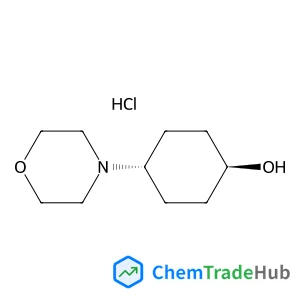
trans-4-(4-Morpholinyl)cyclohexanol hydrochloride (1:1)
CAS Number:
1588441-09-1
Molecular Formula:
C10H20ClNO2
Catiúcia R. M. O. Matos, Fabio S. Miranda, José W. de M. Carneiro, Carlos B. Pinheiro, Célia M. Ronconi
Two series of flexible dicyanomethylene compounds, specifically, class 1 and class 2 compounds, have been designed and synthesised. In class 1 compounds, the dicyanomethylene groups are separated by glycol chain spacers of different lengths, whereas, in class 2 compounds, the spacers are alkyl linkers of different lengths. The notion underlying the design of these compounds is that in class 1 molecules, the spacers contain donor oxygen atoms that could not only form hydrogen bonds during the course of crystal packing but also promote withdrawing effects that modify the photophysical and electrochemical properties of these molecules in solution; in contrast, these effects would be absent for class 2 molecules. However, this study revealed that, with respect to crystal packing, the size of the spacers and their even and odd numbers of atoms are more important than their chemical nature. All of the synthesised compounds exhibited blue emission in the solid state and in CH2Cl2 solutions. The photophysical and electrochemical properties of these compounds in solution were not significantly affected by the type and length of the spacer that was used in each molecule. In the solid state, however, the compound with the shortest spacer showed the highest Stokes shift. The electronic transitions for the synthesized compounds in solution were explained by density functional theory and time-dependent density functional theory calculations, which indicated that the methylene moieties control the properties of both classes of compounds and that the spacers do not conjugate with the end groups. These two series of flexible dicyanomethylene compounds could be utilised as molecular building blocks for the development of new solids with novel properties.
A. Ostendorf, M. Schönhoff, C. Cramer
DOI: 10.1039/C8CP05853A
Inga S. Ulusoy, Angela K. Wilson
DOI: 10.1039/C8CP06583G
Hiroshi Nishigami, Ryu-ichiro Terada, Hiori Kino, Kazuhiko Yamasaki, Masaru Tateno
DOI: 10.1039/C9CP00103D
Xi Cao, Rochan Sinha, Shuxia Tao
DOI: 10.1039/C8CP07684G
Yisheng Lv, Liquan Wang, Fangsheng Wu, Shuting Gong, Jie Wei, Shaoliang Lin
DOI: 10.1039/C9CP00400A
Zi-Han Wang, Cheul-Hyun Yoon, Shoji Yoshida, Yusuke Arashida, Osamu Takeuchi, Yuzo Ohno, Hidemi Shigekawa
DOI: 10.1039/C8CP07786J
Zhongneng Zhou, Xueli Wang
DOI: 10.1039/C9CP00325H
Hong Li, Lijuan Yan, Rutao Liu, Yongjun Liu
DOI: 10.1039/C9CP00987F
Atiya Banerjee, Jindal K. Shah
DOI: 10.1039/C9CP01538H
Peter R. Franke, Gary E. Douberly
DOI: 10.1039/C9CP01476D
Ethyl 4-chlorothieno[2,3-b]pyridine-5-carboxylate (CAS: 59713-58-5) can be synth...
5-Methyl-1H-indole-3-carbaldehyde (CAS: 52562-50-2) is subject to various regula...
(1,3-Dimethyl-2,4-dioxo-1,2,3,4-tetrahydro-5-pyrimidinyl)boronic acid is a white...
Waste containing Sulfocostunolide A (CAS: 1016983-51-9) should be handled with c...
When handling Murraxocin (CAS: 88478-44-8), ensure proper personal protective eq...
Formvar (CAS: 63148-64-1) is an alkyd resin characterized by a high molecular we...
(S)-4-benzyl-2-((benzyloxy)methyl)morpholine is generally safe when handled with...
Methyl 1-(5-bromo-2-pyrimidinyl)cyclopropanecarboxylate (CAS: 1447607-69-3) is p...
2-Methyl-1-phenyl-1-propanamine hydrochloride (CAS: 24290-47-9) is generally con...
3-(4-Bromophenyl)-2-methylpropanoic acid is synthesized through a multi-step pro...

Physical Chemistry Chemical Physics (PCCP) is an international journal co-owned by 19 physical chemistry and physics societies from around the world. This journal publishes original, cutting-edge research in physical chemistry, chemical physics and biophysical chemistry. To be suitable for publication in PCCP, articles must include significant innovation and/or insight into physical chemistry; this is the most important criterion that reviewers and Editors will judge against when evaluating submissions. The journal has a broad scope and welcomes contributions spanning experiment, theory, computation and data science. Topical coverage includes spectroscopy, dynamics, kinetics, statistical mechanics, thermodynamics, electrochemistry, catalysis, surface science, quantum mechanics, quantum computing and machine learning. Interdisciplinary research areas such as polymers and soft matter, materials, nanoscience, energy, surfaces/interfaces, and biophysical chemistry are welcomed if they demonstrate significant innovation and/or insight into physical chemistry. Joined experimental/theoretical studies are particularly appreciated when complementary and based on up-to-date approaches.
![4-{1-[4-(4,4,5,5-Tetramethyl-1,3,2-dioxaborolan-2-yl)phenyl]cyclopropyl}morpholine structure](https://static.chemtradehub.com/structs/120/1206594-08-2-7afb.webp "4-{1-[4-(4,4,5,5-Tetramethyl-1,3,2-dioxaborolan-2-yl)phenyl]cyclopropyl}morpholine structure")
![Sodium 6-amino-3-[(E)-{4-[(E)-(4-aminophenyl)diazenyl]-2-methoxy-5-methylphenyl}diazenyl]-4-hydroxy-2-naphthalenesulfonate structure](https://static.chemtradehub.com/structs/294/2945-96-2-092f.webp "Sodium 6-amino-3-[(E)-{4-[(E)-(4-aminophenyl)diazenyl]-2-methoxy-5-methylphenyl}diazenyl]-4-hydroxy-2-naphthalenesulfonate structure")




