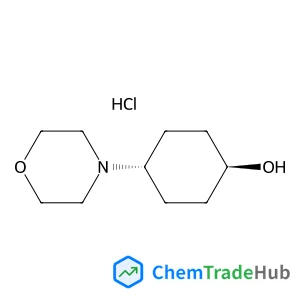
trans-4-(4-Morpholinyl)cyclohexanol hydrochloride (1:1)
CAS Number:
1588441-09-1
Molecular Formula:
C10H20ClNO2
Hiroshi Nishigami, Ryu-ichiro Terada, Hiori Kino, Kazuhiko Yamasaki, Masaru Tateno
We theoretically and experimentally analyzed a conformational ensemble of a small, characteristic polypeptide consisting of positively- and negatively-charged amino acid residue clusters, (Lys)9(Glu)9(Lys)9, designed based on the supercoiled DNA-recognition (SDR) domain, with the capability of preferentially binding to supercoiled DNA. Advanced molecular dynamics (MD) simulations coupled with a generalized ensemble technique revealed that substantial amounts of ordered, helical structures were present at the boundaries of the Lys and Glu segments in the obtained conformational ensemble. In fact, the helical content of the peptide calculated from our MD simulations was consistent with that estimated from our experimental analysis employing circular dichroism (CD) spectroscopy. The statistical analysis of the structural ensemble revealed the metastable hydrophobic contact clusters, which were stabilized by closely cohesive residue contacts, formed through “hybrid” hydrophobic (methylene groups) and electrostatic (salt bridges) residue contacts. Both short-range and long-range residue contacts were involved in the metastable hydrophobic clusters, constituting the aforementioned local helical conformations and the compact entire structures, respectively. A significant helical propensity was also found in the (Lys)n and (Glu)m boundaries of other conventional protein structures deposited in the Protein Data Bank (PDB), thus indicating the generality of this conformational trend that has been identified herein.
Éva Széles, Zsolt Varga, Zsolt Stefánka
DOI: 10.1039/B926332B
Abraham M. Shultz, Omar K. Farha, Joseph T. Hupp, SonBinh T. Nguyen
DOI: 10.1039/C0SC00339E
Chao Hou, Qing Liu, Taka-aki Okamura, Peng Wang, Wei-Yin Sun
DOI: 10.1039/C2CE26533H
Yuquan Feng, Min Li, Hengzhen Shi, Qunzeng Huang, Dongfang Qiu
DOI: 10.1039/C3CE26918C
Pengfei Zhou, Xiaolan Liu, Junying Weng, Li Wang, Xiaozhong Wu, Zhichao Miao, Jinping Zhao, Jin Zhou, Shuping Zhuo
DOI: 10.1039/C8TA07842D
Yanyan Ma, Yuping Zhao, Rui Guo, Linlin Zhu, Weiying Lin
DOI: 10.1039/C8TB02083C
DOI: 10.1039/JA9860100105
Ethyl 4-chlorothieno[2,3-b]pyridine-5-carboxylate (CAS: 59713-58-5) can be synth...
5-Methyl-1H-indole-3-carbaldehyde (CAS: 52562-50-2) is subject to various regula...
(1,3-Dimethyl-2,4-dioxo-1,2,3,4-tetrahydro-5-pyrimidinyl)boronic acid is a white...
Waste containing Sulfocostunolide A (CAS: 1016983-51-9) should be handled with c...
When handling Murraxocin (CAS: 88478-44-8), ensure proper personal protective eq...
Formvar (CAS: 63148-64-1) is an alkyd resin characterized by a high molecular we...
(S)-4-benzyl-2-((benzyloxy)methyl)morpholine is generally safe when handled with...
Methyl 1-(5-bromo-2-pyrimidinyl)cyclopropanecarboxylate (CAS: 1447607-69-3) is p...
2-Methyl-1-phenyl-1-propanamine hydrochloride (CAS: 24290-47-9) is generally con...
3-(4-Bromophenyl)-2-methylpropanoic acid is synthesized through a multi-step pro...

Physical Chemistry Chemical Physics (PCCP) is an international journal co-owned by 19 physical chemistry and physics societies from around the world. This journal publishes original, cutting-edge research in physical chemistry, chemical physics and biophysical chemistry. To be suitable for publication in PCCP, articles must include significant innovation and/or insight into physical chemistry; this is the most important criterion that reviewers and Editors will judge against when evaluating submissions. The journal has a broad scope and welcomes contributions spanning experiment, theory, computation and data science. Topical coverage includes spectroscopy, dynamics, kinetics, statistical mechanics, thermodynamics, electrochemistry, catalysis, surface science, quantum mechanics, quantum computing and machine learning. Interdisciplinary research areas such as polymers and soft matter, materials, nanoscience, energy, surfaces/interfaces, and biophysical chemistry are welcomed if they demonstrate significant innovation and/or insight into physical chemistry. Joined experimental/theoretical studies are particularly appreciated when complementary and based on up-to-date approaches.


![2-Methyl-2-propanyl 1,6-diazaspiro[3.4]octane-6-carboxylate structure](https://static.chemtradehub.com/structs/115/1158749-79-1-81ee.webp "2-Methyl-2-propanyl 1,6-diazaspiro[3.4]octane-6-carboxylate structure")