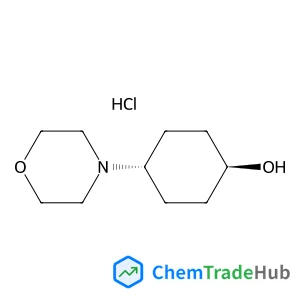
trans-4-(4-Morpholinyl)cyclohexanol hydrochloride (1:1)
CAS Number:
1588441-09-1
Molecular Formula:
C10H20ClNO2
Cheng-Tar Wu, Jin Qu, Joseph Elliott, Kai Man Kerry Yu, Shik Chi Edman Tsang
There is tremendous growing interest in utilizing biomass molecules for energy provision due to their carbon neutrality. Here, we employ ethylene glycol as a model compound for catalytic activation, which represents a basic unit for complex carbohydrate molecules (polyols). In this paper, hydrogenolysis of ethylene glycol to produce methanol in hydrogen over modified RANEY® Ni and Cu catalysts has been studied. This work provides essential information that may leads to the development of new catalysts for carbohydrate activation to methanol, a novel but important reaction concerning biomass conversion to transportable form of energy. Particularly, in this study, modification of electronic structure hence adsorption properties of RANEY® catalysts has mainly been achieved by blending with second metal(s). It is found that the activity and selectivity of this reaction can be significantly affected by this approach. In contrast, there is no subtle effect on methanol selectivity despite a great variation in the d-band centre position which shows a distinctive effect on other products. This result suggests that methanol is produced on specific surface sites independent from the other sites at an intrinsic rate and will not be converted to other products by the d-band alteration.
Zhong-Fa Sun, Chandan K. Bishwakarma, Lei Song, Ad van der Avoird, Marc C. van Hemert, Arthur G. Suits, George C. McBane, David H. Parker
DOI: 10.1039/C9CP00876D
Afshan Mohajeri, Nasim Hassani
DOI: 10.1039/C8CP07372D
Richard J. Mandle, John W. Goodby
DOI: 10.1039/C9CP00736A
Kartik Pilar, Zeyu Deng, Joya A. Cooley
DOI: 10.1039/C9CP01420A
Aric C. Rousso, Nils Hansen, Ahren W. Jasper, Yiguang Ju
DOI: 10.1039/C9CP00473D
Sergey Yu. Ketkov, Sheng Yuan Tzeng, Elena A. Rychagova, Lyubov’ V. Kalakutskaya, Marco Fuss, Holger Braunschweig, Wen-Bih Tzeng
DOI: 10.1039/C9CP00888H
Vaishali Arunachalam, Anil Kumar Tummanapelli, Sukumaran Vasudevan
DOI: 10.1039/C9CP00761J
Nuno M. S. Almeida, Filip Pawłowski, Joseph Vincent Ortiz, Evangelos Miliordos
DOI: 10.1039/C8CP07420H
Nima Rahmatian, Alexander Ostermann, Bernhard Massani, Thomas Loerting, Jörg Petrasch
DOI: 10.1039/C8CP07871H
Tim Kohlmann, Martin Goez
DOI: 10.1039/C8CP07486K
Ethyl 4-chlorothieno[2,3-b]pyridine-5-carboxylate (CAS: 59713-58-5) can be synth...
5-Methyl-1H-indole-3-carbaldehyde (CAS: 52562-50-2) is subject to various regula...
(1,3-Dimethyl-2,4-dioxo-1,2,3,4-tetrahydro-5-pyrimidinyl)boronic acid is a white...
Waste containing Sulfocostunolide A (CAS: 1016983-51-9) should be handled with c...
When handling Murraxocin (CAS: 88478-44-8), ensure proper personal protective eq...
Formvar (CAS: 63148-64-1) is an alkyd resin characterized by a high molecular we...
(S)-4-benzyl-2-((benzyloxy)methyl)morpholine is generally safe when handled with...
Methyl 1-(5-bromo-2-pyrimidinyl)cyclopropanecarboxylate (CAS: 1447607-69-3) is p...
2-Methyl-1-phenyl-1-propanamine hydrochloride (CAS: 24290-47-9) is generally con...
3-(4-Bromophenyl)-2-methylpropanoic acid is synthesized through a multi-step pro...

Physical Chemistry Chemical Physics (PCCP) is an international journal co-owned by 19 physical chemistry and physics societies from around the world. This journal publishes original, cutting-edge research in physical chemistry, chemical physics and biophysical chemistry. To be suitable for publication in PCCP, articles must include significant innovation and/or insight into physical chemistry; this is the most important criterion that reviewers and Editors will judge against when evaluating submissions. The journal has a broad scope and welcomes contributions spanning experiment, theory, computation and data science. Topical coverage includes spectroscopy, dynamics, kinetics, statistical mechanics, thermodynamics, electrochemistry, catalysis, surface science, quantum mechanics, quantum computing and machine learning. Interdisciplinary research areas such as polymers and soft matter, materials, nanoscience, energy, surfaces/interfaces, and biophysical chemistry are welcomed if they demonstrate significant innovation and/or insight into physical chemistry. Joined experimental/theoretical studies are particularly appreciated when complementary and based on up-to-date approaches.
![Sodium 6-amino-3-[(E)-{4-[(E)-(4-aminophenyl)diazenyl]-2-methoxy-5-methylphenyl}diazenyl]-4-hydroxy-2-naphthalenesulfonate structure](https://static.chemtradehub.com/structs/294/2945-96-2-092f.webp "Sodium 6-amino-3-[(E)-{4-[(E)-(4-aminophenyl)diazenyl]-2-methoxy-5-methylphenyl}diazenyl]-4-hydroxy-2-naphthalenesulfonate structure")
![9,9'-Spirobi[fluoren]-2-amine structure](https://static.chemtradehub.com/structs/118/118951-68-1-0d14.webp "9,9'-Spirobi[fluoren]-2-amine structure")