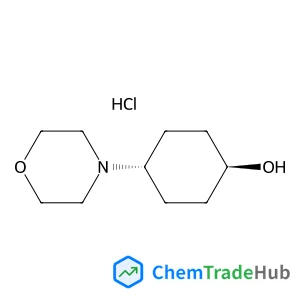
trans-4-(4-Morpholinyl)cyclohexanol hydrochloride (1:1)
CAS Number:
1588441-09-1
Molecular Formula:
C10H20ClNO2
Aric C. Rousso, Nils Hansen, Ahren W. Jasper, Yiguang Ju
The reaction network of the simplest Criegee intermediate (CI) CH2OO has been studied experimentally during the ozonolysis of ethylene. The results provide valuable information about plasma- and ozone-assisted combustion processes and atmospheric aerosol formation. A network of CI reactions was identified, which can be described best by the sequential addition of CI with ethylene, water, formic acid, and other molecules containing hydroxy, aldehyde, and hydroperoxy functional groups. Species resulting from as many as four sequential CI addition reactions were observed, and these species are highly oxygenated oligomers that are known components of secondary organic aerosols in the atmosphere. Insights into these reaction pathways were obtained from a near-atmospheric pressure jet-stirred reactor coupled to a high-resolution molecular-beam mass spectrometer. The mass spectrometer employs single-photon ionization with synchrotron-generated, tunable vacuum-ultraviolet radiation to minimize fragmentation via near-threshold ionization and to observe mass-selected photoionization efficiency (PIE) curves. Species identification is supported by comparison of the mass-selected, experimentally observed photo-ionization thresholds with theoretical calculations for the ionization energies. A variety of multi-functional peroxide species are identified, including hydroxymethyl hydroperoxide (HOCH2OOH), hydroperoxymethyl formate (HOOCH2OCHO), methoxymethyl hydroperoxide (CH3OCH2OOH), ethoxymethyl hydroperoxide (C2H5OCH2OOH), 2-hydroxyethyl hydroperoxide (HOC2H4OOH), dihydroperoxy methane (HOOCH2OOH), and 1-hydroperoxypropan-2-one [CH3C(O)CH2OOH]. A semi-quantitative analysis of the signal intensities as a function of successive CI additions and temperature provides mechanistic insights and valuable information for future modeling work of the associated energy conversion processes and atmospheric chemistry. This work provides further evidence that the CI is a key intermediate in the formation of oligomeric species via the formation of hydroperoxides.
Jayakumar Anjali, Vishal K. Jose, Jong-Min Lee
DOI: 10.1039/C9TA02525A
Mika Matsunaga, Toshitaka Ishizaki, Takamasa Nonaka
DOI: 10.1039/C2CE06119H
Yanyan Ma, Yuping Zhao, Rui Guo, Linlin Zhu, Weiying Lin
DOI: 10.1039/C8TB02083C
Wenmin Cheng, Haimei Shi, Mengjing Teng, Menghuan Yu, Bin Feng, Chuanfan Ding, Shaoning Yu, Fan Yang
DOI: 10.1039/D1AN02098F
Michael Stiboller, Fabiana P. Freitas, Kevin A. Francesconi, Tanja Schwerdtle, António J. A. Nogueira, Georg Raber
DOI: 10.1039/C9JA00249A
Nicole M. Ralbovsky, Randal J. Soukup, Justin P. Lomont, Mackenzie L. Lauro, Amanda Gulasarian, Anumita Saha-Shah, Michael A. Winters, Douglas D. Richardson, Sheng-Ching Wang, Ian Mangion, Joseph P. Smith
DOI: 10.1039/D1AN01797G
Clare A. Manderson, Heather McLiesh, Rico F. Tabor, Gil Garnier
DOI: 10.1039/D0AN01993C
Weidi Sun, Xue Han, Fengli Qu, Rong-Mei Kong, Zilong Zhao
DOI: 10.1039/D1AN00218J
Francesco Foschi, Torsten Roth, Markus Enders, Hubert Wadepohl, Eric Clot, Lutz H. Gade
DOI: 10.1039/C8CC00478A
Joseph Baugh, Adetunji Alabi, Ahmed AlHajaj, Linda Zou, Robert A. W. Dryfe
DOI: 10.1039/C8TA09160A
Ethyl 4-chlorothieno[2,3-b]pyridine-5-carboxylate (CAS: 59713-58-5) can be synth...
5-Methyl-1H-indole-3-carbaldehyde (CAS: 52562-50-2) is subject to various regula...
(1,3-Dimethyl-2,4-dioxo-1,2,3,4-tetrahydro-5-pyrimidinyl)boronic acid is a white...
Waste containing Sulfocostunolide A (CAS: 1016983-51-9) should be handled with c...
When handling Murraxocin (CAS: 88478-44-8), ensure proper personal protective eq...
Formvar (CAS: 63148-64-1) is an alkyd resin characterized by a high molecular we...
(S)-4-benzyl-2-((benzyloxy)methyl)morpholine is generally safe when handled with...
Methyl 1-(5-bromo-2-pyrimidinyl)cyclopropanecarboxylate (CAS: 1447607-69-3) is p...
2-Methyl-1-phenyl-1-propanamine hydrochloride (CAS: 24290-47-9) is generally con...
3-(4-Bromophenyl)-2-methylpropanoic acid is synthesized through a multi-step pro...

Physical Chemistry Chemical Physics (PCCP) is an international journal co-owned by 19 physical chemistry and physics societies from around the world. This journal publishes original, cutting-edge research in physical chemistry, chemical physics and biophysical chemistry. To be suitable for publication in PCCP, articles must include significant innovation and/or insight into physical chemistry; this is the most important criterion that reviewers and Editors will judge against when evaluating submissions. The journal has a broad scope and welcomes contributions spanning experiment, theory, computation and data science. Topical coverage includes spectroscopy, dynamics, kinetics, statistical mechanics, thermodynamics, electrochemistry, catalysis, surface science, quantum mechanics, quantum computing and machine learning. Interdisciplinary research areas such as polymers and soft matter, materials, nanoscience, energy, surfaces/interfaces, and biophysical chemistry are welcomed if they demonstrate significant innovation and/or insight into physical chemistry. Joined experimental/theoretical studies are particularly appreciated when complementary and based on up-to-date approaches.
![2-Methyl-2-propanyl 1,6-diazaspiro[3.4]octane-6-carboxylate structure](https://static.chemtradehub.com/structs/115/1158749-79-1-81ee.webp "2-Methyl-2-propanyl 1,6-diazaspiro[3.4]octane-6-carboxylate structure")