












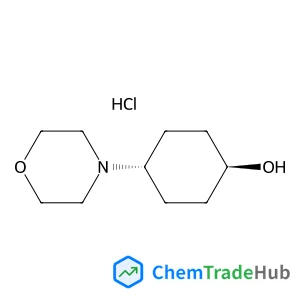
trans-4-(4-Morpholinyl)cyclohexanol hydrochloride (1:1)
CAS Number:
1588441-09-1
Molecular Formula:
C10H20ClNO2
Richard J. Mandle, John W. Goodby
Twist-bend (TB) phases possess a local helical structure with a pitch length of a few nanometers. The TB phase was first observed in low molecular weight dimers, and as such these have been the focus of efforts to understand the properties and structure of these new phases of matter. Recently several oligomeric and polymeric materials have been reported, but there is little information on the properties and structure of the TB phase in these materials. Herein we compare the order parameters, orientational distribution functions (ODF) and heliconical tilt angles of the TB phase exhibited by a liquid-crystalline dimer (CB7CB) to a tetramer (O47) and hexamer (O67) by SAXS/WAXS. Following the N-TB phase transition we find that all order parameters decrease, and while 〈P2〉 remains positive 〈P4〉 becomes negative. For all three materials the order parameter 〈P6〉 is near zero in both phases. The ODF is sugarloaf-like in the nematic phase and volcano-like in the TB phase, allowing us to estimate the heliconical tilt angle of each material and its thermal evolution. Surprisingly, the heliconical tilt angle appears to be largely independent of the material studied despite the differing number of mesogenic units.
Jia Liu, Dan Xie, Zhen Liu
DOI: 10.1039/D1AN00003A
Rubén Granero-García, Fernando J. Lahoz, Sofiane Saouane, Francesca P. A. Fabbiani
DOI: 10.1039/C2CE26362A
Xiaoping Tao, Na Ta, Jianming Li, Xu Jin, Rengui Li, Can Li
DOI: 10.1039/C9TA03090E
Jing-Cyuan Yang, Chun-Hua Chen, Ren-Jye Wu
DOI: 10.1039/C2CE06385A
Sandro Spagnolo, Eric S. Muckley, Ilia N. Ivanov, Tibor Hianik
DOI: 10.1039/D1AN01800K
C. Grazia Bezzu, Mariolino Carta, Maria-Chiara Ferrari, Johannes C. Jansen, Marcello Monteleone, Elisa Esposito, Alessio Fuoco, Kyle Hart, T. P. Liyana-Arachchi, Coray M. Colina, Neil B. McKeown
DOI: 10.1039/C8TA02601G
Zifeng Wang, Zhaoheng Ruan, Zhuoxin Liu, Yukun Wang, Zijie Tang, Hongfei Li, Minshen Zhu, Tak Fuk Hung, Jun Liu, Zicong Shi, Chunyi Zhi
DOI: 10.1039/C8TA01172A
Keiichi Katoh, Brian K. Breedlove, Masahiro Yamashita
DOI: 10.1039/C5SC04669F
Madeleine Peschke, Clara Brieke
DOI: 10.1039/C7CC09409D
Ethyl 4-chlorothieno[2,3-b]pyridine-5-carboxylate (CAS: 59713-58-5) can be synth...
5-Methyl-1H-indole-3-carbaldehyde (CAS: 52562-50-2) is subject to various regula...
(1,3-Dimethyl-2,4-dioxo-1,2,3,4-tetrahydro-5-pyrimidinyl)boronic acid is a white...
Waste containing Sulfocostunolide A (CAS: 1016983-51-9) should be handled with c...
When handling Murraxocin (CAS: 88478-44-8), ensure proper personal protective eq...
Formvar (CAS: 63148-64-1) is an alkyd resin characterized by a high molecular we...
(S)-4-benzyl-2-((benzyloxy)methyl)morpholine is generally safe when handled with...
Methyl 1-(5-bromo-2-pyrimidinyl)cyclopropanecarboxylate (CAS: 1447607-69-3) is p...
2-Methyl-1-phenyl-1-propanamine hydrochloride (CAS: 24290-47-9) is generally con...
3-(4-Bromophenyl)-2-methylpropanoic acid is synthesized through a multi-step pro...

Physical Chemistry Chemical Physics (PCCP) is an international journal co-owned by 19 physical chemistry and physics societies from around the world. This journal publishes original, cutting-edge research in physical chemistry, chemical physics and biophysical chemistry. To be suitable for publication in PCCP, articles must include significant innovation and/or insight into physical chemistry; this is the most important criterion that reviewers and Editors will judge against when evaluating submissions. The journal has a broad scope and welcomes contributions spanning experiment, theory, computation and data science. Topical coverage includes spectroscopy, dynamics, kinetics, statistical mechanics, thermodynamics, electrochemistry, catalysis, surface science, quantum mechanics, quantum computing and machine learning. Interdisciplinary research areas such as polymers and soft matter, materials, nanoscience, energy, surfaces/interfaces, and biophysical chemistry are welcomed if they demonstrate significant innovation and/or insight into physical chemistry. Joined experimental/theoretical studies are particularly appreciated when complementary and based on up-to-date approaches.
![4-[(1-Methyl-1H-pyrrol-2-yl)methylene]-1,3(2H,4H)-isoquinolinedione structure](https://static.chemtradehub.com/structs/110/1104546-89-5-a600.webp "4-[(1-Methyl-1H-pyrrol-2-yl)methylene]-1,3(2H,4H)-isoquinolinedione structure")




