












Facile synthesis of novel Si nanoparticles–graphene composites as high-performance anode materials for Li-ion batteries
Literature Information
Publication Date
2013-05-20
DOI
10.1039/C3CP51276B
Impact Factor
3.676
Authors
Min Zhou, Fan Pu, Zhao Wang, Tingwei Cai, Hao Chen, Haiyong Zhang, Shiyou Guan
View Original
Abstract
Improving the Li storage properties of a Si negative electrode is of great significance for Li-ion batteries. A major challenge is to fabricate Si-based active materials with good electronic conduction and structural integrity in the process of discharging and charging. In this study, novel Si nanoparticles–graphene composites have been synthesized by hybrid electrostatic assembly between positively charged aminopropyltriethoxysilane modified Si nanoparticles and negatively charged graphene oxide, followed by thermal reduction. Commercially available Si nanoparticles are well embedded and uniformly dispersed into the graphene sheets, and the typically wrinkled graphene sheets form a network and cover the highly dispersed Si nanoparticles well. No any obvious aggregation of the Si nanoparticles can be found and many nanospaces exist around the Si nanoparticles, which provide buffering spaces needed for volume changes of Si nanoparticles during insertion/extraction of Li. High capacity and long cycle life (822 mA h g−1 after 100 cycles at a current density of 0.1 A g−1) have been realized in the novel Si nanoparticles–graphene composites for Li-ion batteries. The excellent electrochemical performance is ascribed to the uniform distribution of Si nanoparticles and graphene, which effectively prevents aggregation and pulverization of Si nanoparticles, keeps the overall electrode highly conductive, and maintains the stability of the structure.
Related Literature
A synthetic approach to kingianin A based on biosynthetic speculation
Pallavi Sharma, Dougal J. Ritson, James Burnley, John E. Moses
2011-08-24
Communication
DOI: 10.1039/C1CC13949E
Functionalization of luminescent cyclometalated iridium(iii) polypyridine complexes with a fluorous moiety: photophysics, protein-binding, bioconjugation, and cellular uptake properties
Siu-Kit Leung, Hua-Wei Liu, Kenneth Kam-Wing Lo
2011-04-27
Communication
DOI: 10.1039/C1CC11423A
Yeast cell wall particles: a promising class of nature-inspired microcarriers for multimodal imaging
João Nuno Moreira, Carlos F. G. C. Geraldes, Silvia Rizzitelli, Silvio Aime, Enzo Terreno
2011-09-01
Communication
DOI: 10.1039/C1CC14019A
Silicananoparticles functionalised with cation coordination sites and fluorophores for the differential sensing of anions in a quencher displacement assay (QDA)
Mandy Hecht, Knut Rurack
2011-09-05
Communication
DOI: 10.1039/C1CC13039K
A molecular bowl sumanene
Toru Amaya, Toshikazu Hirao
2011-07-08
Feature Article
DOI: 10.1039/C1CC12532J
Two-dimensional zeolites: dream or reality?
Wieslaw J. Roth, Jiří Čejka
2011-02-08
Perspective
DOI: 10.1039/C0CY00027B
A novel magnetic mesoporous silica packed S-shaped microfluidic reactor for online proteolysis of low-MW proteome
Qianhao Min, Xiaoxia Zhang, Ren'an Wu, Hanfa Zou, Jun-Jie Zhu
2011-08-24
Communication
DOI: 10.1039/C1CC13969J
Retracted article: A novel approach for N2O decomposition over Rh-substituted hexaaluminate catalysts
Rachid Amrousse, Akimasa Tsutsumi, Ahmed Bachar
2012-12-05
Communication
DOI: 10.1039/C2CY20439H
Comparison of phase transfer agents in the aqueous biphasic hydroformylation of higher alkenes
Henriette Nowothnick, Anke Rost, Tobias Hamerla, Reinhard Schomäcker, Christian Müller, Dieter Vogt
2012-11-07
Paper
DOI: 10.1039/C2CY20629C
You might also like
Compound Q&A
What industries use (1R,3S)-1,3-Cyclopentanediol (CAS: 16326-97-9)?
(1R,3S)-1,3-Cyclopentanediol finds applications in various industries. In the ph...
16326-97-9(1R,3S)-1,3-Cyclopen...
Compound Q&A
What precautions should be taken when handling N'-[4-(Dimethylamino)phenyl]-N,N-dimethyl-1,4-benzenediamine (CAS: 637-31-0)?
When handling N'-[4-(Dimethylamino)phenyl]-N,N-dimethyl-1,4-benzenediamine, it i...
637-31-0N'-[4-(Dimethylamino...
Compound Q&A
Are there alternatives to 5-(2,4-Difluorophenyl)-2-methoxypyrimidine (CAS: 1352318-16-1) in synthesis?
There are several alternatives to 5-(2,4-Difluorophenyl)-2-methoxypyrimidine in ...
1352318-16-15-(2,4-Difluoropheny...
Compound Q&A
What regulatory guidelines apply to 1-(3-Methoxyphenoxy)propan-2-ol (CAS: 382141-68-6)?
1-(3-Methoxyphenoxy)propan-2-ol (CAS: 382141-68-6) must comply with the Globally...
382141-68-61-(3-Methoxyphenoxy)...
Compound Q&A
Is Tetrodotoxin Citrate (CAS: 18660-81-6) safe?
Tetrodotoxin Citrate is extremely dangerous and should be handled with extreme c...
18660-81-6Tetrodotoxin Citrate
Compound Q&A
What are the main uses of 2-Methyl-2-propanyl [(1R,3S)-3-hydroxycyclopentyl]carbamate (CAS: 225641-84-9)?
2-Methyl-2-propanyl [(1R,3S)-3-hydroxycyclopentyl]carbamate (CAS: 225641-84-9) i...
225641-84-92-Methyl-2-propanyl ...
Compound Q&A
How should waste containing 4-(2-Hydroxyhexafluoroisopropyl)Benzoic Acid (CAS: 16261-80-6) be handled?
Waste containing 4-(2-Hydroxyhexafluoroisopropyl)Benzoic Acid (CAS: 16261-80-6) ...
16261-80-64-(2-Hydroxyhexafluo...
Compound Q&A
How is 2-Methyl-2-proanyl {(2S)-1-[(benzyloxy)amino]-3-hydroxy-3-methyl-1-oxo-2-butanyl}carbamate (CAS: 102507-19-7) typically synthesized?
2-Methyl-2-proanyl {(2S)-1-[(benzyloxy)amino]-3-hydroxy-3-methyl-1-oxo-2-butanyl...
102507-19-72-Methyl-2-propanyl ...
Compound Q&A
What is Benzeneethanamine, α-ethyl-, hydrochloride (1:1) (CAS: 20735-15-3)?
Benzeneethanamine, α-ethyl-, hydrochloride (1:1) is an organic compound with the...
20735-15-3Benzeneethanamine, α...
Compound Q&A
Are there alternatives to 3-{(E)-[4-(Dimethylamino)phenyl]diazenyl}benzoic acid (CAS: 20691-84-3) in synthesis?
In the synthesis of compounds similar to 3-{(E)-[4-(Dimethylamino)phenyl]diazeny...
20691-84-33-{(E)-[4-(Dimethyla...
Source Journal
Physical Chemistry Chemical Physics

CiteScore:
5.5
Self-citation Rate:
10.3%
Articles per Year:
3036
Physical Chemistry Chemical Physics (PCCP) is an international journal co-owned by 19 physical chemistry and physics societies from around the world. This journal publishes original, cutting-edge research in physical chemistry, chemical physics and biophysical chemistry. To be suitable for publication in PCCP, articles must include significant innovation and/or insight into physical chemistry; this is the most important criterion that reviewers and Editors will judge against when evaluating submissions. The journal has a broad scope and welcomes contributions spanning experiment, theory, computation and data science. Topical coverage includes spectroscopy, dynamics, kinetics, statistical mechanics, thermodynamics, electrochemistry, catalysis, surface science, quantum mechanics, quantum computing and machine learning. Interdisciplinary research areas such as polymers and soft matter, materials, nanoscience, energy, surfaces/interfaces, and biophysical chemistry are welcomed if they demonstrate significant innovation and/or insight into physical chemistry. Joined experimental/theoretical studies are particularly appreciated when complementary and based on up-to-date approaches.
Recommended Compounds

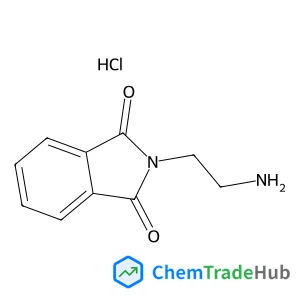
2-(2-Aminoethyl)-1H-isoindole-1,3(2H)-dione hydrochloride (1:1)
CAS Number:
30250-67-0
Molecular Formula:
C10H11ClN2O2
Recommended Suppliers




Disclaimer
This page provides academic journal information for reference and research purposes only. We are not affiliated with any journal publishers and do not handle publication submissions. For publication-related inquiries, please contact the respective journal publishers directly.
If you notice any inaccuracies in the information displayed, please contact us at support@chemtradehub.com. We will promptly review and address your concerns.