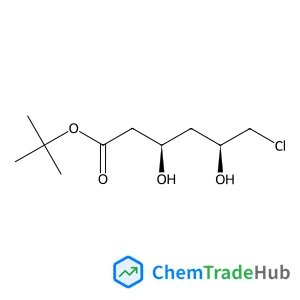
2-Methyl-2-propanyl (3R,5S)-6-chloro-3,5-dihydroxyhexanoate
CAS Number:
154026-93-4
Molecular Formula:
C10H19ClO4
Toru Amaya, Toshikazu Hirao
Nonplanar polyaromatic carbon molecules including fullerenes and carbon nanotubes have been attracting great interest due to their potential as materials, catalysts, etc. In this context, bowl-shaped polyaromatic hydrocarbons (π bowls) are considered to be key materials in the science of nonplanar π-conjugated carbon systems. Among π bowls, we focused on a molecular bowl “sumanene (C21H12)” featuring a C3v symmetric structural motif present in fullerenes or carbon nanotube molecules. In this article, we present the research on sumanenes to date, including their synthesis, structural characterization, derivatization, complexation, and their potential uses as electrical materials. The characteristic structural feature of a sumanene depends on three sp3 hybridized carbon atoms at the benzylic positions. Facile functionalization via selective formation of benzylic anions gives stereoselective substituted compounds, the π-extended derivatives, and the deeper π bowls. Furthermore, the dynamically flexible aspect based on bowl-to-bowl inversion is also described. The crystal with a columnar bowl-in-bowl stacking exhibits a high electron transport ability with anisotropy. Complexation with a cyclopentadienyl iron cation results in the first selective formation of the concave-bound complex as a π-bowl complex.

AIAA Journal

Advances in Colloid and Interface Science

Anti-Corrosion Methods and Materials

Chemistry of Natural Compounds

Journal of the Chinese Chemical Society

Chemistry of Heterocyclic Compounds

Corrosion Science

Biopolymers

Journal of the American Chemical Society

Bulletin of the Chemical Society of Japan
Zhihao Yang, Ying Yuan, Bin Wang, Xiaojun Shen, Xiluan Wang, Tong-Qi Yuan
DOI: 10.1039/D3TA04872A
Dawei Su, Hyo-Jun Ahn
DOI: 10.1039/D3TA90111D
Jun Guo, Xiaomin Xue, Fangfang Li, Meiting Zhao, Youcong Xing, Yanmin Song, Chang Long, Tingting Zhao, Zhiyong Tang
DOI: 10.1039/D3NH00419H
Marco Moors, Irina Werner, Jens Bauer, Jonas Lorenz, Kirill Yu. Monakhov
DOI: 10.1039/D3NH00345K
Michael R. Dworzak, Glenn P. A. Yap, Eric D. Bloch
DOI: 10.1039/D3TA04662A
Chun-Chuan Kao, Jiahao Liu, Chao Ye, Shao-Jian Zhang, Junnan Hao, Shi-Zhang Qiao
DOI: 10.1039/D3TA02866F
Dongrun Xu, Weiye Qu, Junhong Liu, Junxiao Chen, Xue Fang, Liwei Chen, Xi Liu, Yaxin Chen
DOI: 10.1039/D3TA05525F
Wenli Pan, Nobuya Machida, Toshiyuki Matsunaga, Mukesh Kumar, Neha Thakur, Toshiki Watanabe, Atsushi Sakuda, Akitoshi Hayashi, Masahiro Tatsumisago, Yoshiharu Uchimoto
DOI: 10.1039/D3TA05426H
(1R,3S)-1,3-Cyclopentanediol finds applications in various industries. In the ph...
When handling N'-[4-(Dimethylamino)phenyl]-N,N-dimethyl-1,4-benzenediamine, it i...
There are several alternatives to 5-(2,4-Difluorophenyl)-2-methoxypyrimidine in ...
1-(3-Methoxyphenoxy)propan-2-ol (CAS: 382141-68-6) must comply with the Globally...
Tetrodotoxin Citrate is extremely dangerous and should be handled with extreme c...
2-Methyl-2-propanyl [(1R,3S)-3-hydroxycyclopentyl]carbamate (CAS: 225641-84-9) i...
Waste containing 4-(2-Hydroxyhexafluoroisopropyl)Benzoic Acid (CAS: 16261-80-6) ...
2-Methyl-2-proanyl {(2S)-1-[(benzyloxy)amino]-3-hydroxy-3-methyl-1-oxo-2-butanyl...
Benzeneethanamine, α-ethyl-, hydrochloride (1:1) is an organic compound with the...
In the synthesis of compounds similar to 3-{(E)-[4-(Dimethylamino)phenyl]diazeny...

ChemComm publishes urgent research which is of outstanding significance and interest to experts in the field, while also appealing to the journal’s broad chemistry readership. Our communication format is ideally suited to short, urgent studies that are of such importance that they require accelerated publication. Our scope covers all topics in chemistry, and research at the interface of chemistry and other disciplines (such as materials science, nanoscience, physics, engineering and biology) where there is a significant novelty in the chemistry aspects. Major topic areas covered include: Analytical Chemistry Catalysis Chemical Biology and medicinal chemistry Computational Chemistry and Machine Learning Energy and sustainable chemistry Environmental Chemistry Green Chemistry Inorganic Chemistry Materials Chemistry Nanoscience Organic Chemistry Physical Chemistry Polymer Chemistry Supramolecular Chemistry
![N-[(9H-Fluoren-9-ylmethoxy)carbonyl]-beta-phenyl-L-phenylalanine structure](https://static.chemtradehub.com/structs/201/201484-50-6-c2fc.webp "N-[(9H-Fluoren-9-ylmethoxy)carbonyl]-beta-phenyl-L-phenylalanine structure")