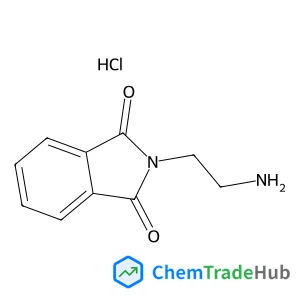
2-(2-Aminoethyl)-1H-isoindole-1,3(2H)-dione hydrochloride (1:1)
CAS Number:
30250-67-0
Molecular Formula:
C10H11ClN2O2
Henriette Nowothnick, Anke Rost, Tobias Hamerla, Reinhard Schomäcker, Christian Müller, Dieter Vogt
The Rh-catalyzed aqueous biphasic hydroformylation with the bidentate ligand SulfoXantPhos was investigated for different phase transfer agents (PTA). As such, polymer latices and microemulsions formed by non-ionic surfactants were used. In general, a higher PTA concentration enhances the reaction progress. The feasibility of catalyst recycling by simple phase separation is shown in principle. The Rh losses are low in the surfactant system and promising for a technical approach.

Russian Chemical Bulletin

Journal of Saudi Chemical Society

Crystallography Reports

Journal of Peptide Science

Current Opinion in Solid State & Materials Science

Drug Discovery Today

Russian Journal of Organic Chemistry

Russian Journal of General Chemistry

Russian Journal of Coordination Chemistry

Acta Materialia
DOI: 10.1039/B300963G
W. Matthew Leevy, Michelle E. Weber, Paul H. Schlesinger
DOI: 10.1039/B413588A
Xurong Xu, Joong Tark Han, Kilwon Cho
DOI: 10.1039/B300581J
Yuyang Liu, Jing Tang, J. H. Xin
DOI: 10.1039/B412282H
Weicheng Wu, Andrew. C. Grimsdale, Klaus Müllen
DOI: 10.1039/B301512M
Steven A. Raw, Richard J. K. Taylor
DOI: 10.1039/B316107B
Luke E. Turner, Matthew G. Thorn, Phillip E. Fanwick, Ian P. Rothwell
DOI: 10.1039/B212724E
Steven H. Bertz, Toby J. Sommer
DOI: 10.1039/B300935A
Giovanni Bottari, Tomás Torres
DOI: 10.1039/B411960F
John J. Perry, Gregory J. McManus, Michael J. Zaworotko
DOI: 10.1039/B408973A
(1R,3S)-1,3-Cyclopentanediol finds applications in various industries. In the ph...
When handling N'-[4-(Dimethylamino)phenyl]-N,N-dimethyl-1,4-benzenediamine, it i...
There are several alternatives to 5-(2,4-Difluorophenyl)-2-methoxypyrimidine in ...
1-(3-Methoxyphenoxy)propan-2-ol (CAS: 382141-68-6) must comply with the Globally...
Tetrodotoxin Citrate is extremely dangerous and should be handled with extreme c...
2-Methyl-2-propanyl [(1R,3S)-3-hydroxycyclopentyl]carbamate (CAS: 225641-84-9) i...
Waste containing 4-(2-Hydroxyhexafluoroisopropyl)Benzoic Acid (CAS: 16261-80-6) ...
2-Methyl-2-proanyl {(2S)-1-[(benzyloxy)amino]-3-hydroxy-3-methyl-1-oxo-2-butanyl...
Benzeneethanamine, α-ethyl-, hydrochloride (1:1) is an organic compound with the...
In the synthesis of compounds similar to 3-{(E)-[4-(Dimethylamino)phenyl]diazeny...
Catalysis Science & Technology is committed to publishing research reporting high-quality, cutting-edge developments across the catalysis community at large. The journal places equal focus on publications from the heterogeneous, homogeneous, thermo-, electro-, photo-, organo- and biocatalysis communities. Works published in the journal feature a balanced mix of fundamental, technology-oriented, experimental, computational, digital and data-driven original research, thus appealing to catalysis practitioners in both academic and industrial environments. Original research articles published in the journal must demonstrate new catalytic discoveries and/or methodological advances that represent a significant advance on previously published work, from the molecular to the process scales. We welcome rigorous research in a wide range of timely or emerging applications related to the environment, health, energy and materials. Catalysis Science & Technology publishes Communications, Articles, Reviews and Perspectives. More details regarding manuscript types may be found in the Information for Authors section.