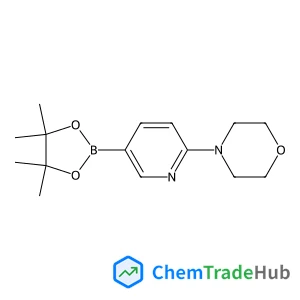
4-(5-(4,4,5,5-tetramethyl-1,3,2-dioxaborolan-2-yl)pyridin-2-yl)morpholine
CAS Number:
485799-04-0
Molecular Formula:
C15H23BN2O3
Wieslaw J. Roth, Jiří Čejka
Delaminated and pillared zeolites, called here “two-dimensional zeolites”, are a promising and exciting area of solid materials research with high practical potential in adsorption and catalysis. Synthetic approaches for their preparation, crucial issues concerning reliable identification and characterization of these materials, and examples of their catalytic behaviour are highlighted in this contribution. Last, but not least, ideas and challenges for future progress of these materials are addressed.
Sarah E. Lister, Ivana Radosavljevic Evans, Judith A. K. Howard, Alan Coelho, John S. O. Evans
DOI: 10.1039/B408413F
Byunghoon Yoon, Hakwon Kim, Chien M. Wai
DOI: 10.1039/B211836J
Svetlana L. Kachkarova-Sorokina, Pierre Gallezot, Alexander B. Sorokin
DOI: 10.1039/B411694A
Tsutomu Konno, Jungha Chae, Tomoo Tanaka, Takashi Ishihara, Hiroki Yamanaka
DOI: 10.1039/B316065C
Weicheng Wu, Andrew. C. Grimsdale, Klaus Müllen
DOI: 10.1039/B301512M
V. Ajay Mallia, Nobuyuki Tamaoki
DOI: 10.1039/B410902C
Serge Vilminot, Mireille Richard-Plouet, Gilles André, Tahar Mhiri, Mohamedally Kurmoo
DOI: 10.1039/B411304G
Yahong Zhang, Xijuan Yu, Xiaoyan Wang, Wei Shan, Pengyuan Yang, Yi Tang
DOI: 10.1039/B411336E
Xianying Li, Hongzhi Wang, Kouzou Inoue, Masato Uehara, Hiroyuki Nakamura, Masaya Miyazaki, Eiichi Abe, Hideaki Maeda
DOI: 10.1039/B300765K
Jianzhong Yang, Andrew R. Barron
DOI: 10.1039/B411118D
(1R,3S)-1,3-Cyclopentanediol finds applications in various industries. In the ph...
When handling N'-[4-(Dimethylamino)phenyl]-N,N-dimethyl-1,4-benzenediamine, it i...
There are several alternatives to 5-(2,4-Difluorophenyl)-2-methoxypyrimidine in ...
1-(3-Methoxyphenoxy)propan-2-ol (CAS: 382141-68-6) must comply with the Globally...
Tetrodotoxin Citrate is extremely dangerous and should be handled with extreme c...
2-Methyl-2-propanyl [(1R,3S)-3-hydroxycyclopentyl]carbamate (CAS: 225641-84-9) i...
Waste containing 4-(2-Hydroxyhexafluoroisopropyl)Benzoic Acid (CAS: 16261-80-6) ...
2-Methyl-2-proanyl {(2S)-1-[(benzyloxy)amino]-3-hydroxy-3-methyl-1-oxo-2-butanyl...
Benzeneethanamine, α-ethyl-, hydrochloride (1:1) is an organic compound with the...
In the synthesis of compounds similar to 3-{(E)-[4-(Dimethylamino)phenyl]diazeny...

Catalysis Science & Technology is committed to publishing research reporting high-quality, cutting-edge developments across the catalysis community at large. The journal places equal focus on publications from the heterogeneous, homogeneous, thermo-, electro-, photo-, organo- and biocatalysis communities. Works published in the journal feature a balanced mix of fundamental, technology-oriented, experimental, computational, digital and data-driven original research, thus appealing to catalysis practitioners in both academic and industrial environments. Original research articles published in the journal must demonstrate new catalytic discoveries and/or methodological advances that represent a significant advance on previously published work, from the molecular to the process scales. We welcome rigorous research in a wide range of timely or emerging applications related to the environment, health, energy and materials. Catalysis Science & Technology publishes Communications, Articles, Reviews and Perspectives. More details regarding manuscript types may be found in the Information for Authors section.