












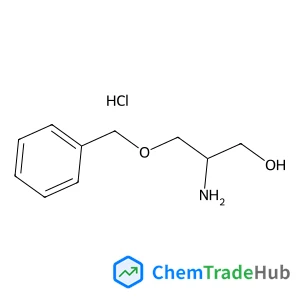
(R)-2-amino-3-(benzyloxy)propan-1-ol hydrochloride
CAS Number:
58577-95-0
Molecular Formula:
C10H16ClNO2
Li Guan, Xue-Mei Zhang, Shuai Wang, Li-Hua Gan, Qing-Dao Zeng, Chen Wang
2D porous networks have attracted great attention as they can be used to immobilize functional units as guest molecules in a spatially ordered arrangement. In this work, a novel molecular hybrid network with two kinds of cavities was fabricated. Several kinds of guest molecules, such as coronene, copper(II) phthalocyanine (CuPc), triphenylene, heptanoic acid and fullerene molecules, can be immobilized into this template. Site- and size-selective effects can be observed. Furthermore, we have also fabricated interesting 2D crystal architecture with complex four-component structure at the liquid–solid interface, following investigation by scanning tunnelling microscopy (STM). The current findings provide a convenient approach towards the formation of more complex and functionalized surface nanopatterns, which can benefit the study of host–guest assembly behaviour within a monolayer composed by several components at interfaces.
Amanda N. Oehrlein, Antonio Sanchez-Diaz, Philip C. Goff, Miquel Planells, Neil Robertson, David A. Blank, Wayne L. Gladfelter
DOI: 10.1039/C9CP00420C
F. K. A. Gregson, M. Ordoubadi, R. E. H. Miles, A. E. Haddrell, D. Barona, D. Lewis, T. Church, R. Vehring, J. P. Reid
DOI: 10.1039/C9CP01158G
Zi-Han Wang, Cheul-Hyun Yoon, Shoji Yoshida, Yusuke Arashida, Osamu Takeuchi, Yuzo Ohno, Hidemi Shigekawa
DOI: 10.1039/C8CP07786J
Iuliana Mihalache, Eugeniu Vasile, Cristina Pachiu, Sandra A. V. Eremia, Antonio Radoi, Mihaela Kusko
DOI: 10.1039/C9CP00751B
Wenyu Li, Qianyun Zhang, Jonas J. Joos, Philippe F. Smet, Jörn Schmedt auf der Günne
DOI: 10.1039/C9CP00953A
Hiroshi Nishigami, Ryu-ichiro Terada, Hiori Kino, Kazuhiko Yamasaki, Masaru Tateno
DOI: 10.1039/C9CP00103D
Pavel Kocán, Barbara Pieczyrak, Leszek Jurczyszyn, Yoshihide Yoshimoto, Kazuma Yagyu, Hiroshi Tochihara, Takayuki Suzuki
DOI: 10.1039/C9CP01335K
Peter R. Franke, Gary E. Douberly
DOI: 10.1039/C9CP01476D
Rocío Durán, Barbara Herrera
DOI: 10.1039/C8CP07752E
Xilong Xu, Yandong Ma, Baibiao Huang, Ying Dai
DOI: 10.1039/C9CP00011A
Ethyl 4-chlorothieno[2,3-b]pyridine-5-carboxylate (CAS: 59713-58-5) can be synth...
5-Methyl-1H-indole-3-carbaldehyde (CAS: 52562-50-2) is subject to various regula...
(1,3-Dimethyl-2,4-dioxo-1,2,3,4-tetrahydro-5-pyrimidinyl)boronic acid is a white...
Waste containing Sulfocostunolide A (CAS: 1016983-51-9) should be handled with c...
When handling Murraxocin (CAS: 88478-44-8), ensure proper personal protective eq...
Formvar (CAS: 63148-64-1) is an alkyd resin characterized by a high molecular we...
(S)-4-benzyl-2-((benzyloxy)methyl)morpholine is generally safe when handled with...
Methyl 1-(5-bromo-2-pyrimidinyl)cyclopropanecarboxylate (CAS: 1447607-69-3) is p...
2-Methyl-1-phenyl-1-propanamine hydrochloride (CAS: 24290-47-9) is generally con...
3-(4-Bromophenyl)-2-methylpropanoic acid is synthesized through a multi-step pro...

Physical Chemistry Chemical Physics (PCCP) is an international journal co-owned by 19 physical chemistry and physics societies from around the world. This journal publishes original, cutting-edge research in physical chemistry, chemical physics and biophysical chemistry. To be suitable for publication in PCCP, articles must include significant innovation and/or insight into physical chemistry; this is the most important criterion that reviewers and Editors will judge against when evaluating submissions. The journal has a broad scope and welcomes contributions spanning experiment, theory, computation and data science. Topical coverage includes spectroscopy, dynamics, kinetics, statistical mechanics, thermodynamics, electrochemistry, catalysis, surface science, quantum mechanics, quantum computing and machine learning. Interdisciplinary research areas such as polymers and soft matter, materials, nanoscience, energy, surfaces/interfaces, and biophysical chemistry are welcomed if they demonstrate significant innovation and/or insight into physical chemistry. Joined experimental/theoretical studies are particularly appreciated when complementary and based on up-to-date approaches.
![Sodium 6-amino-3-[(E)-{4-[(E)-(4-aminophenyl)diazenyl]-2-methoxy-5-methylphenyl}diazenyl]-4-hydroxy-2-naphthalenesulfonate structure](https://static.chemtradehub.com/structs/294/2945-96-2-092f.webp "Sodium 6-amino-3-[(E)-{4-[(E)-(4-aminophenyl)diazenyl]-2-methoxy-5-methylphenyl}diazenyl]-4-hydroxy-2-naphthalenesulfonate structure")
![Imidazo[1,5-a]pyrazine structure](https://static.chemtradehub.com/structs/274/274-49-7-d749.webp "Imidazo[1,5-a]pyrazine structure")






