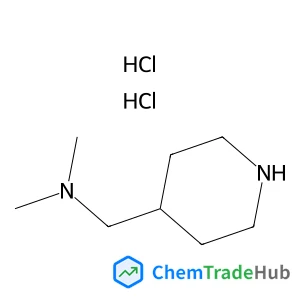
N,N-dimethyl(piperidin-4-yl)methanamine hydrochloride
CAS Number:
172281-72-0
Molecular Formula:
C8H20Cl2N2
Ping Wu, Yang Gao, Yimei Lu, Hui Zhang, Chenxin Cai
Lung cancer is the leading cause of cancer death worldwide. Its early detection is of paramount importance for diagnosis, classification, treatment, and improvement of survivorship. However, current methods are not sensitive enough to detect lung cancer in its nascent stage. We reported an aptamer–Ag–Au shell–core nanostructure-based surface-enhanced Raman scattering (SERS) assay for sensitive and specific detection, and near-infrared (NIR) photothermal therapy of lung adenocarcinoma cells (A549 cells). The nanostructures target the cells with high affinity and specificity via the specific interaction between the aptamer (a 45-base oligonucleotide) and the cell, and distinguish A549 cells from other types of cancer cells (HeLa and MCF-7 cells) and subtypes of lung cancer cells (NCI-H157, NCI-H520, NCI-H1299, and NCI-H446 cells). The nanostructures have a high capability to absorb NIR irradiation and are able to perform photothermal therapy of the cells at a very low irradiation power density (0.20 W cm−2) without destroying the healthy cells and the surrounding normal tissues. In addition, the nanostructures exhibit a high SERS activity. Based on the SERS signal of the labeled Raman reporter (Rh6G molecules), we can specifically detect A549 cells at a very low abundance (∼10 cells per mL) and monitor the therapy process of the cancer cells. Therefore, this nanostructure-based SERS assay has great potential in specific recognition, sensitive detection, and effective photothermal therapy of lung cancer.
Steven O. Nielsen, Rosa E. Bulo, Preston B. Moore, Bernd Ensing
DOI: 10.1039/C004111D
M. Retuerto, F. Jiménez-Villacorta, M. J. Martínez-Lope, Y. Huttel, E. Roman, M. T. Fernández-Díaz, J. A. Alonso
DOI: 10.1039/C004370B
Kaname Kanai, Yukiko Noda, Keita Kato, Takashi Kubo, Kai Iketaki, Akihiro Shimizu, Yukio Ouchi, Kazuhiro Nakasuji, Kazuhiko Seki
DOI: 10.1039/C0CP00178C
Patrick W. Fowler, Wendy Myrvold
DOI: 10.1039/C0CP01513J
A. M. Czoska, S. Livraghi, M. C. Paganini, E. Giamello, C. Di Valentin, G. Pacchioni
DOI: 10.1039/C0CP00143K
Mladen Petravic, Robert Peter, Ivna Kavre, Lu Hua Li, Ying Chen, Liang-Jen Fan, Yaw-Wen Yang
DOI: 10.1039/C0CP00984A
Jan Philipp Hofmann, Stefan Zweidinger, Attila Farkas, Marcus Knapp, Olivier Balmes, Edvin Lundgren, Jesper N. Andersen, Herbert Over
DOI: 10.1039/C0CP01126F
Pascale Changenet-Barret, Christina Loukou, Christian Ley, Fabien Lacombat, Pascal Plaza, Jean-Maurice Mallet, Monique M. Martin
DOI: 10.1039/C0CP00618A
Ethyl 4-chlorothieno[2,3-b]pyridine-5-carboxylate (CAS: 59713-58-5) can be synth...
5-Methyl-1H-indole-3-carbaldehyde (CAS: 52562-50-2) is subject to various regula...
(1,3-Dimethyl-2,4-dioxo-1,2,3,4-tetrahydro-5-pyrimidinyl)boronic acid is a white...
Waste containing Sulfocostunolide A (CAS: 1016983-51-9) should be handled with c...
When handling Murraxocin (CAS: 88478-44-8), ensure proper personal protective eq...
Formvar (CAS: 63148-64-1) is an alkyd resin characterized by a high molecular we...
(S)-4-benzyl-2-((benzyloxy)methyl)morpholine is generally safe when handled with...
Methyl 1-(5-bromo-2-pyrimidinyl)cyclopropanecarboxylate (CAS: 1447607-69-3) is p...
2-Methyl-1-phenyl-1-propanamine hydrochloride (CAS: 24290-47-9) is generally con...
3-(4-Bromophenyl)-2-methylpropanoic acid is synthesized through a multi-step pro...

Analyst publishes analytical and bioanalytical research that reports premier fundamental discoveries and inventions, and the applications of those discoveries, unconfined by traditional discipline barriers.
![[2-(Benzyloxy)-3-bromo-5-methylphenyl]boronic acid structure](https://static.chemtradehub.com/structs/870/870777-20-1-24ac.webp "[2-(Benzyloxy)-3-bromo-5-methylphenyl]boronic acid structure")