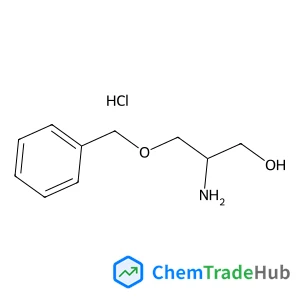
(R)-2-amino-3-(benzyloxy)propan-1-ol hydrochloride
CAS Number:
58577-95-0
Molecular Formula:
C10H16ClNO2
M. Retuerto, F. Jiménez-Villacorta, M. J. Martínez-Lope, Y. Huttel, E. Roman, M. T. Fernández-Díaz, J. A. Alonso
The knowledge of the oxidation state of the transition metal cations in Sr2FeMO6 (M = W, Mo, Re and Sb) double perovskites is of paramount importance to understand their appealing magnetoresistive or magnetic properties. We present a systematic investigation of the valences of Fe, W, Mo, Re and Sb cations in these perovskites using three different and complementary techniques of analysis. We have used a diffraction method, neutron powder diffraction (NPD), coupled with the bond-valence model; and two spectroscopy methods, X-ray photoemission spectroscopy (XPS) and X-ray absorption spectroscopy (XAS). These two techniques are also complementary since XPS analyses the surface of the samples whereas XAS probes the bulk material. The analysis of the Fe K-edge spectra of the four samples shows a clear shift of the Fe K-edge as the valence of iron increases in the sequence M = W, Mo, Re and Sb. In addition, XANES pre-edge structures unveil a progressive reduction in the occupancy level of the Fe-3d band as the oxidation state of iron increases along the sequence M = W, Mo, Re and Sb. Finally, XANES computations have determined the electronic structures of Sr2FeWO6, Sr2FeMoO6, Sr2FeReO6 and Sr2FeSbO6.
Salvatore Mamone, Mónica Jiménez-Ruiz, Mark R. Johnson, Stéphane Rols, Anthony J. Horsewill
DOI: 10.1039/C6CP06059E
Athanasios Athanasiadis, Clare Fitzgerald, Nicholas M. Davidson, Chiara Giorio, Stanley W. Botchway, Andrew D. Ward, Markus Kalberer, Francis D. Pope, Marina K. Kuimova
DOI: 10.1039/C6CP05674A
Zhicong Liang, Xiaofeng Fan
DOI: 10.1039/C6CP04984B
Meiye Jia, Peifeng Su, Zhixun Luo, Jiannian Yao
DOI: 10.1039/C6CP04922B
Junjie Li, Alexander B. Pacheco, Krishnan Raghavachari, Srinivasan S. Iyengar
DOI: 10.1039/C6CP04450F
Bhaswati Sengupta, Arusha Acharyya, Pratik Sen
DOI: 10.1039/C6CP05743H
Zhuqing Zhang, Yanhua Ouyang, Tao Chen
DOI: 10.1039/C6CP06181H
S. F. Bychkov, M. P. Popov
DOI: 10.1039/C6CP05435H
Ji Won Yang, Jeong Min Choi, Jun Yeob Lee
DOI: 10.1039/C6CP06308J
Daniela Trogolo, J. Samuel Arey
DOI: 10.1039/C6CP90261H
Ethyl 4-chlorothieno[2,3-b]pyridine-5-carboxylate (CAS: 59713-58-5) can be synth...
5-Methyl-1H-indole-3-carbaldehyde (CAS: 52562-50-2) is subject to various regula...
(1,3-Dimethyl-2,4-dioxo-1,2,3,4-tetrahydro-5-pyrimidinyl)boronic acid is a white...
Waste containing Sulfocostunolide A (CAS: 1016983-51-9) should be handled with c...
When handling Murraxocin (CAS: 88478-44-8), ensure proper personal protective eq...
Formvar (CAS: 63148-64-1) is an alkyd resin characterized by a high molecular we...
(S)-4-benzyl-2-((benzyloxy)methyl)morpholine is generally safe when handled with...
Methyl 1-(5-bromo-2-pyrimidinyl)cyclopropanecarboxylate (CAS: 1447607-69-3) is p...
2-Methyl-1-phenyl-1-propanamine hydrochloride (CAS: 24290-47-9) is generally con...
3-(4-Bromophenyl)-2-methylpropanoic acid is synthesized through a multi-step pro...

Physical Chemistry Chemical Physics (PCCP) is an international journal co-owned by 19 physical chemistry and physics societies from around the world. This journal publishes original, cutting-edge research in physical chemistry, chemical physics and biophysical chemistry. To be suitable for publication in PCCP, articles must include significant innovation and/or insight into physical chemistry; this is the most important criterion that reviewers and Editors will judge against when evaluating submissions. The journal has a broad scope and welcomes contributions spanning experiment, theory, computation and data science. Topical coverage includes spectroscopy, dynamics, kinetics, statistical mechanics, thermodynamics, electrochemistry, catalysis, surface science, quantum mechanics, quantum computing and machine learning. Interdisciplinary research areas such as polymers and soft matter, materials, nanoscience, energy, surfaces/interfaces, and biophysical chemistry are welcomed if they demonstrate significant innovation and/or insight into physical chemistry. Joined experimental/theoretical studies are particularly appreciated when complementary and based on up-to-date approaches.
![Imidazo[1,5-a]pyrazine structure](https://static.chemtradehub.com/structs/274/274-49-7-d749.webp "Imidazo[1,5-a]pyrazine structure")
![9,9'-Spirobi[fluoren]-2-amine structure](https://static.chemtradehub.com/structs/118/118951-68-1-0d14.webp "9,9'-Spirobi[fluoren]-2-amine structure")