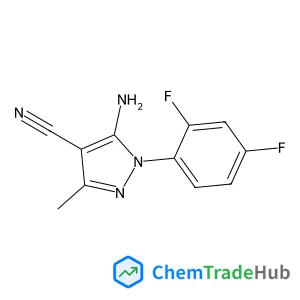
5-Amino-1-(2,4-difluorophenyl)-3-methyl-1H-pyrazole-4-carbonitrile
CAS Number:
1020057-92-4
Molecular Formula:
C11H8F2N4
Patrick W. Fowler, Wendy Myrvold
Fullerenes with properly closed shells (having exactly half their adjacency eigenvalues strictly positive) are rare. All reported examples obey the isolated-pentagon rule (IPR), usually considered a necessary condition of overall stability, and fall into three series (leapfrogs, carbon cylinders and sporadic closed shells). It is shown here that there also exist fullerenes with properly closed shells that violate the IPR (‘super-sporadic’ fullerenes). All have negative LUMO eigenvalues of small magnitude. Exhaustive search finds four examples with 160 or fewer vertices: one isomer of C120, two of C156 and one of C160. The first three contain single pentagon pairs and the fourth, a linear triple of fused pentagons. Larger examples can be found. A capping construction gives a series of properly closed shell fullerenes of C3/C3v symmetry, each with a single fully fused triple of pentagons and ≥632 vertices. Tubular extension of the C120 example leads a series of C1/Cs isomer pairs with ≥168 vertices, retaining the single pentagon adjacency and approaching isospectrality with increasing size. Both constructions are conjectured to lead to an infinite number of super-sporadic fullerenes.
Cheng Hua Zhang, Chan Kyung Kim, Ying Xue
DOI: 10.1039/C0CP02783A
Michael Maes, Stijn Schouteden, Luc Alaerts, Diederik Depla, Dirk E. De Vos
DOI: 10.1039/C0CP01703E
Sylvain Cristol
DOI: 10.1039/C0CP01295E
Hideki Nabika, Masahiro Oowada, Kei Murakoshi
DOI: 10.1039/C0CP01790F
Pedro F. Façanha Filho, Paulo T. C. Freire, José A. Lima Jr., Adenilson O. dos Santos, Paul F. Henry, Ewout Kremner, Heloisa N. Bordallo
DOI: 10.1039/C0CP02278K
Lung-Ching Sang, Marc-Olivier Coppens
DOI: 10.1039/C0CP02273J
Piers R. F. Barnes, Assaf Y. Anderson, James R. Durrant, Brian C. O'Regan
DOI: 10.1039/C0CP01554G
Carolina Estarellas, Antonio Bauzá, Antonio Frontera, David Quiñonero, Pere M. Deyà
DOI: 10.1039/C0CP01894E
Hongzhen Lin, Ivan G. Scheblykin
DOI: 10.1039/C0CP02764B
Ethyl 4-chlorothieno[2,3-b]pyridine-5-carboxylate (CAS: 59713-58-5) can be synth...
5-Methyl-1H-indole-3-carbaldehyde (CAS: 52562-50-2) is subject to various regula...
(1,3-Dimethyl-2,4-dioxo-1,2,3,4-tetrahydro-5-pyrimidinyl)boronic acid is a white...
Waste containing Sulfocostunolide A (CAS: 1016983-51-9) should be handled with c...
When handling Murraxocin (CAS: 88478-44-8), ensure proper personal protective eq...
Formvar (CAS: 63148-64-1) is an alkyd resin characterized by a high molecular we...
(S)-4-benzyl-2-((benzyloxy)methyl)morpholine is generally safe when handled with...
Methyl 1-(5-bromo-2-pyrimidinyl)cyclopropanecarboxylate (CAS: 1447607-69-3) is p...
2-Methyl-1-phenyl-1-propanamine hydrochloride (CAS: 24290-47-9) is generally con...
3-(4-Bromophenyl)-2-methylpropanoic acid is synthesized through a multi-step pro...

Physical Chemistry Chemical Physics (PCCP) is an international journal co-owned by 19 physical chemistry and physics societies from around the world. This journal publishes original, cutting-edge research in physical chemistry, chemical physics and biophysical chemistry. To be suitable for publication in PCCP, articles must include significant innovation and/or insight into physical chemistry; this is the most important criterion that reviewers and Editors will judge against when evaluating submissions. The journal has a broad scope and welcomes contributions spanning experiment, theory, computation and data science. Topical coverage includes spectroscopy, dynamics, kinetics, statistical mechanics, thermodynamics, electrochemistry, catalysis, surface science, quantum mechanics, quantum computing and machine learning. Interdisciplinary research areas such as polymers and soft matter, materials, nanoscience, energy, surfaces/interfaces, and biophysical chemistry are welcomed if they demonstrate significant innovation and/or insight into physical chemistry. Joined experimental/theoretical studies are particularly appreciated when complementary and based on up-to-date approaches.