













Cononsolvency in the ‘drunken’ state: the thermoresponsiveness of a new acrylamide copolymer in water–alcohol mixtures
Literature Information
Publication Date
2017-01-03
DOI
10.1039/C6PY01751G
Impact Factor
5.582
Authors
Niklas Lucht, Steffen Eggers
View Original
Abstract
Stimuli-responsive ‘smart’ polymers are a promising class of materials for switchable devices. In this work, we present poly[N-acryloylpiperidine-random-N-acryloylpyrrolidine] (poly[APi-r-APy]) as a novel thermoresponsive copolymer which was synthesised by reversible addition–fragmentation chain transfer (RAFT) polymerisation in a controlled manner. One of its attractive features is that the lower critical solution temperature (LCST) in aqueous solution, i.e. the temperature at which the polymer instantaneously becomes insoluble, can be freely adjusted between 3 °C and 47 °C. This adjustment is indeed extremely straightforward because the LCST of the copolymer is linearly dependent on the copolymer composition. We furthermore discuss the influence of the addition of a second ‘good’ solvent to polymer–water solutions on the thermoresponsiveness of the system. Depending on the nature of the additive, the cloud point can be shifted both upwards and downwards. Our research is focused on alcoholic additives, with systematic variation of the chemical structure of the alcohol, which resulted in the occurrence of remarkable cononsolvency effects. The results are discussed in terms of polymer–additive as well as additive–water interactions and help to gain a more detailed understanding of water interactions with amphiphilic additives and, hence, of cononsolvency phenomena. This work moreover contributes to the systematic design of switchable systems with tailored phase transition properties.
Related Literature
Swelling properties of thermoresponsive/hydrophilic co-networks with functional crosslinked domain structures
Shohei Ida, Hironobu Kitanaka, Tatsuya Ishikawa, Shokyoku Kanaoka, Yoshitsugu Hirokawa
2018-01-03
Paper
DOI: 10.1039/C7PY01793F
Polyallene-based amphiphilic triblock copolymer via successive free radical polymerization and ATRP
Hao Guo, Xiaoyu Huang
2017-11-27
Paper
DOI: 10.1039/C7PY01407D
ROS-responsive poly(ε-caprolactone) with pendent thioether and selenide motifs
Li Yu, Mei Zhang, Fu-Sheng Du, Zi-Chen Li
2018-06-21
Paper
DOI: 10.1039/C8PY00620B
Ab initio based kinetic Monte Carlo analysis to unravel the propagation kinetics in vinyl acetate pulsed laser polymerization
Gilles B. Desmet, Yoshi W. Marien, Paul H. M. Van Steenberge, Marie-Françoise Reyniers, Guy B. Marin
2017-10-30
Paper
DOI: 10.1039/C7PY01008G
Nanogel-like UCST triblock copolymer micelles showing large volume expansion before abrupt dissolution
Amélie Augé, Daniel Fortin, Xia Tong, Yue Zhao
2018-08-13
Paper
DOI: 10.1039/C8PY00960K
Macrocycle-based topological azo-polymers: facile synthesis and unusual photoresponsive properties‡
Wei Song, Ruiyu Jiang, Lei Zhu
2016-12-22
Paper
DOI: 10.1039/C6PY01743F
You might also like
Compound Q&A
What are the main uses of 4-Nitrophenyl phosphate disodium salt hexahydrate (CAS: 333338-18-4)?
4-Nitrophenyl phosphate disodium salt hexahydrate is primarily used as a substra...
333338-18-44-Nitrophenyl phosph...
Compound Q&A
What are the main uses of 2-(Trifluoromethyl)-1,3-oxazole-4-carboxylic Acid (CAS: 1060816-01-4)?
2-(Trifluoromethyl)-1,3-oxazole-4-carboxylic Acid (CAS: 1060816-01-4) is widely ...
1060816-01-42-(Trifluoromethyl)-...
Compound Q&A
How should 2-Fluoro-4-biphenylcarboxylic acid (CAS: 137045-30-8) be stored?
2-Fluoro-4-biphenylcarboxylic acid should be stored in a cool, dry place at room...
137045-30-82-Fluoro-4-biphenylc...
Compound Q&A
What industries use Prednisolone-21-Carboxylic Acid (CAS: 61549-70-0)?
Prednisolone-21-Carboxylic Acid is primarily used in the pharmaceutical industry...
61549-70-0Prednisolone-21-Carb...
Compound Q&A
How should 4-(Hydrazinomethyl)-1,2,3-benzenetriol (CAS: 3614-72-0) be stored?
4-(Hydrazinomethyl)-1,2,3-benzenetriol (CAS: 3614-72-0) should be stored in a co...
3614-72-04-(Hydrazinomethyl)-...
Compound Q&A
What industries use 4-Amino-1-methyl-1H-pyrazole-5-carboxylic acid hydrochloride (CAS: 92534-70-8)?
4-Amino-1-methyl-1H-pyrazole-5-carboxylic acid hydrochloride (CAS: 92534-70-8) i...
92534-70-84-Amino-1-methyl-1H-...
Compound Q&A
What regulatory guidelines apply to dehydropachymic acid (CAS: 77012-31-8)?
Dehydropachymic acid (CAS: 77012-31-8) is regulated by various agencies. It fall...
77012-31-8Dehydropachymic acid
Compound Q&A
What is the market or research trend for 6-[(2,2-Dimethylpropanoyl)amino]nicotinic acid (CAS: 898561-66-5)?
The market and research trends for 6-[(2,2-Dimethylpropanoyl)amino]nicotinic aci...
898561-66-56-[(2,2-Dimethylprop...
Compound Q&A
How should 1,10-Phenanthroline-2,9-dicarbaldehyde (CAS: 57709-62-3) be stored?
1,10-Phenanthroline-2,9-dicarbaldehyde should be stored in a cool, dry place awa...
57709-62-31,10-Phenanthroline-...
Compound Q&A
How is 5-Carbamoyl-11-oxo-10,11-dihydro-5H-dibenzo[b,f]azepin-10-yl acetate (CAS: 113952-21-9) typically synthesized?
5-Carbamoyl-11-oxo-10,11-dihydro-5H-dibenzo[b,f]azepin-10-yl acetate can be synt...
113952-21-95-Carbamoyl-11-oxo-1...
Source Journal
Polymer Chemistry

CiteScore:
8.6
Self-citation Rate:
7.3%
Articles per Year:
457
Polymer Chemistry welcomes submissions in all areas of polymer science that have a strong focus on macromolecular chemistry. Manuscripts may cover a broad range of fields, yet no direct application focus is required.
Recommended Compounds

cis-3-Amino-1-(trifluoromethyl)cyclobutanol hydrochloride (1:1)
CAS Number:
1408075-16-0
Molecular Formula:
C5H9ClF3NO
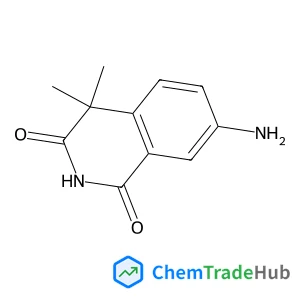
1,3(2H,4H)-Isoquinolinedione, 7-amino-4,4-dimethyl-
CAS Number:
14576-22-8
Molecular Formula:
C11H12N2O2
Recommended Suppliers






Disclaimer
This page provides academic journal information for reference and research purposes only. We are not affiliated with any journal publishers and do not handle publication submissions. For publication-related inquiries, please contact the respective journal publishers directly.
If you notice any inaccuracies in the information displayed, please contact us at support@chemtradehub.com. We will promptly review and address your concerns.