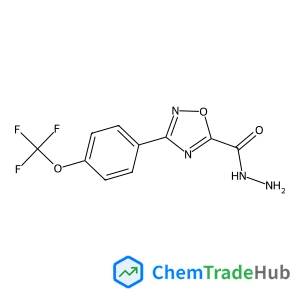
3-(4-(Trifluoromethoxy)phenyl)-1,2,4-oxadiazole-5-carbohydrazide
CAS Number:
883028-82-8
Molecular Formula:
C10H7F3N4O3
Taek Joon Lee, Yong-Gi Ko, Hung-Ju Yen, Kyungtae Kim, Dong Min Kim, Wonsang Kwon, Suk Gyu Hahm, Guey-Sheng Liou, Moonhor Ree
Two aromatic polyimides bearing triphenylamine (TPA) derivatives with reasonably high molecular weights were synthesized: poly(N-(2,4,6-trimethylphenyl)-N,N-4,4′-diphenylene hexafluoroisopropylidenediphthalimide) (6F-TPA-Me3 PI) and poly(N-(4-dimethylaminophenyl)-N,N-4,4′-diphenylene hexafluoroisopropylidenediphthalimide) (6F-TPA-NMe2 PI). These polymers were thermally and dimensionally very stable, providing high-quality nanoscale thin films using a conventional solution coating process. The film densities, optical properties, and electrochemical properties were determined. The polymers displayed a different nonvolatile memory behavior that depended on the substituents of the TPA unit. The 6F-TPA-Me3 PI film showed a unipolar write-once-read-many-times (WORM) memory behavior, whereas the 6F-TPA-NMe2 PI film revealed unipolar and bipolar switching memory behavior. All PI films displayed excellent retention in both the OFF- and ON-states, even under ambient conditions. The ON/OFF current ratio was high, up to 108–109. All memory behaviors were governed by a mechanism that involved trap-limited space charge limited conduction and local filament formation. The memory characteristics may originate from the electron-donating TPA and substituents and from the electron-accepting hexafluoroisopropylidenyl and imide units in the polymer backbone, which acted as effective charge-trapping sites. The film density was found to significantly influence the memory behavior. This study demonstrated that the thermally and dimensionally stable 6F-TPA-Me3 and 6F-TPA-NMe2 PIs are suitable active materials for the low-cost mass production of high-performance programmable memory devices that can be operated with very low power consumption. Moreover, the memory mode and its polarity may be tuned by changing the substituent on the TPA unit.
Yong-Lei Wang, Zhong-Yuan Lu
DOI: 10.1039/C4CP02843K
Gabriele D'Avino, Luca Muccioli, Jérôme Cornil, David Beljonne
DOI: 10.1039/C4CP01872A
Sonja Kouva, Jenni Andersin, Karoliina Honkala, Juha Lehtonen, Jaana Kanervo
DOI: 10.1039/C4CP02742F
Dariusz W. Szczepanik, Marcin Andrzejak, Karol Dyduch, Emil Żak, Marcin Makowski, Grzegorz Mazur, Janusz Mrozek
DOI: 10.1039/C4CP02932A
Valeria Tagliazucca, Matteo Leoni, Claudia Weidenthaler
DOI: 10.1039/C4CP90131B
Shi-Hsin Lin, Jer-Lai Kuo
DOI: 10.1039/C4CP02048K
Daungruthai Jarukanont, João T. S. Coimbra, Bernd Bauerhenne, Pedro A. Fernandes, Shekhar Patel, Maria J. Ramos, Martin E. Garcia
DOI: 10.1039/C4CP02289K
Jonelle Harvey, Richard P. Tuckett, Andras Bodi
DOI: 10.1039/C4CP03009E
Julian Few, Gus Hancock
DOI: 10.1039/C4CP00740A
4-(4-tert-Butylphenyl)-1H-pyrazol-3-amine finds applications in various industri...
H3TATAB is used in the pharmaceutical industry for the synthesis of certain orga...
1-Ethyl-3-fluorobenzene (CAS: 696-39-9) is primarily used as a precursor in the ...
1-(tert-Butoxycarbonyl)-4-(4-methoxyphenyl)pyrrolidine-3-carboxylic acid is prim...
1-Cyclobutyl-4-piperidinone (CAS: 359880-05-0) is a colorless or white crystalli...
Pyridine-2,6-dicarboxylic acid mono-tert-butyl ester (CAS: 575433-76-0) is a che...
The market for 2,3-Difluorophenylalanine (CAS: 236754-62-4) is growing with incr...
(2-Hydroxy-1-naphthyl)boronic acid can be synthesized through the reduction of 2...
This compound is a crystalline solid with a molecular weight of approximately 52...
While 5,7-Dihydroxy-4-oxo-2-(3,4,5-trihydroxyphenyl)-4H-chromen-3-yl beta-D-gluc...

Polymer Chemistry welcomes submissions in all areas of polymer science that have a strong focus on macromolecular chemistry. Manuscripts may cover a broad range of fields, yet no direct application focus is required.