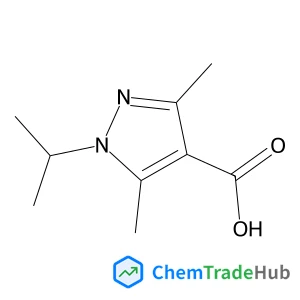
1-isopropyl-3,5-dimethyl-1H-pyrazole-4-carboxylic acid
CAS Number:
1007542-01-9
Molecular Formula:
C9H14N2O2
Yong-Lei Wang, Zhong-Yuan Lu
Dynamical behavior and characteristics of 1-butyl-3-methylimidazolium hexafluorophosphate ([BMIM][PF6]) ionic liquid (IL) in confined films with varied film thickness have been investigated using atomistic molecular dynamics simulations. Simulation results indicate that the dynamics of confined ionic groups in interfacial regions is highly heterogeneous and depends strongly on their relative layered positions in the confined IL film. The dynamics and relaxation times of the ionic groups in the bulk region of confined IL films are very similar to that in the corresponding pure bulk simulation. In contrast, the diffusion of the corresponding ionic groups slows down and can be characterized by slaved diffusion while the corresponding relaxation times increase remarkably as these ionic groups come closer to the neutral graphene surface. While at the IL–vacuum interface, the diffusion and relaxation of terminal carbon atoms of butyl chains of [BMIM] cations are much faster than in other layers of the confined IL film and in the bulk region of the simulation system without confinement, due to their librated motion in this interfacial region. The dynamical heterogeneity of the confined ionic groups is intrinsically related to microscopic ionic structures and the orientational preference of [BMIM][PF6] ion pairs in interfacial regions.
Howbeer Muhamadali, Abdu Subaihi, Mahsa Mohammadtaheri, Yun Xu, David I. Ellis, Rajesh Ramanathan, Vipul Bansal, Royston Goodacre
DOI: 10.1039/C6AN00883F
Yih Hong Lee, Jonathan Yong Chew Ho, Yijie Yang, Xing Yi Ling
DOI: 10.1039/C6AN01239F
Matthew R. Bailey, Zachary D. Schultz
DOI: 10.1039/C6AN01054G
Emil Malucelli, Andrea Notargiacomo, Alessandra Gianoncelli, Lucia Merolle, Azzurra Sargenti, Concettina Cappadone
DOI: 10.1039/C6AN01091A
Yang Liu, Pei Li, Zhou Nie, Jinghong Li
DOI: 10.1039/C6AN01090C
Jacquelyn A. DuVall, Scott T. Cabaniss, Morgan L. Angotti, John H. Moore, Mayuresh Abhyankar, Nishant Shukla, Daniel L. Mills, Bryan G. Kessel, Gavin T. Garner, Nathan S. Swami
DOI: 10.1039/C6AN00674D
Halina Abramczyk, Jakub Surmacki, Monika Kopeć, Alicja Klaudia Olejnik, Agnieszka Kaufman-Szymczyk, Krystyna Fabianowska-Majewska
DOI: 10.1039/C6AN00859C
Woong Kim, Nara Kim, Eunbyoul Lee, Duckhoe Kim, Zee Hwan Kim, Joon Won Park
DOI: 10.1039/C6AN00035E
Elefterios Trikantzopoulos, Cheng Yang, Mallikarjunarao Ganesana, Ying Wang, B. Jill Venton
DOI: 10.1039/C6AN01469K
When handling 2-Chloro-1,2-bis(4-methylphenyl)ethanone (CAS: 71193-32-3), it is ...
4-Ethoxy-3-(5-methyl-4-oxo-7-propyl-1,4-dihydroimidazo[5,1-f][1,2,4]triazin-2-yl...
Methyl 3-Oxo-4-Androsten-17-Carboxylate (CAS: 2681-55-2) should be stored in a c...
(R)-3-Amino-4-(3-hexylphenylamino)-4-oxobutylphosphonic acid is primarily used i...
2-Methyl-2-propanyl 3-amino-3-carbamoyl-1-azetidinecarboxylate (CAS: 1254120-14-...
There are alternative reagents that can be used in synthesis instead of (E)-4-(t...
[2-(3-Chlorophenyl)-1,3-thiazol-4-yl]methanol (CAS: 121202-20-8) is a crystallin...
The market and research trends for Methyl (2S)-[(4S)-2,2-dimethyl-1,3-dioxolan-4...
The market for 1-Bromo-2-isocyanatoethane (CAS: 42865-19-0) is driven by its use...
4-Nitro-D-phenylalanine hydrochloride (CAS: 147065-06-3) is primarily used in re...

Physical Chemistry Chemical Physics (PCCP) is an international journal co-owned by 19 physical chemistry and physics societies from around the world. This journal publishes original, cutting-edge research in physical chemistry, chemical physics and biophysical chemistry. To be suitable for publication in PCCP, articles must include significant innovation and/or insight into physical chemistry; this is the most important criterion that reviewers and Editors will judge against when evaluating submissions. The journal has a broad scope and welcomes contributions spanning experiment, theory, computation and data science. Topical coverage includes spectroscopy, dynamics, kinetics, statistical mechanics, thermodynamics, electrochemistry, catalysis, surface science, quantum mechanics, quantum computing and machine learning. Interdisciplinary research areas such as polymers and soft matter, materials, nanoscience, energy, surfaces/interfaces, and biophysical chemistry are welcomed if they demonstrate significant innovation and/or insight into physical chemistry. Joined experimental/theoretical studies are particularly appreciated when complementary and based on up-to-date approaches.