












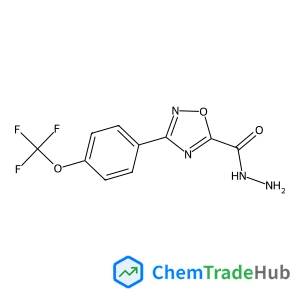
3-(4-(Trifluoromethoxy)phenyl)-1,2,4-oxadiazole-5-carbohydrazide
CAS Number:
883028-82-8
Molecular Formula:
C10H7F3N4O3
Jonelle Harvey, Richard P. Tuckett, Andras Bodi
Internal energy selected carbon tetrachloride cations have been prepared by imaging photoelectron photoion coincidence (iPEPICO) spectroscopy using synchrotron vacuum ultraviolet radiation. The threshold photoelectron spectrum shows a newly observed vibrational progression corresponding to the ν2(e) scissors mode of CCl4+ in the third, 2E band. Ab initio results on the first four doublet and lowest-lying quartet electronic states along the Cl3C+–Cl dissociation coordinate show the state to be strongly bound, and support its relative longevity. The 2T1 and à 2T2 cationic states, on the other hand, are barely bound and dissociate promptly. The 2T2 state may intersystem cross to the quartet ã state, which dissociates to a triplet state of the CCl3+ fragment ion. This path is unique among analogous MX4+ (M = C, Si, Ge; X = F, Cl, Br) systems, among which several have been shown to have long-lived states, which decay by fluorescence. The breakdown diagram, recorded here for the first time for the complete valence photoionisation energy range of CCl4, is interpreted in the context of literature based and CBS-QB3, G4, and W1U computed dissociative photoionisation energies. No Cl2-loss channel is observed in association with the CCl2+ or CCl+ fragments below the 2 or 3 Cl-loss reaction energies, and Cl2 loss is unlikely to be a major channel above them. The breakdown diagram is modelled based on the calculated dissociative photoionisation onsets and assuming a statistical redistribution of the excess energy. The model indicates that dissociation is not impulsive at higher energies, and confirms that the 2T2 state of CCl4+ forms triplet-state CCl3+ fragments with some of the excess energy trapped as electronic excitation energy in CCl3+.
DOI: 10.1039/C6AN00836D
Yanli Wen, Li Xu, Lanying Li, Suzhen Ren, Chengming Cao, Nengqin Jia, Ali Aldalbahi, Shiping Song, Jiye Shi, Jiaoyun Xia, Gang Liu, Xiaolei Zuo
DOI: 10.1039/C6AN01435F
Halina Abramczyk, Jakub Surmacki, Monika Kopeć, Alicja Klaudia Olejnik, Agnieszka Kaufman-Szymczyk, Krystyna Fabianowska-Majewska
DOI: 10.1039/C6AN00859C
DOI: 10.1039/C6AN00729E
Matthew R. Bailey, Zachary D. Schultz
DOI: 10.1039/C6AN01054G
P. D. Rakowska, M. P. Seah, J.-L. Vorng, R. Havelund, I. S. Gilmore
DOI: 10.1039/C6AN00791K
Elefterios Trikantzopoulos, Cheng Yang, Mallikarjunarao Ganesana, Ying Wang, B. Jill Venton
DOI: 10.1039/C6AN01469K
Paolo Zardi, Emma Gallo, Gregory A. Solan, Andrew J. Hudson
DOI: 10.1039/C6AN90078J
When handling 2-Chloro-1,2-bis(4-methylphenyl)ethanone (CAS: 71193-32-3), it is ...
4-Ethoxy-3-(5-methyl-4-oxo-7-propyl-1,4-dihydroimidazo[5,1-f][1,2,4]triazin-2-yl...
Methyl 3-Oxo-4-Androsten-17-Carboxylate (CAS: 2681-55-2) should be stored in a c...
(R)-3-Amino-4-(3-hexylphenylamino)-4-oxobutylphosphonic acid is primarily used i...
2-Methyl-2-propanyl 3-amino-3-carbamoyl-1-azetidinecarboxylate (CAS: 1254120-14-...
There are alternative reagents that can be used in synthesis instead of (E)-4-(t...
[2-(3-Chlorophenyl)-1,3-thiazol-4-yl]methanol (CAS: 121202-20-8) is a crystallin...
The market and research trends for Methyl (2S)-[(4S)-2,2-dimethyl-1,3-dioxolan-4...
The market for 1-Bromo-2-isocyanatoethane (CAS: 42865-19-0) is driven by its use...
4-Nitro-D-phenylalanine hydrochloride (CAS: 147065-06-3) is primarily used in re...

Physical Chemistry Chemical Physics (PCCP) is an international journal co-owned by 19 physical chemistry and physics societies from around the world. This journal publishes original, cutting-edge research in physical chemistry, chemical physics and biophysical chemistry. To be suitable for publication in PCCP, articles must include significant innovation and/or insight into physical chemistry; this is the most important criterion that reviewers and Editors will judge against when evaluating submissions. The journal has a broad scope and welcomes contributions spanning experiment, theory, computation and data science. Topical coverage includes spectroscopy, dynamics, kinetics, statistical mechanics, thermodynamics, electrochemistry, catalysis, surface science, quantum mechanics, quantum computing and machine learning. Interdisciplinary research areas such as polymers and soft matter, materials, nanoscience, energy, surfaces/interfaces, and biophysical chemistry are welcomed if they demonstrate significant innovation and/or insight into physical chemistry. Joined experimental/theoretical studies are particularly appreciated when complementary and based on up-to-date approaches.
![N-[2-Bromo-4-(trifluoromethoxy)phenyl]formamide structure](https://static.chemtradehub.com/structs/941/941294-53-7-f783.webp "N-[2-Bromo-4-(trifluoromethoxy)phenyl]formamide structure")
![7-Amino-5-methyl-5,7-dihydro-6H-dibenzo[b,d]azepin-6-one hydrochloride (1:1) structure](https://static.chemtradehub.com/structs/209/209984-32-7-9912.webp "7-Amino-5-methyl-5,7-dihydro-6H-dibenzo[b,d]azepin-6-one hydrochloride (1:1) structure")
![Methyl 5-iodo-3-({[(2-methyl-2-propanyl)oxy]carbonyl}amino)-2-thiophenecarboxylate structure](https://static.chemtradehub.com/structs/100/1007171-35-8-177e.webp "Methyl 5-iodo-3-({[(2-methyl-2-propanyl)oxy]carbonyl}amino)-2-thiophenecarboxylate structure")





