












Specific ion effects on membrane potential and the permselectivity of ion exchange membranes
Literature Information
Publication Date
2014-08-26
DOI
10.1039/C4CP03076A
Impact Factor
3.676
Authors
Harrison J. Cassady, Donald R. Paul
View Original
Abstract
Membrane potential and permselectivity are critical parameters for a variety of electrochemically-driven separation and energy technologies. An electric potential is developed when a membrane separates electrolyte solutions of different concentrations, and a permselective membrane allows specific species to be transported while restricting the passage of other species. Ion exchange membranes are commonly used in applications that require advanced ionic electrolytes and span technologies such as alkaline batteries to ammonium bicarbonate reverse electrodialysis, but membranes are often only characterized in sodium chloride solutions. Our goal in this work was to better understand membrane behaviour in aqueous ammonium bicarbonate, which is of interest for closed-loop energy generation processes. Here we characterized the permselectivity of four commercial ion exchange membranes in aqueous solutions of sodium chloride, ammonium chloride, sodium bicarbonate, and ammonium bicarbonate. This stepwise approach, using four different ions in aqueous solution, was used to better understand how these specific ions affect ion transport in ion exchange membranes. Characterization of cation and anion exchange membrane permselectivity, using these ions, is discussed from the perspective of the difference in the physical chemistry of the hydrated ions, along with an accompanying re-derivation and examination of the basic equations that describe membrane potential. In general, permselectivity was highest in sodium chloride and lowest in ammonium bicarbonate solutions, and the nature of both the counter- and co-ions appeared to influence measured permselectivity. The counter-ion type influences the binding affinity between counter-ions and polymer fixed charge groups, and higher binding affinity between fixed charge sites and counter-ions within the membrane decreases the effective membrane charge density. As a result permselectivity decreases. The charge density and polarizability of the co-ions also appeared to influence permselectivity leading to ion-specific effects; co-ions that are charge dense and have low polarizability tended to result in high membrane permselectivity.
Related Literature
Rapid, accurate, and comparative differentiation of clinically and industrially relevant microorganisms via multiple vibrational spectroscopic fingerprinting
Howbeer Muhamadali, Abdu Subaihi, Mahsa Mohammadtaheri, Yun Xu, David I. Ellis, Rajesh Ramanathan, Vipul Bansal, Royston Goodacre
2016-07-07
Paper
DOI: 10.1039/C6AN00883F
Molecular labels for analysis of amines and diols by spray based ionization-mass spectrometry
S. T. Ayrton, R. G. Cooks, M. Pugia
2016-06-22
Paper
DOI: 10.1039/C6AN00907G
Preparation of an aptamer based organic–inorganic hybrid monolithic column with gold nanoparticles as an intermediary for the enrichment of proteins
Jin-cheng Zhao, Qing-yun Zhu, Ling-yu Zhao, Hong-zhen Lian, Hong-yuan Chen
2016-06-03
Paper
DOI: 10.1039/C6AN00957C
Ultra-sensitive determination of silver nanoparticles by surface-enhanced Raman spectroscopy (SERS) after hydrophobization-mediated extraction
Huiyuan Guo, Baoshan Xing, Jason C. White, Arnab Mukherjee, Lili He
2016-08-03
Communication
DOI: 10.1039/C6AN01186A
Sensitive fluorescence assay of organophosphorus pesticides based on the fluorescence resonance energy transfer between CdTe quantum dots and porphyrin
Gao Xue, Zhao Yue, Zhang Bing, Tang Yiwei, Liu Xiuying, Li Jianrong
2016-06-06
Paper
DOI: 10.1039/C6AN00626D
Fragmentation, auto-modification and post ionisation proton bound dimer ion formation: the differential mobility spectrometry of low molecular weight alcohols
D. M. Ruszkiewicz, C. L. P. Thomas, G. A. Eiceman
2016-05-19
Paper
DOI: 10.1039/C6AN00435K
IR and Raman imaging of murine brains from control and ApoE/LDLR−/− mice with advanced atherosclerosis
Karolina Chrabaszcz, Edyta Maslak, Katarzyna M. Marzec
2016-06-08
Paper
DOI: 10.1039/C6AN00107F
Electrochemical detection of PCR amplicons of Escherichia coli genome based on DNA nanostructural probes and polyHRP enzyme
Yanli Wen, Li Xu, Lanying Li, Suzhen Ren, Chengming Cao, Nengqin Jia, Ali Aldalbahi, Shiping Song, Jiye Shi, Jiaoyun Xia, Gang Liu, Xiaolei Zuo
2016-07-18
Paper
DOI: 10.1039/C6AN01435F
In vitro monitoring of time and dose dependent cytotoxicity of aminated nanoparticles using Raman spectroscopy
Alan Casey, Hugh J. Byrne
2016-06-28
Paper
DOI: 10.1039/C6AN01199C
You might also like
Compound Q&A
What precautions should be taken when handling 2-Chloro-1,2-bis(4-methylphenyl)ethanone (CAS: 71193-32-3)?
When handling 2-Chloro-1,2-bis(4-methylphenyl)ethanone (CAS: 71193-32-3), it is ...
71193-32-32-Chloro-1,2-bis(4-m...
Compound Q&A
What industries use 4-Ethoxy-3-(5-methyl-4-oxo-7-propyl-1,4-dihydroimidazo[5,1-f][1,2,4]triazin-2-yl)benzenesulfonyl chloride (CAS: 224789-26-8)?
4-Ethoxy-3-(5-methyl-4-oxo-7-propyl-1,4-dihydroimidazo[5,1-f][1,2,4]triazin-2-yl...
224789-26-84-Ethoxy-3-(5-methyl...
Compound Q&A
How should Methyl 3-Oxo-4-Androsten-17-Carboxylate (CAS: 2681-55-2) be stored?
Methyl 3-Oxo-4-Androsten-17-Carboxylate (CAS: 2681-55-2) should be stored in a c...
2681-55-2Methyl 3-Oxo-4-Andro...
Compound Q&A
What are the main uses of (R)-3-Amino-4-(3-hexylphenylamino)-4-oxobutylphosphonic acid (CAS: 909725-61-7)?
(R)-3-Amino-4-(3-hexylphenylamino)-4-oxobutylphosphonic acid is primarily used i...
909725-61-7(R)-3-Amino-4-(3-hex...
Compound Q&A
What regulatory guidelines apply to 2-Methyl-2-propanyl 3-amino-3-carbamoyl-1-azetidinecarboxylate (CAS: 1254120-14-3)?
2-Methyl-2-propanyl 3-amino-3-carbamoyl-1-azetidinecarboxylate (CAS: 1254120-14-...
1254120-14-32-Methyl-2-propanyl ...
Compound Q&A
Are there alternatives to (E)-4-(tert-Butoxy)-4-oxobut-2-enoic acid (CAS: 135355-96-3) in synthesis?
There are alternative reagents that can be used in synthesis instead of (E)-4-(t...
135355-96-3(E)-4-(tert-Butoxy)-...
Compound Q&A
What are the physical and chemical properties of [2-(3-Chlorophenyl)-1,3-thiazol-4-yl]methanol (CAS: 121202-20-8)?
[2-(3-Chlorophenyl)-1,3-thiazol-4-yl]methanol (CAS: 121202-20-8) is a crystallin...
121202-20-8[2-(3-Chlorophenyl)-...
Compound Q&A
What is the market or research trend for Methyl (2S)-[(4S)-2,2-dimethyl-1,3-dioxolan-4-yl]{[(4-methylphenyl)sulfonyl]oxy}acetate (CAS: 166249-17-8)?
The market and research trends for Methyl (2S)-[(4S)-2,2-dimethyl-1,3-dioxolan-4...
166249-17-8Methyl (2S)-[(4S)-2,...
Compound Q&A
What is the market or research trend for 1-Bromo-2-isocyanatoethane (CAS: 42865-19-0)?
The market for 1-Bromo-2-isocyanatoethane (CAS: 42865-19-0) is driven by its use...
42865-19-01-Bromo-2-isocyanato...
Compound Q&A
What are the main uses of 4-Nitro-D-phenylalanine hydrochloride (CAS: 147065-06-3)?
4-Nitro-D-phenylalanine hydrochloride (CAS: 147065-06-3) is primarily used in re...
147065-06-34-Nitro-D-phenylalan...
Source Journal
Physical Chemistry Chemical Physics

CiteScore:
5.5
Self-citation Rate:
10.3%
Articles per Year:
3036
Physical Chemistry Chemical Physics (PCCP) is an international journal co-owned by 19 physical chemistry and physics societies from around the world. This journal publishes original, cutting-edge research in physical chemistry, chemical physics and biophysical chemistry. To be suitable for publication in PCCP, articles must include significant innovation and/or insight into physical chemistry; this is the most important criterion that reviewers and Editors will judge against when evaluating submissions. The journal has a broad scope and welcomes contributions spanning experiment, theory, computation and data science. Topical coverage includes spectroscopy, dynamics, kinetics, statistical mechanics, thermodynamics, electrochemistry, catalysis, surface science, quantum mechanics, quantum computing and machine learning. Interdisciplinary research areas such as polymers and soft matter, materials, nanoscience, energy, surfaces/interfaces, and biophysical chemistry are welcomed if they demonstrate significant innovation and/or insight into physical chemistry. Joined experimental/theoretical studies are particularly appreciated when complementary and based on up-to-date approaches.
Recommended Compounds
![6-Nitro-2-(4-nitrophenyl)imidazo[1,2-a]pyridine structure](https://static.chemtradehub.com/structs/118/118000-57-0-cb82.webp "6-Nitro-2-(4-nitrophenyl)imidazo[1,2-a]pyridine structure")

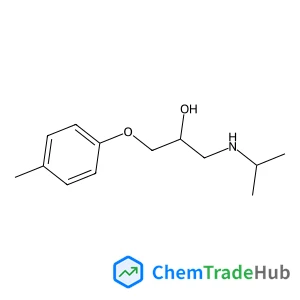
1-(4-Methylphenoxy)-3-(propan-2-ylamino)propan-2-ol
CAS Number:
5790-46-5
Molecular Formula:
C13H21NO2
Recommended Suppliers




Disclaimer
This page provides academic journal information for reference and research purposes only. We are not affiliated with any journal publishers and do not handle publication submissions. For publication-related inquiries, please contact the respective journal publishers directly.
If you notice any inaccuracies in the information displayed, please contact us at support@chemtradehub.com. We will promptly review and address your concerns.