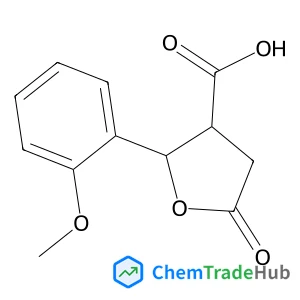
trans-2-(2-Methoxyphenyl)-5-oxotetrahydrofuran-3-carboxylic acid
CAS Number:
99226-02-5
Molecular Formula:
C12H12O5
Chun Du, Weiwei Li, Yan Duan, Cuihong Li, Huanli Dong, Jia Zhu, Wenping Hu, Zhishan Bo
A novel donor–acceptor (D–A) copolymer PDFCDTBT with 3,6-difluoro substituted carbazole as the donor unit and dialkoxy substituted benzothiadiazole as the acceptor unit has been synthesized and used as a donor material for bulk heterojunction polymer solar cells (BHJ PSCs). PDFCDTBT possesses a band gap of 1.75 eV, a low-lying HOMO energy level of −5.23 eV, and a good thermal and electrochemical stability. In comparison with the corresponding non-fluoro substituted HXS-1, which has a HOMO energy level of 5.21 eV, a LUMO energy level of 3.35 eV, and an optical band gap of 1.86 eV, the incorporation of two fluoro atoms in the carbazole donor unit lowers the HOMO and the LUMO energy levels of the polymer, which results in simultaneously decreasing the band gap of the polymer and increasing the Voc of polymer solar cells. The fluoro-containing polymer PDFCDTBT also shows strong intramolecular interactions and forms close packing in the solid state. Polymer solar cells based on PDFCDTBT and (6,6)-phenyl-C71-butyric acid methyl ester (PC71BM) demonstrate a power conversion efficiency (PCE) of 4.8% with a Voc of 0.91 V, a Jsc of 9.5 mA cm−2, and an FF of 0.55. In comparison with HXS-1, the better stability, higher Voc, and narrower band gap indicate that PDFCDTBT is a very promising donor material for high efficiency polymer solar cells.
Yani Zhao, Marek Cieplak
DOI: 10.1039/C7CP03829A
Rajamani Krishna, Jasper M. van Baten
DOI: 10.1039/C7CP00586E
Gousia Begum
DOI: 10.1039/C6CP07854K
DOI: 10.1039/C7CP05102F
Justyna Kozłowska, Marta Chołuj, Robert Zaleśny, Wojciech Bartkowiak
DOI: 10.1039/C6CP07368A
Shangqian Zhu, Xiaomeng Hu, Minhua Shao
DOI: 10.1039/C7CP00404D
Jan Meisner, Max N. Markmeyer, Matthias U. Bohner, Johannes Kästner
DOI: 10.1039/C7CP03722H
Sara Macchi, Riccardo Nifosì, Sebastiano Di Pietro, Claudia Boccardi, Francesca D'Autilia, Fabio Beltram, Francesco Cardarelli
DOI: 10.1039/C7CP04320A
J. S. Eardley, N. Warner, L. Z. Deng, E. Wrede
DOI: 10.1039/C7CP00458C
6-(3-Fluorophenyl)picolinic acid is generally considered safe for laboratory use...
(3R)-3-Pyrrolidinol is used in the pharmaceutical industry as a precursor for dr...
When handling (4R,5R)-4,5-Diethoxycarbonyl-2,2-dimethyldioxolane (CAS: 59779-75-...
1-(6-Chloroimidazo[1,2-b]pyridazin-3-yl)ethanone is often synthesized via a mult...
The market for N-Ethyl-3,4-dimethylbenzylamine (CAS: 39180-83-1) remains steady,...
Tert-butyl 3-(pyrrolidin-1-yl)azetidine-1-carboxylate is a chemical compound wit...
1-Bromo-3-chloro-2,4-dimethoxybenzene (CAS: 1228956-93-1) falls under the classi...
The safety of 8-Bromo-2-methyl-3,4-dihydroisoquinolin-1(2H)-one (CAS: 1368622-07...
Benzyl [(3S)-2,6-dioxo-3-piperidinyl]carbamate is generally safe when handled wi...
1-{[4-(4,4,5,5-Tetramethyl-1,3,2-dioxaborolan-2-yl)phenyl]sulfonyl}pyrrolidine s...

Polymer Chemistry welcomes submissions in all areas of polymer science that have a strong focus on macromolecular chemistry. Manuscripts may cover a broad range of fields, yet no direct application focus is required.
![2-[({[(2-Methyl-2-propanyl)oxy]carbonyl}amino)methyl]isonicotinic acid structure](https://static.chemtradehub.com/structs/473/473924-63-9-973b.webp "2-[({[(2-Methyl-2-propanyl)oxy]carbonyl}amino)methyl]isonicotinic acid structure")