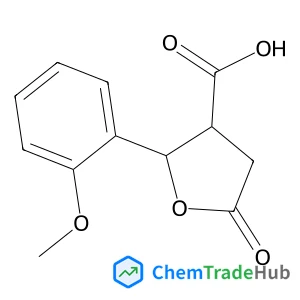
trans-2-(2-Methoxyphenyl)-5-oxotetrahydrofuran-3-carboxylic acid
CAS Number:
99226-02-5
Molecular Formula:
C12H12O5
Jiang Yuan, Xiaobo Huang, Pengfei Li, Li Li
Two major complications generally occur in blood-contacting devices, namely thrombus formation and microbial invasion and infection. Therefore, hemocompatible and antibiofouling surfaces, which function as barriers to bacterial and cell adhesion, are essential. Herein, we report the successful grafting of zwitterionic polysulfobetaine brushes onto a cellulose membrane (CM) via surface-initiated reversible addition–fragmentation chain-transfer (SI-RAFT) polymerization for improving hemocompatibility and antibiofouling property. Both pristine and polysulfobetaine brush-modified CM substrates were characterized by attenuated total reflection Fourier transform infrared spectroscopy (ATR-FTIR), water contact angle measurements (WCA), X-ray photoelectron spectroscopy analysis (XPS), and atomic force microscopy (AFM). Experimental observations demonstrated the successful grafting of polysulfobetaine brushes, where brush thicknesses were found to increase gradually with polymerization time and monomer concentrations. Tests conducted by investigating platelet adhesion, hemolytic rates and protein adsorption indicated that polysulfobetaine brush-grafted CMs had excellent hemocompatibility featuring lower platelet adhesion and protein adsorption properties without causing hemolysis. E. coli adhesion and HeLa cell adhesion tests showed that grafted CMs had superior antibacterial adhesion properties and long-term cell adhesion resistance for up to four days. The functionalized cellulose substrate described holds great potential for use in biomedical applications.
Zhongxu Wang
DOI: 10.1039/C7CP04299J
Jan Meisner, Max N. Markmeyer, Matthias U. Bohner, Johannes Kästner
DOI: 10.1039/C7CP03722H
DOI: 10.1039/C7CP01985H
Sara Macchi, Riccardo Nifosì, Sebastiano Di Pietro, Claudia Boccardi, Francesca D'Autilia, Fabio Beltram, Francesco Cardarelli
DOI: 10.1039/C7CP04320A
K. D. Fulfer, D. G. Kuroda
DOI: 10.1039/C7CP05096H
Laura Muñoz-Senovilla, Gregory Tricot, Francisco Muñoz
DOI: 10.1039/C7CP04171C
J. Gibson, T. J. Penfold
DOI: 10.1039/C7CP00719A
Anna Battisti, Gabriele Ciasca, Alessandro Grottesi, Alexander Tenenbaum
DOI: 10.1039/C6CP07683A
6-(3-Fluorophenyl)picolinic acid is generally considered safe for laboratory use...
(3R)-3-Pyrrolidinol is used in the pharmaceutical industry as a precursor for dr...
When handling (4R,5R)-4,5-Diethoxycarbonyl-2,2-dimethyldioxolane (CAS: 59779-75-...
1-(6-Chloroimidazo[1,2-b]pyridazin-3-yl)ethanone is often synthesized via a mult...
The market for N-Ethyl-3,4-dimethylbenzylamine (CAS: 39180-83-1) remains steady,...
Tert-butyl 3-(pyrrolidin-1-yl)azetidine-1-carboxylate is a chemical compound wit...
1-Bromo-3-chloro-2,4-dimethoxybenzene (CAS: 1228956-93-1) falls under the classi...
The safety of 8-Bromo-2-methyl-3,4-dihydroisoquinolin-1(2H)-one (CAS: 1368622-07...
Benzyl [(3S)-2,6-dioxo-3-piperidinyl]carbamate is generally safe when handled wi...
1-{[4-(4,4,5,5-Tetramethyl-1,3,2-dioxaborolan-2-yl)phenyl]sulfonyl}pyrrolidine s...

Polymer Chemistry welcomes submissions in all areas of polymer science that have a strong focus on macromolecular chemistry. Manuscripts may cover a broad range of fields, yet no direct application focus is required.