


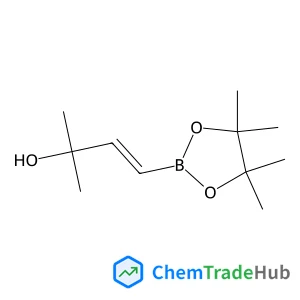
(E)-2-methyl-4-(4,4,5,5-tetramethyl-1,3,2-dioxaborolan-2-yl)but-3-en-2-ol
CAS Number:
581802-26-8
Molecular Formula:
C11H21BO3
Alexander Weigel, Matthias Pfaffe, Mohsen Sajadi, Rainer Mahrwald, Roberto Improta, Vincenzo Barone, Dario Polli, Giulio Cerullo, Nikolaus P. Ernsting, Fabrizio Santoro
The photoisomerisation of 1,1′-diethyl-2,2′-pyridocyanine, regarded by Brooker as the simplest cyanine, is examined in methanol by time-resolved experiments and PCM/TD-CAM-B3LYP calculations. Femtosecond transient absorption, fluorescence upconversion, and stimulated Raman scattering, all with broadband coverage, provide a panoramic view of the photoreaction. On the computational side, evolving distributions on an S1 minimum-energy path are obtained by solving the Smoluchowski equation for drift and diffusion of torsional motion. Absorption and fluorescence bandshapes are calculated and compared to the observations; near-quantitative agreement implies that the entire S1 path has been observed. Most importantly the global S1 minimum, i.e. the perpendicular “phantom state” P*, can be identified and characterized in this way. Internal conversion of P* (3.7 ps), assisted by solvent equilibration, leads to the hot ground state. Within 5 ps, vibrational bands of cis and trans isomers are recognized with the help of calculated Raman spectra. The differences between observed and simulated spectra are discussed.

Biocatalysis and Biotransformation

Journal of Asian Natural Products Research

Topics in Catalysis

Bioorganic & Medicinal Chemistry Letters

Journal of Chemical Sciences

Acta Metallurgica Sinica-English Letters

Medicinal Chemistry Research

Herald of the Russian Academy of Sciences

Colloid Journal

Chinese Journal of Chemistry
Wen-Da Li, Jian-Bing Zeng, Xiao-Jie Lou, Jing-Jing Zhang, Yu-Zhong Wang
DOI: 10.1039/C2PY20068F
Xiaolong Wang, Feng Zhou
DOI: 10.1039/C2PY20148H
Jingjing Zhang, Ying Niu, Caili Huang, Liping Xiao, Zhongtao Chen, Keke Yang, Yuzhong Wang
DOI: 10.1039/C2PY20028G
Samir Beghdadi, Daniele Addis, Hatem Ben Romdhane, Julien Bernard, Eric Drockenmuller
DOI: 10.1039/C1PY00446H
Jie Liu, Dan Ding, Junlong Geng, Bin Liu
DOI: 10.1039/C2PY20113E
Yi Zhang, Mingming Ding, Lijuan Zhou, Hong Tan, Jiehua Li, Huining Xiao, Jianshu Li, James Snow
DOI: 10.1039/C2PY00558A
Xiaodan Li, Yiqing Xia, Wenli Xu, Qichao Ran, Yi Gu
DOI: 10.1039/C2PY20133J
Pieter Espeel, Fabienne Goethals, Milan M. Stamenović, Lionel Petton, Filip E. Du Prez
DOI: 10.1039/C2PY00565D
Peter J. Roth, Thomas P. Davis, Andrew B. Lowe
DOI: 10.1039/C2PY20204B
When considering alternatives to 1-(4-Chlorophenyl)-N-hydroxymethanimine (CAS: 3...
This compound should be stored in a cool, dry place away from direct sunlight. I...
3-(4-Bromophenyl)-5-(2-fluorophenyl)-1,2,4-oxadiazole is synthesized through a m...
5-Chloro-2-(4-chlorophenyl)-4-methyl-6-[3-(1-piperidinyl)propoxy]pyrimidine (CAS...
2-Chloro-4-(difluoromethoxy)pyridine is used in the pharmaceutical industry for ...
3-Chloro-6-methylpyridazine (CAS: 1121-79-5) is classified under the Globally Ha...
Several alternatives can be used in the synthesis of Methyl 4,5-dimethyl-2-nitro...
Alternatives to (2E,2'E)-3,3'-(1,4-Phenylene)bisacrylaldehyde include other acry...
3-Amino-5-chloropyridin-2-ol hydrochloride is an organic compound with the CAS n...
When handling 6,7-Difluoro-2,3-dihydro-4H-chromen-4-one, it is essential to wear...

Physical Chemistry Chemical Physics (PCCP) is an international journal co-owned by 19 physical chemistry and physics societies from around the world. This journal publishes original, cutting-edge research in physical chemistry, chemical physics and biophysical chemistry. To be suitable for publication in PCCP, articles must include significant innovation and/or insight into physical chemistry; this is the most important criterion that reviewers and Editors will judge against when evaluating submissions. The journal has a broad scope and welcomes contributions spanning experiment, theory, computation and data science. Topical coverage includes spectroscopy, dynamics, kinetics, statistical mechanics, thermodynamics, electrochemistry, catalysis, surface science, quantum mechanics, quantum computing and machine learning. Interdisciplinary research areas such as polymers and soft matter, materials, nanoscience, energy, surfaces/interfaces, and biophysical chemistry are welcomed if they demonstrate significant innovation and/or insight into physical chemistry. Joined experimental/theoretical studies are particularly appreciated when complementary and based on up-to-date approaches.
![(2S)-2-{[(9H-Fluoren-9-ylmethoxy)carbonyl]amino}-4-(methylselanyl)butanoic acid structure](https://static.chemtradehub.com/structs/121/1217852-49-7-f252.webp "(2S)-2-{[(9H-Fluoren-9-ylmethoxy)carbonyl]amino}-4-(methylselanyl)butanoic acid structure")




