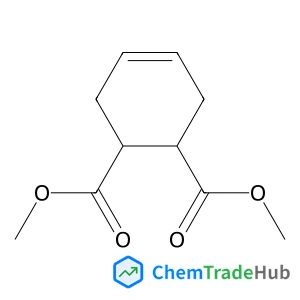
4-Cyclohexene-1,2-dicarboxylic acid, 1,2-dimethyl ester, (1R,2R)-rel-
CAS Number:
17673-68-6
Molecular Formula:
C10H14O4
W. Chuiling, M. V. Reddy, G. V. Subba Rao, B. V. R. Chowdari
The Pechini type polymerizable complex decomposition method is employed to prepare LiTi2(PO4)3 at 1000 °C in air. High energy ball milling followed by carbon coating by the glucose-method yielded C-coated nano-LiTi2(PO4)3 (LTP) with a crystallite size of 80(±5) nm. The phase is characterized by X-ray diffraction, Rietveld refinement, thermogravimetry, SEM, HR-TEM and Raman spectra. Lithium cycling properties of LTP show that 1.75 moles of Li (∼121 mA h g−1 at 15 mA g−1 current) per formula unit can be reversibly cycled between 2 and 3.4 V vs. Li with 83% capacity retention after 70 cycles. Cyclic voltammograms (CV) reveal the two-phase reaction mechanism during Li insertion/extraction. A hybrid electrochemical supercapacitor (HEC) with LTP as negative electrode and activated carbon (AC) as positive electrode in non-aqueous electrolyte is studied by CV at various scan rates and by galvanostatic cycling at various current rates up to 1000 cycles in the range 0–3 V. Results show that the HEC delivers a maximum energy density of 14 W h kg−1 and a power density of 180 W kg−1.
Sanjib Bhattacharyya, Jean-Paul Salvetat, Romain Fleurier, Anke Husmann, Thomas Cacciaguerra, Marie-Louise Saboungi
DOI: 10.1039/B509026A
Nadia J. Kershaw, Matthew E. C. Caines, Mark C. Sleeman, Christopher J. Schofield
DOI: 10.1039/B505964J
Xin-Long Wang, Chao Qin, En-Bo Wang, Zhong-Min Su, Lin Xu, Stuart R. Batten
DOI: 10.1039/B506398A
Javier Ruiz, Mario Ceroni, Marilín Vivanco, Marta P. Gonzalo, Santiago García-Granda, Francisco van der Maelen
DOI: 10.1039/B507600E
Wataru Setaka, Natsuki Hamada, Chizuko Kabuto, Mitsuo Kira
DOI: 10.1039/B505109F
Raymond Wai-Yin Sun, Rong Chen, Nancy P.-Y. Chung, Chi-Ming Ho, Chen-Lung Steve Lin, Chi-Ming Che
DOI: 10.1039/B510984A
Juan Qiao, Li. D. Wang, Jun. F. Xie, Gang. T. Lei, Guo. S. Wu, Yong Qiu
DOI: 10.1039/B506907F
Goverdhan Mehta, Kotapalli Pallavi, Jayant D. Umarye
DOI: 10.1039/B506931A
Stephanie R. Vogel, Christopher Deck, Clemens Richert
DOI: 10.1039/B510775J
6-(3-Fluorophenyl)picolinic acid is generally considered safe for laboratory use...
(3R)-3-Pyrrolidinol is used in the pharmaceutical industry as a precursor for dr...
When handling (4R,5R)-4,5-Diethoxycarbonyl-2,2-dimethyldioxolane (CAS: 59779-75-...
1-(6-Chloroimidazo[1,2-b]pyridazin-3-yl)ethanone is often synthesized via a mult...
The market for N-Ethyl-3,4-dimethylbenzylamine (CAS: 39180-83-1) remains steady,...
Tert-butyl 3-(pyrrolidin-1-yl)azetidine-1-carboxylate is a chemical compound wit...
1-Bromo-3-chloro-2,4-dimethoxybenzene (CAS: 1228956-93-1) falls under the classi...
The safety of 8-Bromo-2-methyl-3,4-dihydroisoquinolin-1(2H)-one (CAS: 1368622-07...
Benzyl [(3S)-2,6-dioxo-3-piperidinyl]carbamate is generally safe when handled wi...
1-{[4-(4,4,5,5-Tetramethyl-1,3,2-dioxaborolan-2-yl)phenyl]sulfonyl}pyrrolidine s...

Physical Chemistry Chemical Physics (PCCP) is an international journal co-owned by 19 physical chemistry and physics societies from around the world. This journal publishes original, cutting-edge research in physical chemistry, chemical physics and biophysical chemistry. To be suitable for publication in PCCP, articles must include significant innovation and/or insight into physical chemistry; this is the most important criterion that reviewers and Editors will judge against when evaluating submissions. The journal has a broad scope and welcomes contributions spanning experiment, theory, computation and data science. Topical coverage includes spectroscopy, dynamics, kinetics, statistical mechanics, thermodynamics, electrochemistry, catalysis, surface science, quantum mechanics, quantum computing and machine learning. Interdisciplinary research areas such as polymers and soft matter, materials, nanoscience, energy, surfaces/interfaces, and biophysical chemistry are welcomed if they demonstrate significant innovation and/or insight into physical chemistry. Joined experimental/theoretical studies are particularly appreciated when complementary and based on up-to-date approaches.
![(2E)-4-[(1R,2S,8R,19S,21R)-14-Hydroxy-11-isopropenyl-8,23,23-trimethyl-5-(3-methyl-2-buten-1-yl)-16,20-dioxo-3,7,22-trioxaheptacyclo[17.4.1.1~8,12~.0~2,17~.0~2,21~.0~4,15~.0~6,13~]pentacosa-4(15),5,13
,17-tetraen-21-yl]-2-methyl-2-butenoic acid structure](https://static.chemtradehub.com/structs/173/173867-04-4-d2d3.webp "(2E)-4-[(1R,2S,8R,19S,21R)-14-Hydroxy-11-isopropenyl-8,23,23-trimethyl-5-(3-methyl-2-buten-1-yl)-16,20-dioxo-3,7,22-trioxaheptacyclo[17.4.1.1~8,12~.0~2,17~.0~2,21~.0~4,15~.0~6,13~]pentacosa-4(15),5,13
,17-tetraen-21-yl]-2-methyl-2-butenoic acid structure")