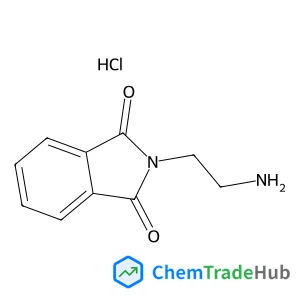
2-(2-Aminoethyl)-1H-isoindole-1,3(2H)-dione hydrochloride (1:1)
CAS Number:
30250-67-0
Molecular Formula:
C10H11ClN2O2
Raymond Wai-Yin Sun, Rong Chen, Nancy P.-Y. Chung, Chi-Ming Ho, Chen-Lung Steve Lin, Chi-Ming Che
Silver nanoparticles fabricated in Hepes buffer exhibit potent cytoprotective and post-infected anti-HIV-1 activities toward Hut/CCR5 cells.
Li-Juan Zhang, Bin Yang, Da-Zhi Li
DOI: 10.1039/D0CP04101G
V. H. Shafeeq, G. Unnikrishnan
DOI: 10.1039/D0CP04275G
A. I. Lozano, L. S. Maioli, B. Pamplona, M. Mendes, F. Ferreira da Silva, F. Kossoski, D. Süβ, M. H. F. Bettega, G. García, P. Limão-Vieira
DOI: 10.1039/D0CP02570D
Jinjie Gu, Xilong Qu
DOI: 10.1039/D0CP04565A
Xiaoxiao Lu, Bina Fu, Dong H. Zhang
DOI: 10.1039/D0CP04611F
Cesar E. P. Villegas, Alexandre R. Rocha
DOI: 10.1039/C9CP04054D
D. K. Andrea Phan Huu, Cristina Sissa, Francesca Terenziani, Anna Painelli
DOI: 10.1039/D0CP04496B
Tae-Hyeon Park, Dong-Won Jeong, Du-Jeon Jang
DOI: 10.1039/D0CP03734F
Xiaohui Song, Donghai Mei
DOI: 10.1039/D0CP04444J
Weiwei Ju, Shuai Zhang, Caijuan Xia
DOI: 10.1039/C9CP05185F
Waste containing 2-Ethyl-4-Methyl-1H-Imidazole-5-Carbaldehyde (CAS: 88634-80-4) ...
Triethoxy(octyl)silane (CAS: 1385031-14-0) is widely used in the pharmaceuticals...
Several alternatives to 3-iodo-7-nitro-1H-indazole (CAS: 864724-64-1) exist in t...
Yes, there are alternatives to Benzene, bis[(trimethoxysilyl)ethyl] (CAS: 266317...
Isothiazole-3-carbonitrile (CAS: 1452-17-1) is generally considered safe when us...
(3-Chlorophenyl)methanol (CAS: 873-63-2) is considered low to moderately toxic. ...
(2S,3S)-2-Hydroxy-3-({[(2-methyl-2-propanyl)oxy]carbonyl}amino)-3-(2-naphthyl)pr...
Proper handling of methyl 2-(bromomethyl)-5-methoxybenzoate requires the use of ...
6,8-Dibromoimidazo[1,2-a]pyridine-2-carboxylic acid (CAS: 904805-36-3) is an aro...
3-Amino-5-bromo-2-pyridinecarbonitrile is considered safe when handled under pro...

ChemComm publishes urgent research which is of outstanding significance and interest to experts in the field, while also appealing to the journal’s broad chemistry readership. Our communication format is ideally suited to short, urgent studies that are of such importance that they require accelerated publication. Our scope covers all topics in chemistry, and research at the interface of chemistry and other disciplines (such as materials science, nanoscience, physics, engineering and biology) where there is a significant novelty in the chemistry aspects. Major topic areas covered include: Analytical Chemistry Catalysis Chemical Biology and medicinal chemistry Computational Chemistry and Machine Learning Energy and sustainable chemistry Environmental Chemistry Green Chemistry Inorganic Chemistry Materials Chemistry Nanoscience Organic Chemistry Physical Chemistry Polymer Chemistry Supramolecular Chemistry
![N-[(5,6-Dichloro-1H-benzimidazol-2-yl)methyl]-9-(1-methyl-1H-pyrazol-4-yl)-2-(4-morpholinyl)-9H-purin-6-amine structure](https://static.chemtradehub.com/structs/238/2387704-62-1-25f4.webp "N-[(5,6-Dichloro-1H-benzimidazol-2-yl)methyl]-9-(1-methyl-1H-pyrazol-4-yl)-2-(4-morpholinyl)-9H-purin-6-amine structure")