












One step synthesis of highly crystalline and high coercive cobalt-ferrite nanocrystals
Literature Information
Publication Date
2005-09-01
DOI
10.1039/B509026A
Impact Factor
6.222
Authors
Sanjib Bhattacharyya, Jean-Paul Salvetat, Romain Fleurier, Anke Husmann, Thomas Cacciaguerra, Marie-Louise Saboungi
View Original
Abstract
Highly crystalline and almost monodisperse spinel cobalt-ferrite nanocrystals are synthesized in a one step process, which has very high coercivity at 10 K and exhibits superparamagnetic behaviour at 300 K.
Related Literature
Encapsulation of the Hoveyda–Grubbs 2nd generation catalyst in magnetically separable alginate/mesoporous carbon beads for olefin metathesis reactions in water
Zeynep Tunalı, Bengi Özgün Öztürk
2022-04-08
Paper
DOI: 10.1039/D2RE00058J
Direct synthesis of dimethyl ether from CO2 hydrogenation over a highly active, selective and stable catalyst containing Cu–ZnO–Al2O3/Al–Zr(1 : 1)-SBA-15
Ujjal Mondal, Ganapati D. Yadav
2022-03-02
Paper
DOI: 10.1039/D2RE00025C
Upgrading furanic platforms to α-enaminones: tunable continuous flow hydrogenation of bio-based cyclopentenones
Lídia A. S. Cavaca, Jaime A. S. Coelho, Susana D. Lucas, Rui M. S. Loureiro, Rafael F. A. Gomes, Carlos A. M. Afonso
2022-11-24
Paper
DOI: 10.1039/D2RE00292B
Enhanced flow synthesis of small molecules by in-line integration of sequential catalysis and benchtop twin-column continuous chromatography
Alessandra Sivo, Tae Keun Kim, Vincenzo Ruta, Renzo Luisi, Jose Osorio-Tejada, Marc Escriba-Gelonch, Volker Hessel, Mattia Sponchioni, Gianvito Vilé
2022-09-06
Paper
DOI: 10.1039/D2RE00242F
Improved experimental method for electroless deposition of iridium using a platinum sublayer to form a catalyst coated membrane
Aseem Partap Singh Gill, Jason Tai Hong Kwan, David P. Wilkinson
2022-08-25
Tutorial Account
DOI: 10.1039/D2RE00216G
Highly conductive CNT aerogel synthesized via an inert FC-CVD technique: a step towards a greener approach
2022-07-04
Communication
DOI: 10.1039/D2RE00170E
Convenient and accurate insight into solution-phase equilibria from FlowNMR titrations
Ian Clegg, Anna Codina
2022-06-09
Paper
DOI: 10.1039/D2RE00123C
You might also like
Compound Q&A
How should waste containing 2-Ethyl-4-Methyl-1H-Imidazole-5-Carbaldehyde (CAS: 88634-80-4) be handled?
Waste containing 2-Ethyl-4-Methyl-1H-Imidazole-5-Carbaldehyde (CAS: 88634-80-4) ...
88634-80-42-Ethyl-4-Methyl-1H-...
Compound Q&A
What industries use Triethoxy(octyl)silane (CAS: 1385031-14-0)?
Triethoxy(octyl)silane (CAS: 1385031-14-0) is widely used in the pharmaceuticals...
1385031-14-0Triethoxy(octyl)sila...
Compound Q&A
Are there alternatives to 3-iodo-7-nitro-1H-indazole (CAS: 864724-64-1) in synthesis?
Several alternatives to 3-iodo-7-nitro-1H-indazole (CAS: 864724-64-1) exist in t...
864724-64-13-iodo-7-nitro-1H-in...
Compound Q&A
Are there alternatives to Benzene, bis[(trimethoxysilyl)ethyl] (CAS: 266317-71-9) in synthesis?
Yes, there are alternatives to Benzene, bis[(trimethoxysilyl)ethyl] (CAS: 266317...
266317-71-9Benzene, bis[(trimet...
Compound Q&A
Is Isothiazole-3-carbonitrile (CAS: 1452-17-1) safe?
Isothiazole-3-carbonitrile (CAS: 1452-17-1) is generally considered safe when us...
1452-17-1Isothiazole-3-carbon...
Compound Q&A
Is (3-Chlorophenyl)methanol (CAS: 873-63-2) safe?
(3-Chlorophenyl)methanol (CAS: 873-63-2) is considered low to moderately toxic. ...
873-63-2(3-Chlorophenyl)meth...
Compound Q&A
How is (2S,3S)-2-Hydroxy-3-({[(2-methyl-2-propanyl)oxy]carbonyl}amino)-3-(2-naphthyl)propanoic acid (CAS: 959583-98-3) typically synthesized?
(2S,3S)-2-Hydroxy-3-({[(2-methyl-2-propanyl)oxy]carbonyl}amino)-3-(2-naphthyl)pr...
959583-98-3(2S,3S)-2-Hydroxy-3-...
Compound Q&A
What precautions should be taken when handling Methyl 2-(bromomethyl)-5-methoxybenzoate (CAS: 788081-99-2)?
Proper handling of methyl 2-(bromomethyl)-5-methoxybenzoate requires the use of ...
788081-99-2Methyl 2-(bromomethy...
Compound Q&A
What is 6,8-Dibromoimidazo[1,2-a]pyridine-2-carboxylic acid (CAS: 904805-36-3)?
6,8-Dibromoimidazo[1,2-a]pyridine-2-carboxylic acid (CAS: 904805-36-3) is an aro...
904805-36-36,8-Dibromoimidazo[1...
Compound Q&A
Is 3-Amino-5-bromo-2-pyridinecarbonitrile (CAS: 573675-27-1) safe?
3-Amino-5-bromo-2-pyridinecarbonitrile is considered safe when handled under pro...
573675-27-13-Amino-5-bromo-2-py...
Source Journal
Chemical Communications

CiteScore:
8.6
Self-citation Rate:
4.7%
Articles per Year:
2458
ChemComm publishes urgent research which is of outstanding significance and interest to experts in the field, while also appealing to the journal’s broad chemistry readership. Our communication format is ideally suited to short, urgent studies that are of such importance that they require accelerated publication. Our scope covers all topics in chemistry, and research at the interface of chemistry and other disciplines (such as materials science, nanoscience, physics, engineering and biology) where there is a significant novelty in the chemistry aspects. Major topic areas covered include: Analytical Chemistry Catalysis Chemical Biology and medicinal chemistry Computational Chemistry and Machine Learning Energy and sustainable chemistry Environmental Chemistry Green Chemistry Inorganic Chemistry Materials Chemistry Nanoscience Organic Chemistry Physical Chemistry Polymer Chemistry Supramolecular Chemistry
Recommended Compounds
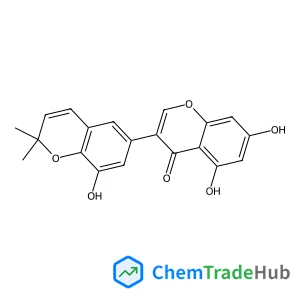
5,7,8'-Trihydroxy-2',2'-dimethyl-2'H,4H-3,6'-bichromen-4-one
CAS Number:
129280-33-7
Molecular Formula:
C20H16O6
Recommended Suppliers





Disclaimer
This page provides academic journal information for reference and research purposes only. We are not affiliated with any journal publishers and do not handle publication submissions. For publication-related inquiries, please contact the respective journal publishers directly.
If you notice any inaccuracies in the information displayed, please contact us at support@chemtradehub.com. We will promptly review and address your concerns.