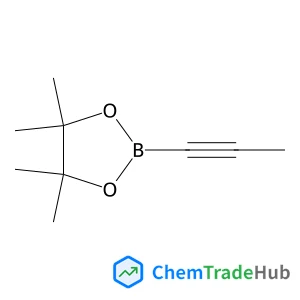
4,4,5,5-Tetramethyl-2-(1-propyn-1-YL)-1,3,2-dioxaborolane
CAS Number:
347389-75-7
Molecular Formula:
C9H15BO2
Sushanta K. Das, Atula S. D. Sandanayaka, Navaneetha K. Subbaiyan, Deviprasad R. Gollapalli, Melvin E. Zandler, Takatsugu Wakahara
Photoinduced charge separation processes of three-layer supramolecular hybrids, fullerene–porphyrin–SWCNT, which are constructed from semiconducting (7,6)- and (6,5)-enriched SWCNTs and self-assembled via π–π interacting long alkyl chain substituted porphyrins (tetrakis(4-dodecyloxyphenyl)porphyrins; abbreviated as MP(alkyl)4) (M = Zn and H2), to which imidazole functionalized fullerene[60] (C60Im) is coordinated, have been investigated in organic solvents. The intermolecular alkyl–π and π–π interactions between the MP(alkyl)4 and SWCNTs, in addition, coordination between C60Im and Zn ion in the porphyrin cavity are visualized using DFT calculations at the B3LYP/3-21G(*) level, predicting donor–acceptor interactions between them in the ground and excited states. The donor–acceptor nanohybrids thus formed are characterized by TEM imaging, steady-state absorption and fluorescence spectra. The time-resolved fluorescence studies of MP(alkyl)4 in two-layered nanohybrids (MP(alkyl)4/SWCNT) revealed efficient quenching of the singlet excited states of MP(alkyl)4 (1MP*(alkyl)4) with the rate constants of charge separation (kCS) in the range of (1–9) × 109 s−1. A nanosecond transient absorption technique confirmed the electron transfer products, MP˙+(alkyl)4/SWCNT˙− and/or MP˙−(alkyl)4/SWCNT˙+ for the two-layer nanohybrids. Upon further coordination of C60Im to ZnP, acceleration of charge separation via1ZnP* in C60Im→ZnP(alkyl)4/SWCNT is observed to form C60˙−Im→ZnP˙+(alkyl)4/SWCNT and C60˙−Im→ZnP(alkyl)4/SWCNT˙+ charge separated states as supported by the transient absorption spectra. These characteristic absorptions decay with rate constants due to charge recombination (kCR) in the range of (6–10) × 106 s−1, corresponding to the lifetimes of the radical ion-pairs of 100–170 ns. The electron transfer in the nanohybrids has further been utilized for light-to-electricity conversion by the construction of proof-of-concept photoelectrochemical solar cells.
Xuanyu Xiao, Lei Li, Hui Deng, Yuting Zhong, Wei Deng, Yuanyuan Xu, Zhiyu Chen, Jieyu Zhang, Xuefeng Hu, Yunbing Wang
DOI: 10.1039/D3TB01910A
Yihua Fu, Yan Zhang, Changwei Hu, Zhishan Su
DOI: 10.1039/D3NJ04395A
Zhenyu Shu, Xiaoli Zheng, Sailong Wei, Meng Ma, Huiwen He, Yanqin Shi, Xiangyang Gong, Si Chen, Xu Wang
DOI: 10.1039/D3TB01706K
Charles C. Chusuei, Ram Chandra Nepal
DOI: 10.1039/D3NJ04054B
Li Xing, Youshan An, Yishan Qin, Hui Xin, Tianyu Deng, Kaini Meng, Da Liu, Wei Xue
DOI: 10.1039/D3NJ04902G
Hong-Liang Wang, Yu-Ting Du, Xiao-Juan Zhang, Hai-Xian Ren, Lu Qin, Xiao-Bo Luo, Pei-Yang Gu, Lingyun Xu, Shi-Yuan Zhou
DOI: 10.1039/D3NJ04177H
Qi Chen, Xiang Ke, Yusong Cai, Hao Wang, Zhiyun Dong, Xinlong Li, Jinlin Li, Xinyuan Xu, Jun Luo
DOI: 10.1039/D3TB02186F
Anqi Ju, Shuxian Zhang, Dong Li, Kunming Li, Xuepeng Ni, Yi Li, Yang Jiang
DOI: 10.1039/D3NJ04456D
Jiawei Hu, Junfei Zhu, Jingjing Chai, Yudie Zhao, Jiajie Luan, Yan Wang
DOI: 10.1039/D3TB01991H
DOI: 10.1039/D3NJ04311H
6-(3-Fluorophenyl)picolinic acid is generally considered safe for laboratory use...
(3R)-3-Pyrrolidinol is used in the pharmaceutical industry as a precursor for dr...
When handling (4R,5R)-4,5-Diethoxycarbonyl-2,2-dimethyldioxolane (CAS: 59779-75-...
1-(6-Chloroimidazo[1,2-b]pyridazin-3-yl)ethanone is often synthesized via a mult...
The market for N-Ethyl-3,4-dimethylbenzylamine (CAS: 39180-83-1) remains steady,...
Tert-butyl 3-(pyrrolidin-1-yl)azetidine-1-carboxylate is a chemical compound wit...
1-Bromo-3-chloro-2,4-dimethoxybenzene (CAS: 1228956-93-1) falls under the classi...
The safety of 8-Bromo-2-methyl-3,4-dihydroisoquinolin-1(2H)-one (CAS: 1368622-07...
Benzyl [(3S)-2,6-dioxo-3-piperidinyl]carbamate is generally safe when handled wi...
1-{[4-(4,4,5,5-Tetramethyl-1,3,2-dioxaborolan-2-yl)phenyl]sulfonyl}pyrrolidine s...

Physical Chemistry Chemical Physics (PCCP) is an international journal co-owned by 19 physical chemistry and physics societies from around the world. This journal publishes original, cutting-edge research in physical chemistry, chemical physics and biophysical chemistry. To be suitable for publication in PCCP, articles must include significant innovation and/or insight into physical chemistry; this is the most important criterion that reviewers and Editors will judge against when evaluating submissions. The journal has a broad scope and welcomes contributions spanning experiment, theory, computation and data science. Topical coverage includes spectroscopy, dynamics, kinetics, statistical mechanics, thermodynamics, electrochemistry, catalysis, surface science, quantum mechanics, quantum computing and machine learning. Interdisciplinary research areas such as polymers and soft matter, materials, nanoscience, energy, surfaces/interfaces, and biophysical chemistry are welcomed if they demonstrate significant innovation and/or insight into physical chemistry. Joined experimental/theoretical studies are particularly appreciated when complementary and based on up-to-date approaches.
![3-[(3R,4R)-3-[(6-aminopyrimidin-4-yl)-methyl-amino]-4-methyl-1-piperidyl]-3-oxo-propanenitrile structure](https://static.chemtradehub.com/structs/164/1640971-60-3-83a4.webp "3-[(3R,4R)-3-[(6-aminopyrimidin-4-yl)-methyl-amino]-4-methyl-1-piperidyl]-3-oxo-propanenitrile structure")