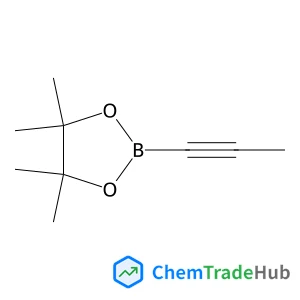
4,4,5,5-Tetramethyl-2-(1-propyn-1-YL)-1,3,2-dioxaborolane
CAS Number:
347389-75-7
Molecular Formula:
C9H15BO2
Jin-Sung Park, Sook Ho Kim, Nam-Kyung Lee, Kyoung J. Lee, Seok-Cheol Hong
Platinum-based anti-cancer drugs form a major family of cancer chemotherapeutic agents. Cisplatin, the first member of the family, remains a potent anti-cancer drug and exhibits its clinical effect by inducing local DNA kinks and subsequently interfering with DNA metabolism. Although its mechanism is reasonably well understood, effects of intracellular ions on cisplatin activity are left to be elucidated because cisplatin binding to DNA, thus its drug efficacy, is modified by various ions. One such issue is the effect of carbonate ions: cisplatin binding to DNA is suppressed under physiological carbonate conditions. Here, we examined the role of common cellular ions (carbonate and chloride) by measuring cisplatin binding in relevant physiological buffersvia a DNA micromanipulation technique. Using two orthogonal single-molecule methods, we succeeded in detecting hidden monofunctional adducts (kink-free, presumably clinically inactive form) and clearly showed that the major effect of carbonates was to form such adducts and to prevent them from converting to bifunctional adducts (kinked, clinically active). The chloride-rich environment also led to the formation of monofunctional adducts. Our approach is widely applicable to the study of the transient behaviours of various drugs and proteins that bind to DNA in different modes depending on various physical and chemical factors such as tension, torsion, ligands, and ions.

Herald of the Russian Academy of Sciences

Polycyclic Aromatic Compounds

Critical Reviews in Solid State and Materials Sciences

Atomization and Sprays

Journal of Asian Natural Products Research

Heteroatom Chemistry

Chinese Journal of Chemistry

Bioorganic & Medicinal Chemistry Letters

Electroanalysis

Cellulose
Miaohui Yu, Tingting Fu, Wenzhai Li, Yan Zhang, Huayan Wen, Min Zheng, Moran Shi, Caiyun Liu, Meng Jin, Kechun Liu, Baocun Zhu
DOI: 10.1039/D3NJ04746F
Anqi Ju, Shuxian Zhang, Dong Li, Kunming Li, Xuepeng Ni, Yi Li, Yang Jiang
DOI: 10.1039/D3NJ04456D
Wenjun Zhang, Chun-Sing Lee
DOI: 10.1039/D3TB01648J
Yi Yao, Xiaoxin Shi, Zihong Zhao, Afang Zhang, Wen Li
DOI: 10.1039/D3TB01803B
Kaisei Wakishima, Tomohiro Higashi, Kenji Yoshino
DOI: 10.1039/D3NJ04878K
Xiao Wen, Zhipeng Deng, Hui Wang, Jianyang Shi, Shuang Wang, Haibo Wang, Yueming Song, Zongliang Du, Jinghong Qiu, Xu Cheng
DOI: 10.1039/D3TB01570J
Chen Zhang, Kaiyue Liu, Yuanmeng He, Rong Chang, Fangxia Guan, Minghao Yao
DOI: 10.1039/D3TB01384G
Francisco Gámez, Roberto Gallardo, Manuel Pernia Leal
DOI: 10.1039/D3TB01821K
Qian Chen, Tianhe Shan, Yanjie Liang, Yujing Xu, Enyu Shi, Yue Wang, Changyi Li, Mingxin Cao
DOI: 10.1039/D3TB02046K
6-(3-Fluorophenyl)picolinic acid is generally considered safe for laboratory use...
(3R)-3-Pyrrolidinol is used in the pharmaceutical industry as a precursor for dr...
When handling (4R,5R)-4,5-Diethoxycarbonyl-2,2-dimethyldioxolane (CAS: 59779-75-...
1-(6-Chloroimidazo[1,2-b]pyridazin-3-yl)ethanone is often synthesized via a mult...
The market for N-Ethyl-3,4-dimethylbenzylamine (CAS: 39180-83-1) remains steady,...
Tert-butyl 3-(pyrrolidin-1-yl)azetidine-1-carboxylate is a chemical compound wit...
1-Bromo-3-chloro-2,4-dimethoxybenzene (CAS: 1228956-93-1) falls under the classi...
The safety of 8-Bromo-2-methyl-3,4-dihydroisoquinolin-1(2H)-one (CAS: 1368622-07...
Benzyl [(3S)-2,6-dioxo-3-piperidinyl]carbamate is generally safe when handled wi...
1-{[4-(4,4,5,5-Tetramethyl-1,3,2-dioxaborolan-2-yl)phenyl]sulfonyl}pyrrolidine s...

Physical Chemistry Chemical Physics (PCCP) is an international journal co-owned by 19 physical chemistry and physics societies from around the world. This journal publishes original, cutting-edge research in physical chemistry, chemical physics and biophysical chemistry. To be suitable for publication in PCCP, articles must include significant innovation and/or insight into physical chemistry; this is the most important criterion that reviewers and Editors will judge against when evaluating submissions. The journal has a broad scope and welcomes contributions spanning experiment, theory, computation and data science. Topical coverage includes spectroscopy, dynamics, kinetics, statistical mechanics, thermodynamics, electrochemistry, catalysis, surface science, quantum mechanics, quantum computing and machine learning. Interdisciplinary research areas such as polymers and soft matter, materials, nanoscience, energy, surfaces/interfaces, and biophysical chemistry are welcomed if they demonstrate significant innovation and/or insight into physical chemistry. Joined experimental/theoretical studies are particularly appreciated when complementary and based on up-to-date approaches.
![5-Bromo-3-isopropyl-1H-pyrrolo[2,3-b]pyridine structure](https://static.chemtradehub.com/structs/125/1256819-54-1-8620.webp "5-Bromo-3-isopropyl-1H-pyrrolo[2,3-b]pyridine structure")