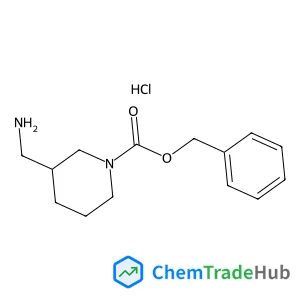
Benzyl 3-(aminomethyl)piperidine-1-carboxylate hydrochloride
CAS Number:
1186663-23-9
Molecular Formula:
C14H21ClN2O2
Ana M. Gutiérrez, Ángela Sastre-Santos, Fernando Fernández-Lázaro
Photoinduced electron-transfer dynamics of self-assembled donor–acceptor dyads formed by axial coordination of zinc naphthalocyanine, ZnNc, and perylenediimide (PDI) bearing either pyridine (py) or imidazole (im) coordinating ligands were investigated. The PDIim unit was functionalized with tert-octylphenoxy groups at the bay positions, which avoid aggregation providing solubility, to examine the effect of the bulky substituents at the bay positions on the rates of electron-transfer reactions. The combination between zinc naphthalocyanine and perylenediimide entities absorbs light over a wide region of the visible and near infrared (NIR) spectrum. The binding constants of the self-assembled ZnNc:PDIpy (1) and ZnNc:PDIim (2) in toluene were found to be 2.40 × 10⁴ and 1.10 × 10⁵ M−1, respectively, from the steady-state absorption and emission measurements, indicating formation of moderately stable complexes. The geometric and electronic calculations by using an ab initio B3LYP/6-311G method showed the majority of the highest occupied frontier molecular orbital (HOMO) on the zinc naphthalocyanine entity, while the lowest unoccupied molecular orbital (LUMO) was on the perylenediimide entities, suggesting that the charge-separated states of the supramolecular dyads are ZnNc˙+:PDI˙−. The electrochemical results suggest the exothermic charge-separation process via the singlet states of both ZnNc and PDI entities in nonpolar toluene. Upon coordination of perylenediimide to ZnNc, the main quenching pathway involved charge separation via the singlet-excited states of ZnNc and PDIs. Clear evidence of the intramolecular electron transfer from the singlet-excited state of ZnNc to PDI within the supramolecular dyads in toluene was monitored by the femtosecond laser photolysis by observing the characteristic absorption band of the PDI radical anion (PDI˙−) and the ZnNc radical cation (ZnNc˙+) in the visible and NIR regions. The rate constants of charge-separation (kCS) processes of the self-assembled dyads 1 and 2 were determined to be 4.05 × 10¹⁰ and 1.20 × 10⁹ s−1, respectively. The rate constant of charge recombination (kCR) and the lifetime of charge-separated states (τCS) of dyad 1 were determined to be 2.34 × 10⁸ s−1 and 4.30 ns, respectively. Interestingly, a slower charge recombination (2.20 × 10⁷ s−1) and a longer lifetime of the charge separated state (45 ns) were observed in dyad 2 in nonpolar toluene by utilizing the nanosecond transient measurements. The absorption in a wide section of the solar spectrum and the high charge-separation/charge-recombination ratio suggest the usefulness of the self-assembled zinc naphthalocyanine–perylenediimide dyads as good photosynthetic models.
Wei Xu, Deqing Zhang, Daoben Zhu
DOI: 10.1039/B509133K
Yoshihiko Yamamoto, Kozo Hattori, Jun-ichi Ishii, Hisao Nishiyama, Kenji Itoh
DOI: 10.1039/B506977G
DOI: 10.1039/B508531B
Sunita Thyagarajan, Kenneth D. Karlin, Steven E. Rokita
DOI: 10.1039/B509690A
Hans-Wolfram Lerner, Günter Margraf, Jan W. Bats, Matthias Wagner
DOI: 10.1039/B507833D
Petr Sazama, Blanka Wichterlová
DOI: 10.1039/B507553J
Kathleen M. McKenzie, Michael M. Meijler, Colin A. Lowery, Grant E. Boldt, Kim D. Janda
DOI: 10.1039/B509396A
Marianne Steurer, Karin Tiedl, Yaping Wang, Walter Weissensteiner
DOI: 10.1039/B508761A
Mathieu Etienne, David Grosso, Cédric Boissière, Clément Sanchez, Alain Walcarius
DOI: 10.1039/B508093B
Mark D. Roydhouse, John C. Walton
DOI: 10.1039/B506391D
6-(3-Fluorophenyl)picolinic acid is generally considered safe for laboratory use...
(3R)-3-Pyrrolidinol is used in the pharmaceutical industry as a precursor for dr...
When handling (4R,5R)-4,5-Diethoxycarbonyl-2,2-dimethyldioxolane (CAS: 59779-75-...
1-(6-Chloroimidazo[1,2-b]pyridazin-3-yl)ethanone is often synthesized via a mult...
The market for N-Ethyl-3,4-dimethylbenzylamine (CAS: 39180-83-1) remains steady,...
Tert-butyl 3-(pyrrolidin-1-yl)azetidine-1-carboxylate is a chemical compound wit...
1-Bromo-3-chloro-2,4-dimethoxybenzene (CAS: 1228956-93-1) falls under the classi...
The safety of 8-Bromo-2-methyl-3,4-dihydroisoquinolin-1(2H)-one (CAS: 1368622-07...
Benzyl [(3S)-2,6-dioxo-3-piperidinyl]carbamate is generally safe when handled wi...
1-{[4-(4,4,5,5-Tetramethyl-1,3,2-dioxaborolan-2-yl)phenyl]sulfonyl}pyrrolidine s...

Physical Chemistry Chemical Physics (PCCP) is an international journal co-owned by 19 physical chemistry and physics societies from around the world. This journal publishes original, cutting-edge research in physical chemistry, chemical physics and biophysical chemistry. To be suitable for publication in PCCP, articles must include significant innovation and/or insight into physical chemistry; this is the most important criterion that reviewers and Editors will judge against when evaluating submissions. The journal has a broad scope and welcomes contributions spanning experiment, theory, computation and data science. Topical coverage includes spectroscopy, dynamics, kinetics, statistical mechanics, thermodynamics, electrochemistry, catalysis, surface science, quantum mechanics, quantum computing and machine learning. Interdisciplinary research areas such as polymers and soft matter, materials, nanoscience, energy, surfaces/interfaces, and biophysical chemistry are welcomed if they demonstrate significant innovation and/or insight into physical chemistry. Joined experimental/theoretical studies are particularly appreciated when complementary and based on up-to-date approaches.
![[4-Chloro-3-(diethylcarbamoyl)phenyl]boronic acid structure](https://static.chemtradehub.com/structs/871/871332-68-2-0e3b.webp "[4-Chloro-3-(diethylcarbamoyl)phenyl]boronic acid structure")