












Selective catalytic reduction of NOx by hydrocarbons enhanced by hydrogen peroxide over silver/alumina catalysts
Literature Information
Publication Date
2005-08-17
DOI
10.1039/B507553J
Impact Factor
6.222
Authors
Petr Sazama, Blanka Wichterlová
View Original
Abstract
It is shown that hydrogen peroxide enhances substantially selective reduction of NOx to nitrogen with hydrocarbons over Ag/alumina catalysts.
Recommended Journals
Related Literature
Dynamics and kinetics of the OH + HO2 → H2O + O2 (1Δg) reaction on a global full-dimensional singlet-state potential energy surface
Xiaoxiao Lu, Bina Fu, Dong H. Zhang
2020-10-28
Paper
DOI: 10.1039/D0CP04611F
Optical spectra of organic dyes in condensed phases: the role of the medium polarizability
D. K. Andrea Phan Huu, Cristina Sissa, Francesca Terenziani, Anna Painelli
2020-10-21
Paper
DOI: 10.1039/D0CP04496B
Towards accurate prediction for laser-coolable molecules: relativistic coupled-cluster calculations for yttrium monoxide and prospects for improving its laser cooling efficiencies
Chaoqun Zhang, Hannah Korslund, Lan Cheng
2020-11-05
Paper
DOI: 10.1039/D0CP04608F
First-principles investigation on the transport properties of quaternary CoFeRGa (R = Ti, V, Cr, Mn, Cu, and Nb) Heusler compounds
Jingyu Li, Chi Zhang, Peng-Fei Liu
2020-09-17
Paper
DOI: 10.1039/D0CP03226C
Behavior of the water/vapor interface of chitosan solutions with an anionic surfactant: effect of polymer–surfactant interactions
2020-09-12
Paper
DOI: 10.1039/D0CP02470H
Redox potentials along the redox-active low-barrier H-bonds in electron transfer pathways
Manoj Mandal
2020-09-15
Paper
DOI: 10.1039/D0CP04265J
Synthesis and characterization of a strong ferromagnetic and high hardness intermetallic compound Fe2B
Xingbin Zhao, Li Li, Kuo Bao, Pinwen Zhu, Qiang Tao, Shuailing Ma, Bo Liu, Yufei Ge, Da Li
2020-10-22
Paper
DOI: 10.1039/D0CP03380D
A comprehensive approach for the characterization of porous polymers using 13C and 15N dynamic nuclear polarization NMR spectroscopy
Sven Grätz, Torsten Gutmann, Lars Borchardt
2020-09-21
Paper
DOI: 10.1039/D0CP04010J
Anharmonic coupling behind vibrational spectra of solvated ammonium: lighting up overtone states by Fermi resonance through tuning solvation environments
Chih-Kai Lin, Qian-Rui Huang, Jer-Lai Kuo
2020-09-30
Paper
DOI: 10.1039/D0CP03519J
You might also like
Compound Q&A
How should waste containing 2-Ethyl-4-Methyl-1H-Imidazole-5-Carbaldehyde (CAS: 88634-80-4) be handled?
Waste containing 2-Ethyl-4-Methyl-1H-Imidazole-5-Carbaldehyde (CAS: 88634-80-4) ...
88634-80-42-Ethyl-4-Methyl-1H-...
Compound Q&A
What industries use Triethoxy(octyl)silane (CAS: 1385031-14-0)?
Triethoxy(octyl)silane (CAS: 1385031-14-0) is widely used in the pharmaceuticals...
1385031-14-0Triethoxy(octyl)sila...
Compound Q&A
Are there alternatives to 3-iodo-7-nitro-1H-indazole (CAS: 864724-64-1) in synthesis?
Several alternatives to 3-iodo-7-nitro-1H-indazole (CAS: 864724-64-1) exist in t...
864724-64-13-iodo-7-nitro-1H-in...
Compound Q&A
Are there alternatives to Benzene, bis[(trimethoxysilyl)ethyl] (CAS: 266317-71-9) in synthesis?
Yes, there are alternatives to Benzene, bis[(trimethoxysilyl)ethyl] (CAS: 266317...
266317-71-9Benzene, bis[(trimet...
Compound Q&A
Is Isothiazole-3-carbonitrile (CAS: 1452-17-1) safe?
Isothiazole-3-carbonitrile (CAS: 1452-17-1) is generally considered safe when us...
1452-17-1Isothiazole-3-carbon...
Compound Q&A
Is (3-Chlorophenyl)methanol (CAS: 873-63-2) safe?
(3-Chlorophenyl)methanol (CAS: 873-63-2) is considered low to moderately toxic. ...
873-63-2(3-Chlorophenyl)meth...
Compound Q&A
How is (2S,3S)-2-Hydroxy-3-({[(2-methyl-2-propanyl)oxy]carbonyl}amino)-3-(2-naphthyl)propanoic acid (CAS: 959583-98-3) typically synthesized?
(2S,3S)-2-Hydroxy-3-({[(2-methyl-2-propanyl)oxy]carbonyl}amino)-3-(2-naphthyl)pr...
959583-98-3(2S,3S)-2-Hydroxy-3-...
Compound Q&A
What precautions should be taken when handling Methyl 2-(bromomethyl)-5-methoxybenzoate (CAS: 788081-99-2)?
Proper handling of methyl 2-(bromomethyl)-5-methoxybenzoate requires the use of ...
788081-99-2Methyl 2-(bromomethy...
Compound Q&A
What is 6,8-Dibromoimidazo[1,2-a]pyridine-2-carboxylic acid (CAS: 904805-36-3)?
6,8-Dibromoimidazo[1,2-a]pyridine-2-carboxylic acid (CAS: 904805-36-3) is an aro...
904805-36-36,8-Dibromoimidazo[1...
Compound Q&A
Is 3-Amino-5-bromo-2-pyridinecarbonitrile (CAS: 573675-27-1) safe?
3-Amino-5-bromo-2-pyridinecarbonitrile is considered safe when handled under pro...
573675-27-13-Amino-5-bromo-2-py...
Source Journal
Chemical Communications

CiteScore:
8.6
Self-citation Rate:
4.7%
Articles per Year:
2458
ChemComm publishes urgent research which is of outstanding significance and interest to experts in the field, while also appealing to the journal’s broad chemistry readership. Our communication format is ideally suited to short, urgent studies that are of such importance that they require accelerated publication. Our scope covers all topics in chemistry, and research at the interface of chemistry and other disciplines (such as materials science, nanoscience, physics, engineering and biology) where there is a significant novelty in the chemistry aspects. Major topic areas covered include: Analytical Chemistry Catalysis Chemical Biology and medicinal chemistry Computational Chemistry and Machine Learning Energy and sustainable chemistry Environmental Chemistry Green Chemistry Inorganic Chemistry Materials Chemistry Nanoscience Organic Chemistry Physical Chemistry Polymer Chemistry Supramolecular Chemistry
Recommended Compounds
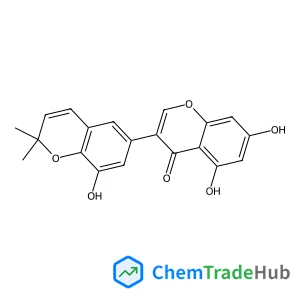
5,7,8'-Trihydroxy-2',2'-dimethyl-2'H,4H-3,6'-bichromen-4-one
CAS Number:
129280-33-7
Molecular Formula:
C20H16O6
Recommended Suppliers





Disclaimer
This page provides academic journal information for reference and research purposes only. We are not affiliated with any journal publishers and do not handle publication submissions. For publication-related inquiries, please contact the respective journal publishers directly.
If you notice any inaccuracies in the information displayed, please contact us at support@chemtradehub.com. We will promptly review and address your concerns.