












Synthesis of bi- and tricyclic arylboronates via Cp*RuCl-catalyzed cycloaddition of α,ω-diynes with ethynylboronate
Literature Information
Publication Date
2005-08-05
DOI
10.1039/B506977G
Impact Factor
6.222
Authors
Yoshihiko Yamamoto, Kozo Hattori, Jun-ichi Ishii, Hisao Nishiyama, Kenji Itoh
View Original
Abstract
In the presence of 5–10 mol% Cp*RuCl(cod), 1,6- and 1,7-diynes were allowed to react with an ethynylboronate at ambient temperature to give rise to bi- and tricyclic arylboronates in 64–93% isolated yields.
Related Literature
Comparative analysis of ethanol dynamics in aqueous and non-aqueous solutions
Ivo Jukić, Martina Požar, Bernarda Lovrinčević
2020-09-24
Paper
DOI: 10.1039/D0CP03160G
Excellent thermoelectric properties of monolayer RbAgM (M = Se and Te): first-principles calculations
Jinjie Gu, Xilong Qu
2020-10-23
Paper
DOI: 10.1039/D0CP04565A
Structure–property relationships in multi-stimuli responsive BODIPY-biphenyl-benzodithiophene TICT rigidochromic rotors exhibiting (pseudo-)Stokes shifts up to 221 nm
Sushil Sharma, Zimu Wei, Ferdinand C. Grozema, Sanchita Sengupta
2020-10-15
Paper
DOI: 10.1039/D0CP04579A
Micro-solvation of CO in water: infrared spectra and structural calculations for (D2O)2–CO and (D2O)3–CO
A. J. Barclay, A. Pietropolli Charmet, K. H. Michaelian, A. R. W. McKellar, N. Moazzen-Ahmadi
2019-11-21
Paper
DOI: 10.1039/C9CP05480D
Kinetic study of the OH + HO2 → H2O + O2 reaction using ring polymer molecular dynamics and quantum dynamics
Yang Liu, Hongwei Song, Jun Li
2020-09-28
Paper
DOI: 10.1039/D0CP04120C
Disorder–order and order–order phase transformations in Ta5C4 phases predicted using the evolutionary algorithm and symmetry analysis
M. G. Kostenko, A. I. Gusev
2020-09-24
Paper
DOI: 10.1039/D0CP03842C
Atomistic origins of charge traps in CdSe nanoclusters
Natalia Bushlanova, Yurii Uspenskii
2020-10-30
Paper
DOI: 10.1039/D0CP05139J
DNA-binding mechanisms of human and mouse cGAS: a comparative MD and MM/GBSA study
Honghui Zhang, Wenjin Li
2020-10-24
Paper
DOI: 10.1039/D0CP04162A
Silica based ionogels: interface effects with aprotic and protic ionic liquids with lithium
Angélique Marie, Bilel Said, Anne Galarneau, Timo Stettner, Andrea Balducci, Maxime Bayle, Bernard Humbert, Jean Le Bideau
2020-10-02
Paper
DOI: 10.1039/D0CP03599H
Synthesis and characterization of a strong ferromagnetic and high hardness intermetallic compound Fe2B
Xingbin Zhao, Li Li, Kuo Bao, Pinwen Zhu, Qiang Tao, Shuailing Ma, Bo Liu, Yufei Ge, Da Li
2020-10-22
Paper
DOI: 10.1039/D0CP03380D
You might also like
Compound Q&A
How should waste containing 2-Ethyl-4-Methyl-1H-Imidazole-5-Carbaldehyde (CAS: 88634-80-4) be handled?
Waste containing 2-Ethyl-4-Methyl-1H-Imidazole-5-Carbaldehyde (CAS: 88634-80-4) ...
88634-80-42-Ethyl-4-Methyl-1H-...
Compound Q&A
What industries use Triethoxy(octyl)silane (CAS: 1385031-14-0)?
Triethoxy(octyl)silane (CAS: 1385031-14-0) is widely used in the pharmaceuticals...
1385031-14-0Triethoxy(octyl)sila...
Compound Q&A
Are there alternatives to 3-iodo-7-nitro-1H-indazole (CAS: 864724-64-1) in synthesis?
Several alternatives to 3-iodo-7-nitro-1H-indazole (CAS: 864724-64-1) exist in t...
864724-64-13-iodo-7-nitro-1H-in...
Compound Q&A
Are there alternatives to Benzene, bis[(trimethoxysilyl)ethyl] (CAS: 266317-71-9) in synthesis?
Yes, there are alternatives to Benzene, bis[(trimethoxysilyl)ethyl] (CAS: 266317...
266317-71-9Benzene, bis[(trimet...
Compound Q&A
Is Isothiazole-3-carbonitrile (CAS: 1452-17-1) safe?
Isothiazole-3-carbonitrile (CAS: 1452-17-1) is generally considered safe when us...
1452-17-1Isothiazole-3-carbon...
Compound Q&A
Is (3-Chlorophenyl)methanol (CAS: 873-63-2) safe?
(3-Chlorophenyl)methanol (CAS: 873-63-2) is considered low to moderately toxic. ...
873-63-2(3-Chlorophenyl)meth...
Compound Q&A
How is (2S,3S)-2-Hydroxy-3-({[(2-methyl-2-propanyl)oxy]carbonyl}amino)-3-(2-naphthyl)propanoic acid (CAS: 959583-98-3) typically synthesized?
(2S,3S)-2-Hydroxy-3-({[(2-methyl-2-propanyl)oxy]carbonyl}amino)-3-(2-naphthyl)pr...
959583-98-3(2S,3S)-2-Hydroxy-3-...
Compound Q&A
What precautions should be taken when handling Methyl 2-(bromomethyl)-5-methoxybenzoate (CAS: 788081-99-2)?
Proper handling of methyl 2-(bromomethyl)-5-methoxybenzoate requires the use of ...
788081-99-2Methyl 2-(bromomethy...
Compound Q&A
What is 6,8-Dibromoimidazo[1,2-a]pyridine-2-carboxylic acid (CAS: 904805-36-3)?
6,8-Dibromoimidazo[1,2-a]pyridine-2-carboxylic acid (CAS: 904805-36-3) is an aro...
904805-36-36,8-Dibromoimidazo[1...
Compound Q&A
Is 3-Amino-5-bromo-2-pyridinecarbonitrile (CAS: 573675-27-1) safe?
3-Amino-5-bromo-2-pyridinecarbonitrile is considered safe when handled under pro...
573675-27-13-Amino-5-bromo-2-py...
Source Journal
Chemical Communications

CiteScore:
8.6
Self-citation Rate:
4.7%
Articles per Year:
2458
ChemComm publishes urgent research which is of outstanding significance and interest to experts in the field, while also appealing to the journal’s broad chemistry readership. Our communication format is ideally suited to short, urgent studies that are of such importance that they require accelerated publication. Our scope covers all topics in chemistry, and research at the interface of chemistry and other disciplines (such as materials science, nanoscience, physics, engineering and biology) where there is a significant novelty in the chemistry aspects. Major topic areas covered include: Analytical Chemistry Catalysis Chemical Biology and medicinal chemistry Computational Chemistry and Machine Learning Energy and sustainable chemistry Environmental Chemistry Green Chemistry Inorganic Chemistry Materials Chemistry Nanoscience Organic Chemistry Physical Chemistry Polymer Chemistry Supramolecular Chemistry
Recommended Compounds
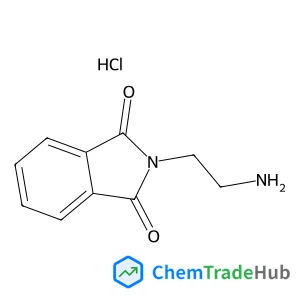
2-(2-Aminoethyl)-1H-isoindole-1,3(2H)-dione hydrochloride (1:1)
CAS Number:
30250-67-0
Molecular Formula:
C10H11ClN2O2
Recommended Suppliers




Disclaimer
This page provides academic journal information for reference and research purposes only. We are not affiliated with any journal publishers and do not handle publication submissions. For publication-related inquiries, please contact the respective journal publishers directly.
If you notice any inaccuracies in the information displayed, please contact us at support@chemtradehub.com. We will promptly review and address your concerns.