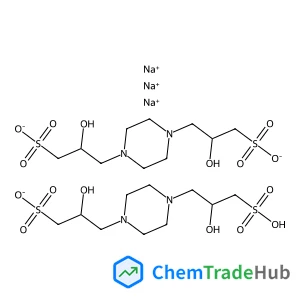
3,3'-(Piperazine-1,4-diyl)bis(2-hydroxypropane-1-sulfonic acid) Sodium Salt
CAS Number:
108321-08-0
Molecular Formula:
C20H41N4Na3O16S4
Alexander W. Jackson, Christopher Stakes, David A. Fulton
Reversible addition-fragmentation chain transfer (RAFT) polymerization has been utilised to prepare diblock copolymer chains possessing ‘inert’ blocks of polystyrene and ‘reactive’ blocks displaying aldehyde or amino functional groups. These polymer chains were shown to cross-link through the formation of imine bonds in organic solvents to form kinetically stable polymer assemblies possessing core-cross-linked star (CCS) polymers architectures which display a size-dependency upon the concentration at which the cross-linking reactions are performed. Evidence was found for the formation of a 2-armed species as a side-product in the formation of CCS polymers. RAFT polymerization was utilised to prepare a series of methacrylate copolymers possessing only ‘reactive’ blocks displaying a significantly lower density of aldehyde and amino functional groups than the diblock copolymers utilized in the formation of CCS polymers. These copolymers were shown to cross-link through the formation of imine bonds in organic solvents to form polymer assemblies possessing nanogel architectures. The lower density of functional groups was required to promote the formation of discrete nanogel assemblies. This cross-linking also displayed a size-dependency upon the concentration at which the cross-linking reactions are performed. Macroscopic gelation of these polymer chains was observed at higher concentrations of the copolymer chains. Both the CCS polymers and nanogels underwent structural reconfiguration to linear polymer chains through component exchange facilitated by trans-imination with a small molecule amine. We speculate that the formation of both the CCS polymers and nanogels is under kinetic control on account of the lack of reversibility of imine bonds in organic solvents.

Advanced Engineering Materials

Angewandte Chemie International Edition

Environmental Toxicology and Pharmacology

Journal of Enzyme inhibition and Medicinal Chemistry

Coloration Technology

Nature Reviews Drug Discovery

Photochemical & Photobiological Sciences

Journal of Medical Biochemistry

Molecules

European Journal of Organic Chemistry
Huacai Yan, Fusheng Li, Qingyu Kong
DOI: 10.1039/D1CP03837K
Xiaozhi Bao, Tian Sun, Yan Liu, Chuan Xu, Weiliang Ma, Junpo Guo, Yun Zheng, Shivananju Bannur Nanjunda, Huating Liu, Zongyu Huang, Shenghuang Lin, Guichuan Xing, Wencai Ren, Qiaoliang Bao, Huaiyu Shao
DOI: 10.1039/D1CP03536C
C. L. Ma, J. Hu
DOI: 10.1039/D1CP02554F
Aleksandr Chernatynskiy, Xiao-Feng Zhao
DOI: 10.1039/D1CP03544D
Masahiro Shimizu, Atsuhito Nakahigashi, Susumu Arai
DOI: 10.1039/D1CP02895B
J. F. Vianna, K. S. Bezerra, A. H. Lima Costa, E. D. Barbosa, J. X. Lima Neto, J. I. N. Oliveira, V. N. Freire, U. L. Fulco
DOI: 10.1039/D1CP02853G
Murilo S. Marques, Vinicius F. Hernandes, José Rafael Bordin
DOI: 10.1039/D1CP00751C
Yasuhiko Sato, Hiroshi Yao
DOI: 10.1039/D1CP02106K
Davide Fioravanti, Giovanni Barcaro, Alessandro Fortunelli
DOI: 10.1039/D1CP03583E
Boris V. Merinov, Sergey I. Morozov
DOI: 10.1039/D1CP00757B
3-Fluoro-2-methylbenzylamine is an organic compound with the CAS number 771573-3...
Tert-butyl 2-(oxetan-3-ylidene)acetate is considered safe for its intended uses ...
Proper personal protective equipment (PPE) such as gloves, goggles, and a lab co...
2-Ethyl-4-methyl-1,3-thiazole is commonly synthesized via the reaction of thiour...
This compound should be stored in a cool, dry place away from direct sunlight an...
L-Lysine Acetate Salt (CAS: 52315-92-1) is subject to various regulatory guideli...
6-Fluoro-3-hydroxy-2-pyrazinecarboxamide (CAS: 259793-96-9) is generally conside...
1,1'-Sulfonylbis(1H-imidazole) is a crystalline solid with a molecular weight of...
4-Methyl-7-nitro-1H-indole-3-carbonitrile (CAS: 289483-82-5) is primarily used i...
Waste containing 5-Bromo-3-indolyl-beta-galactoside (CAS: 97753-82-7) should be ...

Polymer Chemistry welcomes submissions in all areas of polymer science that have a strong focus on macromolecular chemistry. Manuscripts may cover a broad range of fields, yet no direct application focus is required.
![O-Benzyl-N-[(9H-fluoren-9-ylmethoxy)carbonyl]-N-methyl-L-threonine structure](https://static.chemtradehub.com/structs/198/198561-81-8-a56e.webp "O-Benzyl-N-[(9H-fluoren-9-ylmethoxy)carbonyl]-N-methyl-L-threonine structure")
![1,1'-[(E)-1,2-Ethenediyl]bis(4-bromobenzene) structure](https://static.chemtradehub.com/structs/188/18869-30-2-c907.webp "1,1'-[(E)-1,2-Ethenediyl]bis(4-bromobenzene) structure")