












A facile one-step synthesis to ionic liquid-based cross-linked polymeric nanoparticles and their application for CO2 fixation
Literature Information
Publication Date
2011-07-21
DOI
10.1039/C1PY00201E
Impact Factor
5.582
Authors
Yubing Xiong, Yujiao Wang, Hong Wang, Rongmin Wang
View Original
Abstract
Highly cross-linked polymeric nanoparticles (CLPNs) were prepared via a facile one-step synthesis, and these nanoparticles are effective catalysts for CO2 cycloaddition with epoxides. In this study, CLPNs were synthesized by radical copolymerization of 4-vinylbenzyl-tributylphosphorous chloride (PIL) and ethylene glycol dimethacrylate (EGDMA) in selective solvent, such as C1∼C5 alcohols. The results revealed that spherical nanoparticles with the mean diameter range of 10–100 nm could be prepared in these alcohols, and the size of the CLPNs could be facilely tuned by the feed ratio of EGDMA to PIL. The CLPNs were characterized using dynamic light scattering, scanning electron microscopy, transmission electron microscopy, atomic force microscopy, thermogravimetric analysis, atom absorbance spectrometry, and Fourier transform infrared spectroscopy techniques. In addition, CLPNs can be exploited as highly active and selective catalyst for the cycloaddition of CO2 to epoxides. The effects of parameters, such as reaction temperature, pressure, reaction time, and catalyst amount, on the cycloaddition reaction were investigated. As a result, excellent yield (100%) and selectivity (100%) of cyclic carbonates could be achieved under mild conditions (0.1 g CLPNs, 3.0 MPa CO2, 140 °C and 3 h) without the addition of any solvents or co-catalysts. Unexpectedly, the CLPNs could be dispersed in the products homogeneously, which resulted in the extremely high activity and selectivity. At the same time, the CLPNs could be easily separated by filtration after pouring the reaction mixture into toluene. CLPNs could be recycled six times with less than 1.5% loss of catalytic activity.
Related Literature
Excited states of modified oxygen-deficient centers and Si quantum dots in Gd-implanted silica glasses: emission dynamics and lifetime distributions
A. F. Zatsepin, Yu. A. Kuznetsova, E. S. Trofimova, V. A. Pustovarov
2021-09-24
Paper
DOI: 10.1039/D1CP03826E
Phase analysis of tungsten and phonon behavior of beryllium layers in W/Be periodic multilayers
Niranjan Kumar, Roman S. Pleshkov, Aleksey V. Nezhdanov, Vladimir N. Polkovnikov, Nikolay I. Chkhalo, Aleksandr I. Mashin
2021-09-21
Paper
DOI: 10.1039/D1CP02815D
A graphene–Mo2C heterostructure for a highly responsive broadband photodetector
Xiaozhi Bao, Tian Sun, Yan Liu, Chuan Xu, Weiliang Ma, Junpo Guo, Yun Zheng, Shivananju Bannur Nanjunda, Huating Liu, Zongyu Huang, Shenghuang Lin, Guichuan Xing, Wencai Ren, Qiaoliang Bao, Huaiyu Shao
2021-09-15
Paper
DOI: 10.1039/D1CP03536C
Polariton induced conical intersection and berry phase
Marwa H. Farag, Arkajit Mandal
2021-07-19
Paper
DOI: 10.1039/D1CP00943E
Formation of dimethyl carbonate via direct esterification of CO2 with methanol on reduced or stoichiometric CeO2(111) and (110) surfaces
Jian Jiang, Chris M. Marin, Avinash Kumar Both, Chin Li Cheung, Lei Li, Xiao Cheng Zeng
2021-07-19
Paper
DOI: 10.1039/D1CP02152D
Electrically tunable band gap in strained h-BN/silicene van der Waals heterostructures
Douglas D. de Vargas, Rogério J. Baierle
2021-08-03
Paper
DOI: 10.1039/D1CP02012A
Mechanical properties and thermal conductivity of newly introduced graphene-like borophanes: a reactive molecular dynamics study
2021-08-02
Paper
DOI: 10.1039/D1CP01831K
Dissolution kinetics of a sodium borosilicate glass in Tris buffer solutions: impact of Tris concentration and acid (HCl/HNO3) identity
Nicholas Stone-Weiss, Nicholas J. Smith, Randall E. Youngman, Eric M. Pierce, Ashutosh Goel
2021-07-08
Paper
DOI: 10.1039/D0CP06425D
Strain engineering of polar optical phonon scattering mechanism – an effective way to optimize the power-factor and lattice thermal conductivity of ScN
Man Hea Kim, Carlos Baldo, III, Yan Wang, Mahalakshmi Sahasranaman
2021-09-27
Paper
DOI: 10.1039/D1CP02971A
Intercalation/deintercalation of solvated Mg2+ into/from graphite interlayers
Masahiro Shimizu, Atsuhito Nakahigashi, Susumu Arai
2021-07-27
Paper
DOI: 10.1039/D1CP02895B
You might also like
Compound Q&A
What is 3-Fluoro-2-methylbenzylamine (CAS: 771573-36-5)?
3-Fluoro-2-methylbenzylamine is an organic compound with the CAS number 771573-3...
771573-36-53-Fluoro-2-methylben...
Compound Q&A
Is Tert-butyl 2-(oxetan-3-ylidene)acetate (CAS: 1207175-03-8) safe?
Tert-butyl 2-(oxetan-3-ylidene)acetate is considered safe for its intended uses ...
1207175-03-8Tert-butyl 2-(oxetan...
Compound Q&A
What precautions should be taken when handling 4-Acetyl-2-fluorobenzonitrile (CAS: 214760-18-6)?
Proper personal protective equipment (PPE) such as gloves, goggles, and a lab co...
214760-18-64-Acetyl-2-fluoroben...
Compound Q&A
How is 2-Ethyl-4-methyl-1,3-thiazole (CAS: 15679-12-6) typically synthesized?
2-Ethyl-4-methyl-1,3-thiazole is commonly synthesized via the reaction of thiour...
15679-12-62-Ethyl-4-methyl-1,3...
Compound Q&A
How should 5',5''-([2,2'-Bithiophene]-5,5'-diyl)bis(([1,1':3',1''-terphenyl]-4,4''-dicarboxylic acid)) (CAS: 1227780-71-3) be stored?
This compound should be stored in a cool, dry place away from direct sunlight an...
1227780-71-35',5''''-([2,2'-Bith...
Compound Q&A
What regulatory guidelines apply to L-Lysine Acetate Salt (CAS: 52315-92-1)?
L-Lysine Acetate Salt (CAS: 52315-92-1) is subject to various regulatory guideli...
52315-92-1L-LYSINE ACETATE SAL...
Compound Q&A
Is 6-Fluoro-3-hydroxy-2-pyrazinecarboxamide (CAS: 259793-96-9) safe?
6-Fluoro-3-hydroxy-2-pyrazinecarboxamide (CAS: 259793-96-9) is generally conside...
259793-96-96-Fluoro-3-hydroxy-2...
Compound Q&A
What are the physical and chemical properties of 1,1'-Sulfonylbis(1H-imidazole) (CAS: 7189-69-7)?
1,1'-Sulfonylbis(1H-imidazole) is a crystalline solid with a molecular weight of...
7189-69-71,1'-Sulfonylbis(1H-...
Compound Q&A
What industries use 4-methyl-7-nitro-1H-indole-3-carbonitrile (CAS: 289483-82-5)?
4-Methyl-7-nitro-1H-indole-3-carbonitrile (CAS: 289483-82-5) is primarily used i...
289483-82-54-methyl-7-nitro-1H-...
Compound Q&A
How should waste containing 5-Bromo-3-indolyl-beta-galactoside (CAS: 97753-82-7) be handled?
Waste containing 5-Bromo-3-indolyl-beta-galactoside (CAS: 97753-82-7) should be ...
97753-82-75-Bromo-3-indolyl-be...
Source Journal
Polymer Chemistry

CiteScore:
8.6
Self-citation Rate:
7.3%
Articles per Year:
457
Polymer Chemistry welcomes submissions in all areas of polymer science that have a strong focus on macromolecular chemistry. Manuscripts may cover a broad range of fields, yet no direct application focus is required.
Recommended Compounds
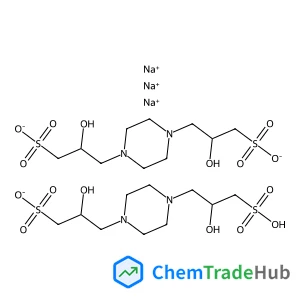
3,3'-(Piperazine-1,4-diyl)bis(2-hydroxypropane-1-sulfonic acid) Sodium Salt
CAS Number:
108321-08-0
Molecular Formula:
C20H41N4Na3O16S4
Recommended Suppliers



Disclaimer
This page provides academic journal information for reference and research purposes only. We are not affiliated with any journal publishers and do not handle publication submissions. For publication-related inquiries, please contact the respective journal publishers directly.
If you notice any inaccuracies in the information displayed, please contact us at support@chemtradehub.com. We will promptly review and address your concerns.