











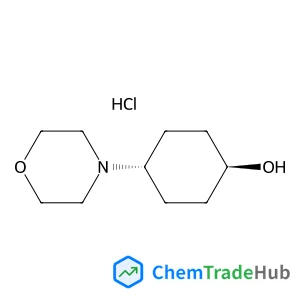
trans-4-(4-Morpholinyl)cyclohexanol hydrochloride (1:1)
CAS Number:
1588441-09-1
Molecular Formula:
C10H20ClNO2
Man Hea Kim, Carlos Baldo, III, Yan Wang, Mahalakshmi Sahasranaman
The tug-of-war between the thermoelectric power factor and the figure-of-merit complicates thermoelectric material selection, particularly for mid-to-high temperature thermoelectric materials. Approaches to reduce lattice thermal conductivity while maintaining a high-power factor are crucial in thermoelectric applications. Using strain engineering, we comprehensively investigated the microscopic mechanisms influencing the lattice thermal conductivity in this study. Scandium nitride (ScN) was chosen for this purpose since it has recently been discovered to be a potential mid-to-high temperature thermoelectric material. Our precise DFT+U calculations showed the exact electronic direct and indirect band gaps in ScN, which was subsequently subjected to compressive and tensile volume strain (up to 2%) within the crystal structure. Relevant thermoelectric properties such as Seebeck coefficient and electrical conductivity were obtained from both strained and unstrained ScN, whilst incorporating three key scattering sources, namely, ionized impurity (IMP), acoustic deformation potential (ADP), and polar optical phonon (POP). Based on the calculated scattering rates, we found that a POP scattering source is the dominant scattering mechanism that has a significant impact on transport properties at high temperatures. Our study revealed that modifying this POP scattering mechanism through strain in ScN has a considerable impact on the variation of lattice thermal conductivity without much reduction in the thermoelectric power factor values. A detailed description was provided with a focus on understanding the effects of strain on the scattering rates and thermoelectric properties of ScN.
Dat Tien Hoang, Selim Alayoglu, Zhi Liu
DOI: 10.1039/C0CP01858A
Cui Yu, Hongmei Liu, Wenbin Ni, Nengyue Gao, Jianwei Zhao, Haoli Zhang
DOI: 10.1039/C0CP01026J
Chunyan Sun, Chuncheng Chen, Wanhong Ma, Jincai Zhao
DOI: 10.1039/C0CP01203C
Igor Leontyev, Alexei Stuchebrukhov
DOI: 10.1039/C0CP01971B
S. Auluck, I. V. Kityk
DOI: 10.1039/C0CP01601B
William O. Oduro, Nick Cailuo, Kai Man K. Yu, Hongwei Yang, Shik Chi Tsang
DOI: 10.1039/C0CP01832E
John Janiak, Lennart Piculell, Gerd Olofsson, Karin Schillén
DOI: 10.1039/C0CP01031F
Ewa Kurach, David Djurado, Jan Rimarčik, Aleksandra Kornet, Marek Wlostowski, Vladimir Lukeš, Jacques Pécaut, Malgorzata Zagorska, Adam Pron
DOI: 10.1039/C0CP01553A
Ilkeun Lee, Manuel A. Albiter, Qiao Zhang, Jianping Ge, Yadong Yin, Francisco Zaera
DOI: 10.1039/C0CP01688H
Uwe Hahn, Francesca Setaro, Xavier Ragàs, Angus Gray-Weale, Santi Nonell, Tomas Torres
DOI: 10.1039/C0CP01015D
Ethyl 4-chlorothieno[2,3-b]pyridine-5-carboxylate (CAS: 59713-58-5) can be synth...
5-Methyl-1H-indole-3-carbaldehyde (CAS: 52562-50-2) is subject to various regula...
(1,3-Dimethyl-2,4-dioxo-1,2,3,4-tetrahydro-5-pyrimidinyl)boronic acid is a white...
Waste containing Sulfocostunolide A (CAS: 1016983-51-9) should be handled with c...
When handling Murraxocin (CAS: 88478-44-8), ensure proper personal protective eq...
Formvar (CAS: 63148-64-1) is an alkyd resin characterized by a high molecular we...
(S)-4-benzyl-2-((benzyloxy)methyl)morpholine is generally safe when handled with...
Methyl 1-(5-bromo-2-pyrimidinyl)cyclopropanecarboxylate (CAS: 1447607-69-3) is p...
2-Methyl-1-phenyl-1-propanamine hydrochloride (CAS: 24290-47-9) is generally con...
3-(4-Bromophenyl)-2-methylpropanoic acid is synthesized through a multi-step pro...

Physical Chemistry Chemical Physics (PCCP) is an international journal co-owned by 19 physical chemistry and physics societies from around the world. This journal publishes original, cutting-edge research in physical chemistry, chemical physics and biophysical chemistry. To be suitable for publication in PCCP, articles must include significant innovation and/or insight into physical chemistry; this is the most important criterion that reviewers and Editors will judge against when evaluating submissions. The journal has a broad scope and welcomes contributions spanning experiment, theory, computation and data science. Topical coverage includes spectroscopy, dynamics, kinetics, statistical mechanics, thermodynamics, electrochemistry, catalysis, surface science, quantum mechanics, quantum computing and machine learning. Interdisciplinary research areas such as polymers and soft matter, materials, nanoscience, energy, surfaces/interfaces, and biophysical chemistry are welcomed if they demonstrate significant innovation and/or insight into physical chemistry. Joined experimental/theoretical studies are particularly appreciated when complementary and based on up-to-date approaches.
![Imidazo[1,5-a]pyrazine structure](https://static.chemtradehub.com/structs/274/274-49-7-d749.webp "Imidazo[1,5-a]pyrazine structure")
![2-(Methylsulfonyl)-2,4,5,6-tetrahydropyrrolo[3,4-c]pyrazole structure](https://static.chemtradehub.com/structs/122/1226781-80-1-09d5.webp "2-(Methylsulfonyl)-2,4,5,6-tetrahydropyrrolo[3,4-c]pyrazole structure")





