












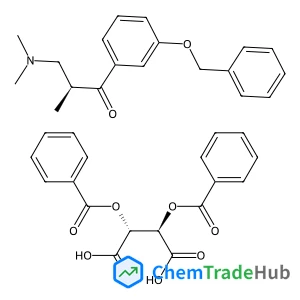
(S)-1-(3-(Benzyloxy)phenyl)-3-(dimethylamino)-2-methylpropan-1-one (2r,3r)-2,3-bis(benzoyloxy)succinate
CAS Number:
1004315-81-4
Molecular Formula:
C37H37NO10
Weitao Yang
The efficiency of the numerical propagators for solving the time-dependent Schrödinger equation in the wave packet approach to reactive scattering is of vital importance. In this Perspective, we first briefly review the propagators used in quantum reactive scattering calculations and their applications to triatomic reactions. Then we present a detailed comparison of about thirty higher-order split operator propagators for solving the Schrödinger equation with their applications to the wave packet evolution within a one-dimensional Morse potential, and the total reaction probability calculations for the H + HD, H + NH, H + O2, and F + HD reactions. These four triatomic reactions have quite different dynamic characteristics and thus provide a comprehensive picture of the relative advantages of these higher-order propagation methods for describing reactive scattering dynamics. Our calculations reveal that the most often used second-order split operator method is typically more efficient for a direct reaction, particularly for those involving flat potential energy surfaces. However, the optimal higher-order split operator methods are more suitable for a reaction with resonances and intermediate complexes or a reaction experiencing potential energy surface with fluctuations of considerable amplitude. Three 4th-order and one 6th-order split operator methods, which are most efficient for solving reactive scattering in various conditions among the tested ones, are recommended for general applications. In addition, a brief discussion on the relative performance between the Chebyshev real wave packet method and the split operator method is given. The results in this Perspective are expected to stimulate more applications of (high-order) split operators to the quantum reactive scattering calculation and other related problems.
Ahmad Nuruddin, Muhammad Iqbal, Hutomo Suryo Wasisto
DOI: 10.1039/D3TB01327H
Marrium Saeed, Urooj Kamran, Amina Khan, Md Irfanul Haque Siddiqui, Hasan Jamal, Haq Nawaz Bhatti
DOI: 10.1039/D3NJ04133F
Chang-Mou Wu, Kebena Gebeyehu Motora, Pankaj Koinkar, Akihiro Furube
DOI: 10.1039/D3NJ04410F
Qiang Wang, Zhen Pei, Zhipeng He, Wei Guo, Lingna Han
DOI: 10.1039/D3TB01731A
Madhumita Bhar, Nayan Bhunia, Prasun Mukherjee
DOI: 10.1039/D3NJ04206E
Mohamed Saadi, Imen Dakhlaoui, Fadhel Hajlaoui, Nidhal Drissi, Mustapha Zighrioui, Fethi Jomni, Nathalie Audebrand, Marie Cordier
DOI: 10.1039/D3NJ04819E
Zheng Li, Jia Wan, Wanbo Zhu, Yingjie Wang, Yuan Chen, Baoliang Lu, Junchen Zhu, Chen Zhu, Xianzuo Zhang
DOI: 10.1039/D3TB01830J
Jammu Ravi, N. R. Jawahar
DOI: 10.1039/D3NJ02840B
6-(3-Fluorophenyl)picolinic acid is generally considered safe for laboratory use...
(3R)-3-Pyrrolidinol is used in the pharmaceutical industry as a precursor for dr...
When handling (4R,5R)-4,5-Diethoxycarbonyl-2,2-dimethyldioxolane (CAS: 59779-75-...
1-(6-Chloroimidazo[1,2-b]pyridazin-3-yl)ethanone is often synthesized via a mult...
The market for N-Ethyl-3,4-dimethylbenzylamine (CAS: 39180-83-1) remains steady,...
Tert-butyl 3-(pyrrolidin-1-yl)azetidine-1-carboxylate is a chemical compound wit...
1-Bromo-3-chloro-2,4-dimethoxybenzene (CAS: 1228956-93-1) falls under the classi...
The safety of 8-Bromo-2-methyl-3,4-dihydroisoquinolin-1(2H)-one (CAS: 1368622-07...
Benzyl [(3S)-2,6-dioxo-3-piperidinyl]carbamate is generally safe when handled wi...
1-{[4-(4,4,5,5-Tetramethyl-1,3,2-dioxaborolan-2-yl)phenyl]sulfonyl}pyrrolidine s...

Physical Chemistry Chemical Physics (PCCP) is an international journal co-owned by 19 physical chemistry and physics societies from around the world. This journal publishes original, cutting-edge research in physical chemistry, chemical physics and biophysical chemistry. To be suitable for publication in PCCP, articles must include significant innovation and/or insight into physical chemistry; this is the most important criterion that reviewers and Editors will judge against when evaluating submissions. The journal has a broad scope and welcomes contributions spanning experiment, theory, computation and data science. Topical coverage includes spectroscopy, dynamics, kinetics, statistical mechanics, thermodynamics, electrochemistry, catalysis, surface science, quantum mechanics, quantum computing and machine learning. Interdisciplinary research areas such as polymers and soft matter, materials, nanoscience, energy, surfaces/interfaces, and biophysical chemistry are welcomed if they demonstrate significant innovation and/or insight into physical chemistry. Joined experimental/theoretical studies are particularly appreciated when complementary and based on up-to-date approaches.
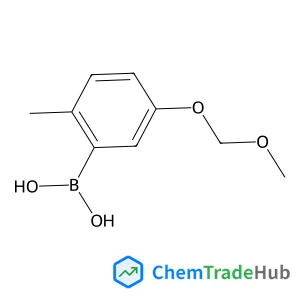
![[1-(5-Methyl-2-pyridinyl)-1H-pyrazol-4-yl]methanol structure](https://static.chemtradehub.com/structs/143/1439822-99-7-6cc9.webp "[1-(5-Methyl-2-pyridinyl)-1H-pyrazol-4-yl]methanol structure")
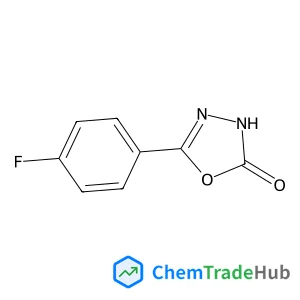
![(3R,4aR,7aS,9aR,10S,11R,13aR,13bS,15aS,15bR)-3,11-Dihydroxy-10-(hydroxymethyl)-4,4,7a,10,13a,15b-hexamethyl-1,2,3,4,4a,7,7a,8,9,9a,10,11,12,13,13a,13b,14,15,15a,15b-icosahydro-5H-naphtho[2',1':4,5]cyc
lohepta[1,2-a]naphthalen-5-one structure](https://static.chemtradehub.com/structs/538/53800-21-8-9f18.webp "(3R,4aR,7aS,9aR,10S,11R,13aR,13bS,15aS,15bR)-3,11-Dihydroxy-10-(hydroxymethyl)-4,4,7a,10,13a,15b-hexamethyl-1,2,3,4,4a,7,7a,8,9,9a,10,11,12,13,13a,13b,14,15,15a,15b-icosahydro-5H-naphtho[2',1':4,5]cyc
lohepta[1,2-a]naphthalen-5-one structure")


