












Diglycolamic acid for the mutual separation of lanthanides and actinides from dilute nitric acid solution: solvent extraction, dynamic light scattering, and spectroscopic investigations
Literature Information
Publication Date
2023-11-22
DOI
10.1039/D3NJ02840B
Impact Factor
3.591
Authors
Jammu Ravi, N. R. Jawahar
View Original
Abstract
N,N-Dialkyl diglycolamic acid (HDRDGA) derivatives with alkyl groups varying from n-hexyl to n-dodecyl were synthesized, and the promising ligands such as N,N-dioctyl diglycolamic acid (HDODGA) and N,N-didecyl diglycolamic acid (HD2DGA) were investigated for the mutual separation of trivalent lanthanides and actinides from dilute nitric acid solution. Since diglycolamic acid is strongly polar, it was dissolved in a traditional diluent, n-dodecane, with the help of an isodecyl alcohol (IDA) phase modifier. Nevertheless, the hexyl and didodecyl derivatives were sparingly soluble even in the presence of 30% (v/v) IDA in n-dodecane, and therefore, the extraction behavior of the lanthanide and actinide representatives, Eu(III) and Am(III), respectively, was studied only in a solution of HDODGA or HD2DGA present in 30% (v/v) IDA/n-dodecane. The cation-exchange mechanism of extraction and the stoichiometry of trivalent metal to HDRDGA were elucidated from the slope analysis of the extraction data. Since the stoichiometry of the metal to ligand complex in the organic phase was unusually varied from 1 : 3 to 1 : 6 depending upon the Nd(III) loading into the organic phase, the reverse micellar aggregation behavior and the coordination chemistry of Nd(III) in the organic phase were probed by dynamic light scattering and visible spectroscopy, respectively. The results revealed that three molecules of anionic DRDGA were coordinated to Nd(III) in the inner-sphere at lower metal concentrations, and also three more molecules of HDRDGA in the outer-sphere at higher metal concentrations. The good separation factor achieved with the use of these ligands showed their potential ability to separate lanthanides from actinides in nitric acid medium.
Recommended Journals
Related Literature
Charging assisted structural phase transitions in monolayer InSe
Liangzhi Kou, Aijun Du, Yandong Ma, Ting Liao, Changfeng Chen
2017-07-27
Paper
DOI: 10.1039/C7CP04469K
How active sites facilitate charge-transfer interactions of silver and gold clusters with TCNQ?
Jing Chen, Zhixun Luo, Jiannian Yao
2017-07-25
Paper
DOI: 10.1039/C7CP02538F
Excited state dynamics and conformations of a Cu(ii)-phthalocyanine-perylenebisimide dyad
K. Wilma, T. Unger, M. Hollfelder, C. Hunger, A. Lang, A. G. Gürek, S. Gekle, R. Hildner
2017-08-04
Paper
DOI: 10.1039/C7CP04026A
Novel multiple phosphorescence in nanostructured zinc oxide and calculations of correlated colour temperature
Sagnik Das, Uttam Kumar Ghorai, Rajib Dey, Chandan Kumar Ghosh, Mrinal Pal
2017-08-08
Paper
DOI: 10.1039/C7CP03631K
Interpenetration of CH3NH3PbI3 and TiO2 improves perovskite solar cells while TiO2 expansion leads to degradation
A. Kovalsky, Y. C. Wang, L. L. Wang, S. Goldberg, W. L. Kao, C. Y. Wu, H. Y. Chang, J. J. Shyue
2017-07-18
Paper
DOI: 10.1039/C7CP03116E
Redox titration of gold and platinum surface oxides at porous microelectrodes
Mareike Haensch, Luis Balboa, Alexander Dyck, Gunther Wittstock
2017-08-09
Paper
DOI: 10.1039/C7CP04589A
Cold atom–atom–ion three-body recombination of 4He–4He–X− (X = H or D)
Bin-Bin Wang, Yong-Chang Han, Wei Gao, Shu-Lin Cong
2017-08-03
Paper
DOI: 10.1039/C7CP04310D
A soluble star-shaped silsesquioxane-cored polymer—towards novel stabilization of pH-dependent high internal phase emulsions
Jun Peng, Kai Xu, Mingcai Chen
2017-08-09
Paper
DOI: 10.1039/C7CP03325G
Solvent effects on the excited-state double proton transfer mechanism in the 7-azaindole dimer: a TDDFT study with the polarizable continuum model
Xue-fang Yu, Shohei Yamazaki, Tetsuya Taketsugu
2017-08-01
Paper
DOI: 10.1039/C7CP04942K
You might also like
Compound Q&A
Is 6-(3-Fluorophenyl)picolinic acid (CAS: 887982-40-3) safe?
6-(3-Fluorophenyl)picolinic acid is generally considered safe for laboratory use...
887982-40-36-(3-Fluorophenyl)pi...
Compound Q&A
What industries use (3R)-3-Pyrrolidinol (CAS: 2799-21-5)?
(3R)-3-Pyrrolidinol is used in the pharmaceutical industry as a precursor for dr...
2799-21-5(3R)-3-Pyrrolidinol
Compound Q&A
What precautions should be taken when handling (4R,5R)-4,5-Diethoxycarbonyl-2,2-dimethyldioxolane (CAS: 59779-75-8)?
When handling (4R,5R)-4,5-Diethoxycarbonyl-2,2-dimethyldioxolane (CAS: 59779-75-...
59779-75-8(4R,5R)-4,5-Diethoxy...
Compound Q&A
How is 1-(6-Chloroimidazo[1,2-b]pyridazin-3-yl)ethanone (CAS: 90734-71-7) typically synthesized?
1-(6-Chloroimidazo[1,2-b]pyridazin-3-yl)ethanone is often synthesized via a mult...
90734-71-71-(6-Chloroimidazo[1...
Compound Q&A
What is the market or research trend for N-Ethyl-3,4-dimethylbenzylamine (CAS: 39180-83-1)?
The market for N-Ethyl-3,4-dimethylbenzylamine (CAS: 39180-83-1) remains steady,...
39180-83-1N-Ethyl-3,4-dimethyl...
Compound Q&A
What is Tert-butyl 3-(pyrrolidin-1-yl)azetidine-1-carboxylate (CAS: 1019008-21-9)?
Tert-butyl 3-(pyrrolidin-1-yl)azetidine-1-carboxylate is a chemical compound wit...
1019008-21-9Tert-butyl 3-(pyrrol...
Compound Q&A
What regulatory guidelines apply to 1-Bromo-3-chloro-2,4-dimethoxybenzene (CAS: 1228956-93-1)?
1-Bromo-3-chloro-2,4-dimethoxybenzene (CAS: 1228956-93-1) falls under the classi...
1228956-93-11-Bromo-3-chloro-2,4...
Compound Q&A
Is 8-Bromo-2-methyl-3,4-dihydroisoquinolin-1(2H)-one (CAS: 1368622-07-4) safe?
The safety of 8-Bromo-2-methyl-3,4-dihydroisoquinolin-1(2H)-one (CAS: 1368622-07...
1368622-07-48-Bromo-2-methyl-3,4...
Compound Q&A
Is Benzyl [(3S)-2,6-dioxo-3-piperidinyl]carbamate (CAS: 22785-43-9) safe?
Benzyl [(3S)-2,6-dioxo-3-piperidinyl]carbamate is generally safe when handled wi...
22785-43-9Benzyl [(3S)-2,6-dio...
Compound Q&A
How should 1-{[4-(4,4,5,5-Tetramethyl-1,3,2-dioxaborolan-2-yl)phenyl]sulfonyl}pyrrolidine (CAS: 928657-21-0) be stored?
1-{[4-(4,4,5,5-Tetramethyl-1,3,2-dioxaborolan-2-yl)phenyl]sulfonyl}pyrrolidine s...
928657-21-01-{[4-(4,4,5,5-Tetra...
Source Journal
New Journal of Chemistry

CiteScore:
5.3
Self-citation Rate:
3.7%
Articles per Year:
2153
NJC (New Journal of Chemistry) is a broad-based primary journal encompassing all branches of chemistry and its sub-disciplines. It contains full research articles, communications, perspectives and focus articles. This well-established journal, owned by the Centre National de la Recherche Scientifique (CNRS) of France, has been co-published with the Royal Society of Chemistry since January 1998. NJC is the forum for the publication of high-quality, original and significant work that opens new directions in chemistry or other scientific disciplines. In addition to having a significant chemical component, work published in NJC must demonstrate that it will have an impact on areas of research other than that of the reported work.
Recommended Compounds
![(3R,4aR,7aS,9aR,10S,11R,13aR,13bS,15aS,15bR)-3,11-Dihydroxy-10-(hydroxymethyl)-4,4,7a,10,13a,15b-hexamethyl-1,2,3,4,4a,7,7a,8,9,9a,10,11,12,13,13a,13b,14,15,15a,15b-icosahydro-5H-naphtho[2',1':4,5]cyc
lohepta[1,2-a]naphthalen-5-one structure](https://static.chemtradehub.com/structs/538/53800-21-8-9f18.webp "(3R,4aR,7aS,9aR,10S,11R,13aR,13bS,15aS,15bR)-3,11-Dihydroxy-10-(hydroxymethyl)-4,4,7a,10,13a,15b-hexamethyl-1,2,3,4,4a,7,7a,8,9,9a,10,11,12,13,13a,13b,14,15,15a,15b-icosahydro-5H-naphtho[2',1':4,5]cyc
lohepta[1,2-a]naphthalen-5-one structure")
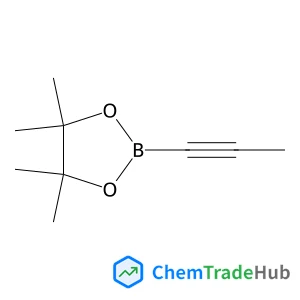
4,4,5,5-Tetramethyl-2-(1-propyn-1-YL)-1,3,2-dioxaborolane
CAS Number:
347389-75-7
Molecular Formula:
C9H15BO2
Recommended Suppliers




Disclaimer
This page provides academic journal information for reference and research purposes only. We are not affiliated with any journal publishers and do not handle publication submissions. For publication-related inquiries, please contact the respective journal publishers directly.
If you notice any inaccuracies in the information displayed, please contact us at support@chemtradehub.com. We will promptly review and address your concerns.