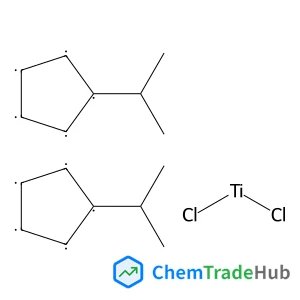
BIS(I-PROPYLCYCLOPENTADIENYL)TITANIUM DICHLORIDE
CAS Number:
12130-65-3
Molecular Formula:
C16H22Cl2Ti
Ahmad Nuruddin, Muhammad Iqbal, Hutomo Suryo Wasisto
This study reports on the modification of surface plasmon resonance (SPR) chips with molybdenum disulfide–molybdenum trioxide (MoS2–MoO3) microflowers to detect the tuberculosis (TB) markers of CFP-10. The MoS2–MoO3 microflowers were prepared by hydrothermal methods with variations in the pH and amount of trisodium citrate (Na3Ct), which were projected to influence the shape and size of microflower particles. The analysis shows that optimum MoS2–MoO3 hybrid microflowers were obtained at neutral pH using 0.5 g Na3Ct. The modified SPR biosensor exhibits a ten times higher response than the bare Au. Moreover, increasing MoS2–MoO3 thickness results in a higher detection response, sensitivity, and a smaller limit of detection (LOD). Using the optimized material composition, the Au/MoS2–MoO3-integrated SPR sensor can demonstrate sensitivity and LOD of 1.005 and 3.45 ng mL−1, respectively. This biosensor also has good selectivity, stability, and reproducibility based on cross-sensitivity characterization with other analytes and repeated measurements on several chips with different storing times and fabrication batch. Therefore, this proposed SPR biosensor possesses high potential to be further developed and applied as a detection technology for CFP-10 in monitoring and diagnosing TB.
Hu Lei, Adam Langlois, Daniel Fortin, Paul-Ludovic Karsenti, Shawkat M. Aly, Pierre D. Harvey
DOI: 10.1039/C7CP04102K
Ibério de P. R. Moreira, Francesc Illas
DOI: 10.1039/C7CP04145D
Debdutta Chakraborty, Ranjita Das, Pratim Kumar Chattaraj
DOI: 10.1039/C7CP02433A
C. Paduani, Andrew M. Rappe
DOI: 10.1039/C7CP02091K
Jiaye Su, Yunzhen Zhao, Chang Fang, Syed Bilal Ahmed, Yue Shi
DOI: 10.1039/C7CP03351F
Ioannis G. Kevrekidis
DOI: 10.1039/C7CP03260A
Zong-You Jiang, Zong-Yan Zhao
DOI: 10.1039/C7CP03796A
J. M. Carnerero, A. Sánchez-Coronilla, E. I. Martín, A. Jimenez-Ruiz, R. Prado-Gotor
DOI: 10.1039/C7CP03692B
Jürgen Bachl, Diego Sampedro, Judith Mayr
DOI: 10.1039/C7CP03529B
Jun Peng, Kai Xu, Mingcai Chen
DOI: 10.1039/C7CP03325G
6-(3-Fluorophenyl)picolinic acid is generally considered safe for laboratory use...
(3R)-3-Pyrrolidinol is used in the pharmaceutical industry as a precursor for dr...
When handling (4R,5R)-4,5-Diethoxycarbonyl-2,2-dimethyldioxolane (CAS: 59779-75-...
1-(6-Chloroimidazo[1,2-b]pyridazin-3-yl)ethanone is often synthesized via a mult...
The market for N-Ethyl-3,4-dimethylbenzylamine (CAS: 39180-83-1) remains steady,...
Tert-butyl 3-(pyrrolidin-1-yl)azetidine-1-carboxylate is a chemical compound wit...
1-Bromo-3-chloro-2,4-dimethoxybenzene (CAS: 1228956-93-1) falls under the classi...
The safety of 8-Bromo-2-methyl-3,4-dihydroisoquinolin-1(2H)-one (CAS: 1368622-07...
Benzyl [(3S)-2,6-dioxo-3-piperidinyl]carbamate is generally safe when handled wi...
1-{[4-(4,4,5,5-Tetramethyl-1,3,2-dioxaborolan-2-yl)phenyl]sulfonyl}pyrrolidine s...
Journal of Materials Chemistry A, B & C cover high quality studies across all fields of materials chemistry. The journals focus on those theoretical or experimental studies that report new understanding, applications, properties and synthesis of materials. The journals have a strong history of publishing quality reports of interest to interdisciplinary communities and providing an efficient and rigorous service through peer review and publication. The journals are led by an international team of Editors-in-Chief and Associate Editors who are all active researchers in their fields. Journal of Materials Chemistry A, B & C are separated by the intended application of the material studied. Broadly, applications in energy and sustainability are of interest to Journal of Materials Chemistry A, applications in biology and medicine are of interest to Journal of Materials Chemistry B, and applications in optical, magnetic and electronic devices are of interest to Journal of Materials Chemistry C. More than one Journal of Materials Chemistry journal may be suitable for certain fields and researchers are encouraged to submit their paper to the journal that they feel best fits for their particular article. Example topic areas within the scope of Journal of Materials Chemistry B are listed below. This list is neither exhaustive nor exclusive. Antifouling coatings Biocompatible materials Bioelectronics Bioimaging Biomimetics Biomineralisation Bionics Biosensors Diagnostics Drug delivery Gene delivery Immunobiology Nanomedicine Regenerative medicine & Tissue engineering Scaffolds Soft robotics Stem cells Therapeutic devices image block All articles published in Journal of Materials Chemistry B from 2019 onwards will be indexed in MEDLINE®. Articles that primarily focus on providing insight into the underlying science and performance of biomaterials within a biological environment are more suited to our companion journal, Biomaterials Science.