



Simulating water with rigid non-polarizable models: a general perspective
Literature Information
Publication Date
2011-09-16
DOI
10.1039/C1CP22168J
Impact Factor
3.676
Authors
Carlos Vega, Jose L. F. Abascal
View Original
Abstract
Over the last forty years many computer simulations of water have been performed using rigid non-polarizable models. Since these models describe water interactions in an approximate way it is evident that they cannot reproduce all of the properties of water. By now many properties for these kinds of models have been determined and it seems useful to compile some of these results and provide a critical view of the successes and failures. In this paper a test is proposed in which 17 properties of water, from the vapour and liquid to the solid phases, are taken into account to evaluate the performance of a water model. A certain number of points between zero (bad agreement) and ten (good agreement) are given for the predictions of each model and property. We applied the test to five rigid non-polarizable models, TIP3P, TIP5P, TIP4P, SPC/E and TIP4P/2005, obtaining an average score of 2.7, 3.7, 4.7, 5.1, and 7.2 respectively. Thus although no model reproduces all properties, some models perform better than others. It is clear that there are limitations for rigid non-polarizable models. Neglecting polarizability prevents an accurate description of virial coefficients, vapour pressures, critical pressure and dielectric constant. Neglecting nuclear quantum effects prevents an accurate description of the structure, the properties of water below 120 K and the heat capacity. It is likely that for rigid non-polarizable models it may not be possible to increase the score in the test proposed here beyond 7.6. To get closer to experiment, incorporating polarization and nuclear quantum effects is absolutely required even though a substantial increase in computer time should be expected. The test proposed here, being quantitative and selecting properties from all phases of water can be useful in the future to identify progress in the modelling of water.
Recommended Journals

Drug Discovery Today

Current Opinion in Colloid & Interface Science

Journal of Saudi Chemical Society

Russian Journal of Bioorganic Chemistry

Russian Chemical Bulletin

Chemical Communications

Russian Journal of Organic Chemistry

New Journal of Chemistry

Russian Journal of Coordination Chemistry

Organic Process Research & Development
Related Literature
Facile hydrothermal synthesis of low generation dendrimer-stabilized gold nanoparticles for in vivo computed tomography imaging applications
Yanhong Xu, Shihui Wen, Jingyi Zhu, Linfeng Zheng, Mingwu Shen, Jinglong Zhao, Guixiang Zhang
2013-01-07
Paper
DOI: 10.1039/C2PY20993D
Phosphonium ionenes from well-defined step-growth polymerization: thermal and melt rheological properties
Sean T. Hemp, Musan Zhang, Mana Tamami, Timothy E. Long
2013-04-23
Paper
DOI: 10.1039/C3PY00365E
Strategy for polymorphic control by enzymatic reaction and antisolvent crystallization: effect of aminoacylase on metastable β-glycine formation
Jen-Chieh Hsueh, Kuan Lin Yeh, Hung Lin Lee, Tu Lee
2021-09-21
Paper
DOI: 10.1039/D1RE00335F
Modulation of the molecular geometry of carbazolebis(thiadiazole)-based conjugated polymers for photovoltaic applications
Daijun Zha, Feiyan Wu, Hongming Wang
2013-02-05
Paper
DOI: 10.1039/C3PY21113D
A facile approach for the synthesis of cyclic poly(N-isopropylacrylamide) based on an anthracene–thiol click reaction
Binyuan Liu, Huili Wang, Li Zhang, Guofu Yang, Xiaoxia Liu, Il Kim
2013-03-04
Communication
DOI: 10.1039/C3PY00184A
A simple combination of higher-oxidation-state FeX3 and phosphine or amineligand for living radical polymerization of styrene, methacrylate, and acrylate
Hiroshi Aoshima, Kotaro Satoh, Tomonari Umemura, Masami Kamigaito
2013-04-11
Paper
DOI: 10.1039/C3PY00352C
Effect of reactive oxygen species on the kinetics of free radical photopolymerization
R. Pynaert, J. Buguet, C. Croutxé-Barghorn, P. Moireau, X. Allonas
2013-02-05
Paper
DOI: 10.1039/C3PY21163K
Insertion metathesis depolymerization
Michael D. Schulz, Rachel R. Ford, Kenneth B. Wagener
2013-05-22
Communication
DOI: 10.1039/C3PY00531C
Dual functionality of formamidinepolymers, as ligands and as bases, in ruthenium-catalysed hydrogen evolution from formic acid
Stephan Enthaler, Henrik Junge, Anna Fischer, Anja Kammer, Jan Dirk Epping
2013-03-06
Paper
DOI: 10.1039/C3PY00120B
Biofunctional micellar nanoparticles from peptide-b-polymer chimeras
Anne-Laure Wirotius, Katell Bathany, Emmanuel Ibarboure, Olivia Condassamy, Sébastien Lecommandoux
2013-01-07
Paper
DOI: 10.1039/C2PY21044D
You might also like
Compound Q&A
What are the main uses of 4-Nitrophenyl phosphate disodium salt hexahydrate (CAS: 333338-18-4)?
4-Nitrophenyl phosphate disodium salt hexahydrate is primarily used as a substra...
333338-18-44-Nitrophenyl phosph...
Compound Q&A
What are the main uses of 2-(Trifluoromethyl)-1,3-oxazole-4-carboxylic Acid (CAS: 1060816-01-4)?
2-(Trifluoromethyl)-1,3-oxazole-4-carboxylic Acid (CAS: 1060816-01-4) is widely ...
1060816-01-42-(Trifluoromethyl)-...
Compound Q&A
How should 2-Fluoro-4-biphenylcarboxylic acid (CAS: 137045-30-8) be stored?
2-Fluoro-4-biphenylcarboxylic acid should be stored in a cool, dry place at room...
137045-30-82-Fluoro-4-biphenylc...
Compound Q&A
What industries use Prednisolone-21-Carboxylic Acid (CAS: 61549-70-0)?
Prednisolone-21-Carboxylic Acid is primarily used in the pharmaceutical industry...
61549-70-0Prednisolone-21-Carb...
Compound Q&A
How should 4-(Hydrazinomethyl)-1,2,3-benzenetriol (CAS: 3614-72-0) be stored?
4-(Hydrazinomethyl)-1,2,3-benzenetriol (CAS: 3614-72-0) should be stored in a co...
3614-72-04-(Hydrazinomethyl)-...
Compound Q&A
What industries use 4-Amino-1-methyl-1H-pyrazole-5-carboxylic acid hydrochloride (CAS: 92534-70-8)?
4-Amino-1-methyl-1H-pyrazole-5-carboxylic acid hydrochloride (CAS: 92534-70-8) i...
92534-70-84-Amino-1-methyl-1H-...
Compound Q&A
What regulatory guidelines apply to dehydropachymic acid (CAS: 77012-31-8)?
Dehydropachymic acid (CAS: 77012-31-8) is regulated by various agencies. It fall...
77012-31-8Dehydropachymic acid
Compound Q&A
What is the market or research trend for 6-[(2,2-Dimethylpropanoyl)amino]nicotinic acid (CAS: 898561-66-5)?
The market and research trends for 6-[(2,2-Dimethylpropanoyl)amino]nicotinic aci...
898561-66-56-[(2,2-Dimethylprop...
Compound Q&A
How should 1,10-Phenanthroline-2,9-dicarbaldehyde (CAS: 57709-62-3) be stored?
1,10-Phenanthroline-2,9-dicarbaldehyde should be stored in a cool, dry place awa...
57709-62-31,10-Phenanthroline-...
Compound Q&A
How is 5-Carbamoyl-11-oxo-10,11-dihydro-5H-dibenzo[b,f]azepin-10-yl acetate (CAS: 113952-21-9) typically synthesized?
5-Carbamoyl-11-oxo-10,11-dihydro-5H-dibenzo[b,f]azepin-10-yl acetate can be synt...
113952-21-95-Carbamoyl-11-oxo-1...
Source Journal
Physical Chemistry Chemical Physics

CiteScore:
5.5
Self-citation Rate:
10.3%
Articles per Year:
3036
Physical Chemistry Chemical Physics (PCCP) is an international journal co-owned by 19 physical chemistry and physics societies from around the world. This journal publishes original, cutting-edge research in physical chemistry, chemical physics and biophysical chemistry. To be suitable for publication in PCCP, articles must include significant innovation and/or insight into physical chemistry; this is the most important criterion that reviewers and Editors will judge against when evaluating submissions. The journal has a broad scope and welcomes contributions spanning experiment, theory, computation and data science. Topical coverage includes spectroscopy, dynamics, kinetics, statistical mechanics, thermodynamics, electrochemistry, catalysis, surface science, quantum mechanics, quantum computing and machine learning. Interdisciplinary research areas such as polymers and soft matter, materials, nanoscience, energy, surfaces/interfaces, and biophysical chemistry are welcomed if they demonstrate significant innovation and/or insight into physical chemistry. Joined experimental/theoretical studies are particularly appreciated when complementary and based on up-to-date approaches.
Recommended Compounds



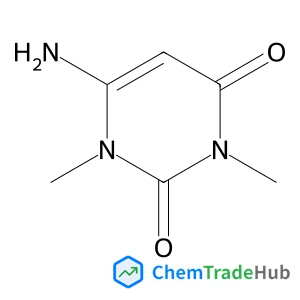
6-amino-1,3-dimethyl-1,2,3,4-tetrahydropyrimidine-2,4-dione
CAS Number:
6642-31-5
Molecular Formula:
C6H9N3O2
Recommended Suppliers




Disclaimer
This page provides academic journal information for reference and research purposes only. We are not affiliated with any journal publishers and do not handle publication submissions. For publication-related inquiries, please contact the respective journal publishers directly.
If you notice any inaccuracies in the information displayed, please contact us at support@chemtradehub.com. We will promptly review and address your concerns.