












Phosphonium ionenes from well-defined step-growth polymerization: thermal and melt rheological properties
Literature Information
Publication Date
2013-04-23
DOI
10.1039/C3PY00365E
Impact Factor
5.582
Authors
Sean T. Hemp, Musan Zhang, Mana Tamami, Timothy E. Long
View Original
Abstract
Step-growth polymerization of ditertiary phosphines with dibromoalkanes enabled the synthesis of novel phosphonium ionenes. In situ FTIR spectroscopy monitored the increase in absorbance as a function of time at 1116 cm−1, which corresponded to the polymeric P+–Ph stretch. Aqueous size-exclusion chromatography (SEC) provided absolute molecular weights and confirmed expected molecular weight growth for difunctional, step-growth polymerization. Phosphonium ionenes exhibited improved thermal and base stability compared to ammonium ionenes, which was attributed to the propensity of the ammonium cation towards Hofmann elimination. Melt rheology examined phosphonium ionene viscous flow and the influence of charge density on melt viscosity as a function of shear rate and temperature. Time–temperature superposition (TTS) resulted in both master curves and pseudomaster curves depending on phosphonium ionene composition. Two primary relaxations occurred: (1) onset of long-range segmental motion at Tg, and (2) relaxation attributed to electrostatic interactions. Higher charge densities shifted these two relaxations to longer time scales and increased flow activation energies. Phosphonium ionenes also readily bound pDNA effectively (± ratios of 1), and base stability suggested applications in energy generation.
Related Literature
Custom-made polar monomers utilized in nickel and palladium promoted olefin copolymerization
Lei Cui, Hongliang Mu
2021-05-31
Review Article
DOI: 10.1039/D1PY00492A
Adsorption in an ordered and non-interconnected mesoporous material: Single crystal porous silicon
N. Dupont-Pavlovsky
2001-03-06
Paper
DOI: 10.1039/B009105G
A kinetic study of catalytic methanol decomposition over nickel supported on silica
Yasuyuki Matsumura, Naoki Tode
2001-03-13
Paper
DOI: 10.1039/B008854O
Photocatalytic decomposition of benzene over TiO2 in a humidified airstream
Paper
DOI: 10.1039/A906214I
A theoretical investigation of OH formation in the gas-phase ozonolysis of E-but-2-ene and Z-but-2-ene
Paper
DOI: 10.1039/A903186C
Amine-containing diblock terpolymers via AROP: a versatile method for the generation of multifunctional micelles
Michael Ringleb
2021-06-14
Paper
DOI: 10.1039/D1PY00666E
Does the cationic or the radical character dominate the reactivity of alkene radical cations towards solvent molecules?‡
M. Mohr, H. Zipse
2001-02-27
Paper
DOI: 10.1039/B007990L
You might also like
Compound Q&A
What are the main uses of 4-Nitrophenyl phosphate disodium salt hexahydrate (CAS: 333338-18-4)?
4-Nitrophenyl phosphate disodium salt hexahydrate is primarily used as a substra...
333338-18-44-Nitrophenyl phosph...
Compound Q&A
What are the main uses of 2-(Trifluoromethyl)-1,3-oxazole-4-carboxylic Acid (CAS: 1060816-01-4)?
2-(Trifluoromethyl)-1,3-oxazole-4-carboxylic Acid (CAS: 1060816-01-4) is widely ...
1060816-01-42-(Trifluoromethyl)-...
Compound Q&A
How should 2-Fluoro-4-biphenylcarboxylic acid (CAS: 137045-30-8) be stored?
2-Fluoro-4-biphenylcarboxylic acid should be stored in a cool, dry place at room...
137045-30-82-Fluoro-4-biphenylc...
Compound Q&A
What industries use Prednisolone-21-Carboxylic Acid (CAS: 61549-70-0)?
Prednisolone-21-Carboxylic Acid is primarily used in the pharmaceutical industry...
61549-70-0Prednisolone-21-Carb...
Compound Q&A
How should 4-(Hydrazinomethyl)-1,2,3-benzenetriol (CAS: 3614-72-0) be stored?
4-(Hydrazinomethyl)-1,2,3-benzenetriol (CAS: 3614-72-0) should be stored in a co...
3614-72-04-(Hydrazinomethyl)-...
Compound Q&A
What industries use 4-Amino-1-methyl-1H-pyrazole-5-carboxylic acid hydrochloride (CAS: 92534-70-8)?
4-Amino-1-methyl-1H-pyrazole-5-carboxylic acid hydrochloride (CAS: 92534-70-8) i...
92534-70-84-Amino-1-methyl-1H-...
Compound Q&A
What regulatory guidelines apply to dehydropachymic acid (CAS: 77012-31-8)?
Dehydropachymic acid (CAS: 77012-31-8) is regulated by various agencies. It fall...
77012-31-8Dehydropachymic acid
Compound Q&A
What is the market or research trend for 6-[(2,2-Dimethylpropanoyl)amino]nicotinic acid (CAS: 898561-66-5)?
The market and research trends for 6-[(2,2-Dimethylpropanoyl)amino]nicotinic aci...
898561-66-56-[(2,2-Dimethylprop...
Compound Q&A
How should 1,10-Phenanthroline-2,9-dicarbaldehyde (CAS: 57709-62-3) be stored?
1,10-Phenanthroline-2,9-dicarbaldehyde should be stored in a cool, dry place awa...
57709-62-31,10-Phenanthroline-...
Compound Q&A
How is 5-Carbamoyl-11-oxo-10,11-dihydro-5H-dibenzo[b,f]azepin-10-yl acetate (CAS: 113952-21-9) typically synthesized?
5-Carbamoyl-11-oxo-10,11-dihydro-5H-dibenzo[b,f]azepin-10-yl acetate can be synt...
113952-21-95-Carbamoyl-11-oxo-1...
Source Journal
Polymer Chemistry

CiteScore:
8.6
Self-citation Rate:
7.3%
Articles per Year:
457
Polymer Chemistry welcomes submissions in all areas of polymer science that have a strong focus on macromolecular chemistry. Manuscripts may cover a broad range of fields, yet no direct application focus is required.
Recommended Compounds

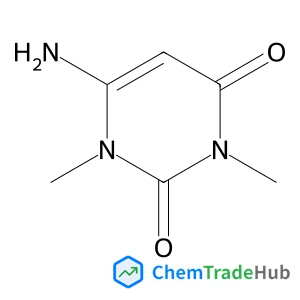
6-amino-1,3-dimethyl-1,2,3,4-tetrahydropyrimidine-2,4-dione
CAS Number:
6642-31-5
Molecular Formula:
C6H9N3O2
Recommended Suppliers







Disclaimer
This page provides academic journal information for reference and research purposes only. We are not affiliated with any journal publishers and do not handle publication submissions. For publication-related inquiries, please contact the respective journal publishers directly.
If you notice any inaccuracies in the information displayed, please contact us at support@chemtradehub.com. We will promptly review and address your concerns.