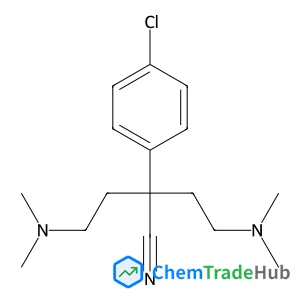
2-(4-Chlorophenyl)-4-(dimethylamino)-2-(2-(dimethylamino)ethyl)butanenitrile
CAS Number:
1246816-57-8
Molecular Formula:
C16H24ClN3
Hongpeng You
The photoluminescence properties and energy transfer of the Eu2+ and Mn2+ co-doped Sr3Y(PO4)3 phosphors are investigated in detail. Two main emission bands attributed to the Eu2+ and Mn2+ ions are observed under UV light excitation via an efficient energy transfer process. When the Eu2+ doping content is fixed, the emission chromaticity can be varied by simply adjusting the content of Mn2+. The study of the behavior as a function of doping concentration indicates that the warm white-light can be obtained in a single host lattice. Furthermore, the analysis of the fluorescence decay curves based on the Inokuti–Hirayama theoretical model reveals that the dipole–quadrupole interaction is mainly responsible for the energy transfer mechanism from the Eu2+ to Mn2+ ions in the Sr3Y(PO4)3 phosphor. The developed phosphor exhibits a strong absorption in UV spectral region and white-light emission which may find utility as a single-component white-light-emitting UV-convertible phosphor in white LED devices.
Guilherme Vieira de Castro, Alessio Ciulli
DOI: 10.1039/D1MD00215E
Stephanie Federico, Stefano Moro, Sonja Kachler, Karl-Norbert Klotz, Giampiero Spalluto
DOI: 10.1039/D0MD00380H
Ruchika Goyal, Gaurav Jerath, Aneesh Chandrasekharan, T. R. Santhosh Kumar, Vibin Ramakrishnan
DOI: 10.1039/D0MD00229A
Xin-Yuan Liang, Narsaiah Battini, Yan-Fei Sui, Mohammad Fawad Ansari, Lin-Ling Gan, Cheng-He Zhou
DOI: 10.1039/D0MD00429D
Kai Gao, Shabnam Shaabani, Ruixue Xu, Tryfon Zarganes-Tzitzikas, Li Gao, Maryam Ahmadianmoghaddam, Matthew R. Groves, Alexander Dömling
DOI: 10.1039/D1MD00087J
Sumit Kumar, Yash Gupta, Charu Upadhyay, Neha Sharma, Andrew S. Herbert, Ravi Durvasula, Vladimir Potemkin, Poonam, Prakasha Kempaiah
DOI: 10.1039/D1MD00202C
Alison Jones, Carys A. Davies, Samuel Fitch, Juma'a R. Al Dulayymi, James Gibbons, A. Prysor Williams, Mark S. Baird
DOI: 10.1039/D0MD00325E
Yoshitsugu Morita, Asuka Saito, Jun Yamaguchi, Teruyuki Komatsu
DOI: 10.1039/D0CB00056F
This compound is mainly used as an intermediate in the synthesis of antipsychoti...
Waste containing 1-(D-Ribofuranosyl)-1,4-dihydro-3-pyridinecarboxamide (CAS: 191...
2-Methyl-2-propanyl 3-bromo-3-(hydroxymethyl)-1-azetidinecarboxylate (CAS: 20079...
N-(4-Chloro-2-pyridinyl)acetamide (CAS: 245056-66-0) is a chemical compound with...
5-Chloro-2-hydroxybenzoic acid, also known as 5-chlorosalicylic acid, is an arom...
When handling 1,1-Dichloro-1-fluoroethane (CAS: 1717-00-6), it is important to u...
Fmoc-(2S,3R)-3-phenylpyrrolidine-2-carboxylic acid is a white crystalline solid ...
4-Amino-5-bromo-2-pyridinecarboxylic acid is primarily used as a precursor in th...
Handling this compound should be done with personal protective equipment (PPE) i...
When handling 8-bromo-2,2-dimethyl-3,4-dihydro-2H-1,4-benzoxazin-3-one, use prop...

Physical Chemistry Chemical Physics (PCCP) is an international journal co-owned by 19 physical chemistry and physics societies from around the world. This journal publishes original, cutting-edge research in physical chemistry, chemical physics and biophysical chemistry. To be suitable for publication in PCCP, articles must include significant innovation and/or insight into physical chemistry; this is the most important criterion that reviewers and Editors will judge against when evaluating submissions. The journal has a broad scope and welcomes contributions spanning experiment, theory, computation and data science. Topical coverage includes spectroscopy, dynamics, kinetics, statistical mechanics, thermodynamics, electrochemistry, catalysis, surface science, quantum mechanics, quantum computing and machine learning. Interdisciplinary research areas such as polymers and soft matter, materials, nanoscience, energy, surfaces/interfaces, and biophysical chemistry are welcomed if they demonstrate significant innovation and/or insight into physical chemistry. Joined experimental/theoretical studies are particularly appreciated when complementary and based on up-to-date approaches.
![Methyl 4-({[(2-methyl-2-propanyl)oxy]carbonyl}amino)bicyclo[2.2.2]octane-1-carboxylate structure](https://static.chemtradehub.com/structs/943/943845-74-7-b7e5.webp "Methyl 4-({[(2-methyl-2-propanyl)oxy]carbonyl}amino)bicyclo[2.2.2]octane-1-carboxylate structure")