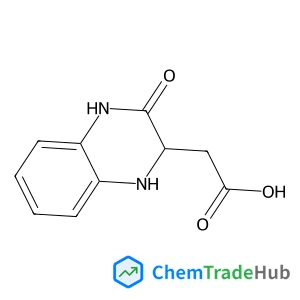
(3-Oxo-1,2,3,4-tetrahydro-2-quinoxalinyl)acetic acid
CAS Number:
136584-14-0
Molecular Formula:
C10H10N2O3
Stephanie Federico, Stefano Moro, Sonja Kachler, Karl-Norbert Klotz, Giampiero Spalluto
A3 adenosine receptors were found to have a role in different pathological states, such as glaucoma, renal fibrosis, neuropathic pain and cancer. Consequently, it is important to utilize any molecular tool which could help to study these conditions. In the present study we continue our search for potent A3 adenosine receptor ligands which could be successively conjugated to other molecules with the aim of obtaining more potent (e.g. allosteric ligand conjugation) or detectable ligands (e.g. fluorescent molecule or biotin conjugation). Specifically, different aminoester moieties were introduced at the 5 position of the pyrazolo[4,3-e]-1,2,4-triazolo[1,5-c]pyrimidine core. The ester functionalization represents the candidate for the subsequent conjugation. All the reported compounds are potent hA3 adenosine receptor antagonists and some of them exhibited high selectivity against the other adenosine receptors. The main structural terms of ligand recognition and selectivity were disclosed by molecular modelling studies. Molecular docking results led to the characterization of an alternative binding mode for antagonists at the orthosteric binding site of the hA3 adenosine receptor, evaluated and assessed by classical molecular dynamics simulations.
J. Järvinen, D. Zvezdov, J. Ahokas, S. Sheludiakov, L. Lehtonen, S. Vasiliev, L. Vlasenko, Y. Ishikawa, Y. Fujii
DOI: 10.1039/C9CP06859G
Silvia Di Fonzo, Jussara Amato, Federica D’Aria, Marco Caterino, Francesco D’Amico, Alessandro Gessini, John W. Brady, Bruno Pagano, Concetta Giancola
DOI: 10.1039/D0CP01022G
Jun Wang
DOI: 10.1039/D0CP00109K
Kwang-Hyon Kim
DOI: 10.1039/D0CP00150C
Michael J. Servis, Ernesto Martinez-Baez
DOI: 10.1039/D0CP00164C
Mark DelloStritto, Jianhang Xu, Xifan Wu, Michael L. Klein
DOI: 10.1039/C9CP06821J
Mustafa Sayin, Alexei Nefedov, Michael Zharnikov
DOI: 10.1039/D0CP00906G
Tiantian Zhang, Longjiu Cheng, Jianguo Zhang, Kun Wang
DOI: 10.1039/D0CP00050G
Nickolas D. Charistos, Alvaro Muñoz-Castro
DOI: 10.1039/D0CP01252A
Antonio Gennaro, Alexander Karabanov, Alexey Potapov, Walter Köckenberger
DOI: 10.1039/D0CP00892C
This compound is mainly used as an intermediate in the synthesis of antipsychoti...
Waste containing 1-(D-Ribofuranosyl)-1,4-dihydro-3-pyridinecarboxamide (CAS: 191...
2-Methyl-2-propanyl 3-bromo-3-(hydroxymethyl)-1-azetidinecarboxylate (CAS: 20079...
N-(4-Chloro-2-pyridinyl)acetamide (CAS: 245056-66-0) is a chemical compound with...
5-Chloro-2-hydroxybenzoic acid, also known as 5-chlorosalicylic acid, is an arom...
When handling 1,1-Dichloro-1-fluoroethane (CAS: 1717-00-6), it is important to u...
Fmoc-(2S,3R)-3-phenylpyrrolidine-2-carboxylic acid is a white crystalline solid ...
4-Amino-5-bromo-2-pyridinecarboxylic acid is primarily used as a precursor in th...
Handling this compound should be done with personal protective equipment (PPE) i...
When handling 8-bromo-2,2-dimethyl-3,4-dihydro-2H-1,4-benzoxazin-3-one, use prop...

![2,6-Di(thiophen-2-yl)dithieno[3,2-b:2',3'-d]thiophene structure](https://static.chemtradehub.com/structs/910/910788-24-8-5b70.webp "2,6-Di(thiophen-2-yl)dithieno[3,2-b:2',3'-d]thiophene structure")