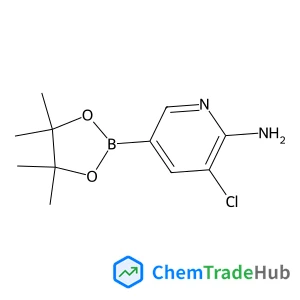
3-Chloro-5-(4,4,5,5-tetramethyl-1,3,2-dioxaborolan-2-yl)-2-pyridinamine
CAS Number:
1032758-99-8
Molecular Formula:
C11H16BClN2O2
Ruchika Goyal, Gaurav Jerath, Aneesh Chandrasekharan, T. R. Santhosh Kumar, Vibin Ramakrishnan
Design of peptide-based targeted delivery vectors with attributes of specificity and selective cellular targeting by fixing their topology and resulting electrostatic fingerprint is the objective of this study. We formulated our peptide design platform by utilizing the possibilities of side-chain induced geometric restrictions in a typical peptide molecule. Conceptually, we locked the conformation of the RGD/NGR motif of tumor homing peptides (THPs) by mutating glycine in these motifs with D-proline and tailed the peptides with a syndiotactic amphipathic segment for cellular penetration. The designed peptides were synthesized, characterized, and tested in vitro on various cell lines, including breast cancer (MDA-MB-231), cervical cancer (HeLa), osteosarcoma (U2-OS) and non-cancer mammary epithelial cells (MCF-10A), by flow cytometry and confocal microscopy. The results showed differential cellular uptake in different cell types, as a result of the distinct electrostatic fingerprint encoded in their design. The uptake of serum pre-treated peptides by cells reveals the retention of peptide activity even after the incubation with serum. In addition, peptide–methotrexate (MTX) conjugates compared to the methotrexate drug showed enhanced apoptotic cell death in MTX-resistant MDA-MB-231 cells, indicating the increase in MTX bioavailability.
Qianwen Chen, Yun Zhao, Lei Zeng, Chunzhen Yang, Feng Huang
DOI: 10.1039/C9CP07002H
Nagaprasad Reddy Samala, Ilya Grinberg
DOI: 10.1039/D0CP04478D
Alexander Kastner, Greta Koumarianou, Pavle Glodic, Peter C. Samartzis, Nicolas Ladda, Simon T. Ranecky, Tom Ring, Sudheendran Vasudevan, Constantin Witte, Hendrike Braun, Han-Gyeol Lee, Arne Senftleben, Robert Berger, Thomas Baumert
DOI: 10.1039/D0CP00470G
Marina Rumyantseva, Abulkosim Nasriddinov, Alexander Gaskov, Anna Moiseeva, Yuri Fedorov, Gediminas Jonusauskas
DOI: 10.1039/C9CP07016H
Keijiro Ohshimo, Shun Miyazaki, Keigo Hattori, Fuminori Misaizu
DOI: 10.1039/C9CP06923B
Silvia Di Fonzo, Jussara Amato, Federica D’Aria, Marco Caterino, Francesco D’Amico, Alessandro Gessini, John W. Brady, Bruno Pagano, Concetta Giancola
DOI: 10.1039/D0CP01022G
Omar Baig, Oliver Kühn, Leticia González
DOI: 10.1039/D0CP04781C
Benjamin A. Link, Ammon J. Sindt, Linda S. Shimizu, Thanh D. Do
DOI: 10.1039/C9CP06938K
Bo Kong, Xin-You An, Ti-Xian Zeng, Jihua Zhang
DOI: 10.1039/C9CP06094D
This compound is mainly used as an intermediate in the synthesis of antipsychoti...
Waste containing 1-(D-Ribofuranosyl)-1,4-dihydro-3-pyridinecarboxamide (CAS: 191...
2-Methyl-2-propanyl 3-bromo-3-(hydroxymethyl)-1-azetidinecarboxylate (CAS: 20079...
N-(4-Chloro-2-pyridinyl)acetamide (CAS: 245056-66-0) is a chemical compound with...
5-Chloro-2-hydroxybenzoic acid, also known as 5-chlorosalicylic acid, is an arom...
When handling 1,1-Dichloro-1-fluoroethane (CAS: 1717-00-6), it is important to u...
Fmoc-(2S,3R)-3-phenylpyrrolidine-2-carboxylic acid is a white crystalline solid ...
4-Amino-5-bromo-2-pyridinecarboxylic acid is primarily used as a precursor in th...
Handling this compound should be done with personal protective equipment (PPE) i...
When handling 8-bromo-2,2-dimethyl-3,4-dihydro-2H-1,4-benzoxazin-3-one, use prop...
![Pyrazolo[1,5-a]pyridine-3-carbothioamide structure](https://static.chemtradehub.com/structs/885/885275-44-5-aae0.webp "Pyrazolo[1,5-a]pyridine-3-carbothioamide structure")
![2,6-Bis({(2R)-2-[hydroxy(diphenyl)methyl]-1-pyrrolidinyl}methyl)-4-methylphenol structure](https://static.chemtradehub.com/structs/877/877395-58-9-70bf.webp "2,6-Bis({(2R)-2-[hydroxy(diphenyl)methyl]-1-pyrrolidinyl}methyl)-4-methylphenol structure")