












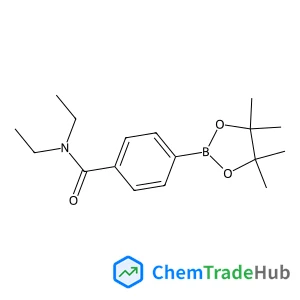
N,N-Diethyl-4-(4,4,5,5-tetramethyl-1,3,2-dioxaborolan-2-yl)benzamide
CAS Number:
325142-99-2
Molecular Formula:
C17H26BNO3
Yoshitsugu Morita, Asuka Saito, Jun Yamaguchi, Teruyuki Komatsu
The allosteric O2 release of haemoglobin (Hb) allows for efficient O2 delivery from the lungs to the tissues. However, allostery is weakened in Hb-based O2 carriers because the chemical modifications of the Lys- and Cys-β93 residues prevent the quaternary transition of Hb. In this paper, we describe the synthesis and O2 binding properties of a recombinant Hb [rHb(βK120C)]–albumin heterotrimer that maintains sufficient Hb allostery. The rHb(βK120C) core, with two additional cysteine residues at the symmetrical positions on its protein surface, was expressed using yeast cells. The mutations did not influence either the O2 binding characteristics or the quaternary transition of Hb. Maleimide-activated human serum albumins (HSAs) were coupled with rHb(βK120C) at the two Cys-β120 positions, yielding the rHb(βK120C)–HSA2 trimer, in which the Cys-β93 residues were unreacted. Molecular dynamics simulation demonstrated that the HSA moiety does not interact with the amino acid residues around the haem pockets and the α1β2 surfaces of the rHb(βK120C) core, the alteration of which retards Hb allostery. Circular dichroism spectroscopy demonstrated that the quaternary transition between the relaxed (R) state and the tense (T) state of the Hb core occurred upon both the association and dissociation of O2. In phosphate-buffered saline solution (pH 7.4) at 37 °C, the rHb(βK120C)–HSA2 trimer exhibited a sigmoidal O2 equilibrium curve with the O2 affinity and cooperativity identical to those of native Hb (p50 = 12 Torr, n = 2.4). Moreover, we observed an equal Bohr effect and 2,3-diphosphoglycerate response in the rHb(βK120C)–HSA2 trimer compared with naked Hb.
Bo Kong, Xin-You An, Ti-Xian Zeng, Jihua Zhang
DOI: 10.1039/C9CP06094D
Samuel Moxon, Adam R. Symington, Joshua S. Tse, James Dawson, Joseph M. Flitcroft, Stephen C. Parker, David J. Cooke, Robert M. Harker, Marco Molinari
DOI: 10.1039/D0CP00021C
Jeremias Sibold, Vera E. Tewaag, Thomas Vagedes, Ingo Mey
DOI: 10.1039/D0CP00335B
K. Kirievsky, D. Fuks, Y. Gelbstein
DOI: 10.1039/D0CP00956C
K. L. Ngai, Z. Wojnarowska, Marian Paluch
DOI: 10.1039/D0CP00282H
Dianhui Wang, Jihui Liang, Chaohao Hu, Lixian Sun, Craig A. J. Fisher
DOI: 10.1039/D0CP01058H
Yinjie Liao, Lei Tong, Yieqin Yang, Xiaogang Wang
DOI: 10.1039/D0CP00866D
Tiantian Zhang, Longjiu Cheng, Jianguo Zhang, Kun Wang
DOI: 10.1039/D0CP00050G
Edvinas Radiunas, Manvydas Dapkevičius, Steponas Raišys, Saulius Juršėnas, Augustina Jozeliūnaitė, Tomas Javorskis, Ugnė Šinkevičiūtė, Edvinas Orentas, Karolis Kazlauskas
DOI: 10.1039/D0CP00144A
This compound is mainly used as an intermediate in the synthesis of antipsychoti...
Waste containing 1-(D-Ribofuranosyl)-1,4-dihydro-3-pyridinecarboxamide (CAS: 191...
2-Methyl-2-propanyl 3-bromo-3-(hydroxymethyl)-1-azetidinecarboxylate (CAS: 20079...
N-(4-Chloro-2-pyridinyl)acetamide (CAS: 245056-66-0) is a chemical compound with...
5-Chloro-2-hydroxybenzoic acid, also known as 5-chlorosalicylic acid, is an arom...
When handling 1,1-Dichloro-1-fluoroethane (CAS: 1717-00-6), it is important to u...
Fmoc-(2S,3R)-3-phenylpyrrolidine-2-carboxylic acid is a white crystalline solid ...
4-Amino-5-bromo-2-pyridinecarboxylic acid is primarily used as a precursor in th...
Handling this compound should be done with personal protective equipment (PPE) i...
When handling 8-bromo-2,2-dimethyl-3,4-dihydro-2H-1,4-benzoxazin-3-one, use prop...
![2,6-Bis({(2R)-2-[hydroxy(diphenyl)methyl]-1-pyrrolidinyl}methyl)-4-methylphenol structure](https://static.chemtradehub.com/structs/877/877395-58-9-70bf.webp "2,6-Bis({(2R)-2-[hydroxy(diphenyl)methyl]-1-pyrrolidinyl}methyl)-4-methylphenol structure")
![1-[3-(4-Morpholinylsulfonyl)phenyl]methanamine structure](https://static.chemtradehub.com/structs/933/933989-32-3-51af.webp "1-[3-(4-Morpholinylsulfonyl)phenyl]methanamine structure")



