












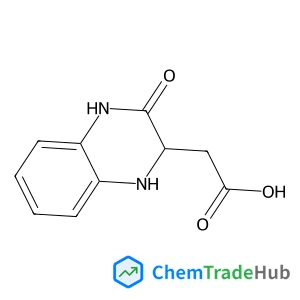
(3-Oxo-1,2,3,4-tetrahydro-2-quinoxalinyl)acetic acid
CAS Number:
136584-14-0
Molecular Formula:
C10H10N2O3
Tahmina Ahmed Milly, Yftah Tal-Gan
Streptococcus pneumoniae, an opportunistic human pathogen, acquires genes from its neighboring species of the mitis group of streptococci, which confer antibiotic resistances and allow it to produce diverse virulence factors. Most species of the mitis group are naturally competent, and they utilize the competence stimulating peptide (CSP) and the CSP-dependent competence regulon, a conserved quorum sensing (QS) circuit, to regulate their competence behavior. The dependence of the mitis group on this communication pathway makes QS a potential target to control their behavior. In this work, we sought to evaluate the impact of the native pheromones of the adjacent species of S. pneumoniae to modulate the activity of the S. pneumoniae competence regulon. Our results revealed the potential role of S. mitis as a modulator of QS in S. pneumoniae. Most importantly, our analysis also revealed that by using the native pheromone of S. mitis as a template, highly potent pan-group agonists and antagonists of the pneumococcal competence regulon could be developed. The newly developed QS modulators may have therapeutic utility in treating pneumococcal infections.
Maxim V. Shugaev, Chengping Wu, Leonid V. Zhigilei
DOI: 10.1039/D0CP00608D
DOI: 10.1039/D0CP90085K
Björn Kriete, Carolien J. Feenstra, Maxim S. Pshenichnikov
DOI: 10.1039/D0CP01734E
Omar Baig, Oliver Kühn, Leticia González
DOI: 10.1039/D0CP04781C
Gregory K. Schenter, John L. Fulton, Thomas Huthwelker, Mahalingam Balasubramanian, Mirza Galib, Marcel D. Baer, Jürg Hutter, Mauro Del Ben, X. S. Zhao
DOI: 10.1039/C9CP06161D
Dilek Yalcin, Andrew J. Christofferson, Calum J. Drummond, Tamar L. Greaves
DOI: 10.1039/D0CP00201A
DOI: 10.1039/D0CP01502D
Nagaprasad Reddy Samala, Ilya Grinberg
DOI: 10.1039/D0CP04478D
Akane Kawafuchi, Shoichi Kutsumizu, Yuki Kawase, Issei Tokiwa, Taro Udagawa, Yohei Miwa
DOI: 10.1039/C9CP06831G
Benjamin A. Link, Ammon J. Sindt, Linda S. Shimizu, Thanh D. Do
DOI: 10.1039/C9CP06938K
This compound is mainly used as an intermediate in the synthesis of antipsychoti...
Waste containing 1-(D-Ribofuranosyl)-1,4-dihydro-3-pyridinecarboxamide (CAS: 191...
2-Methyl-2-propanyl 3-bromo-3-(hydroxymethyl)-1-azetidinecarboxylate (CAS: 20079...
N-(4-Chloro-2-pyridinyl)acetamide (CAS: 245056-66-0) is a chemical compound with...
5-Chloro-2-hydroxybenzoic acid, also known as 5-chlorosalicylic acid, is an arom...
When handling 1,1-Dichloro-1-fluoroethane (CAS: 1717-00-6), it is important to u...
Fmoc-(2S,3R)-3-phenylpyrrolidine-2-carboxylic acid is a white crystalline solid ...
4-Amino-5-bromo-2-pyridinecarboxylic acid is primarily used as a precursor in th...
Handling this compound should be done with personal protective equipment (PPE) i...
When handling 8-bromo-2,2-dimethyl-3,4-dihydro-2H-1,4-benzoxazin-3-one, use prop...
![Pyrazolo[1,5-a]pyridine-3-carbothioamide structure](https://static.chemtradehub.com/structs/885/885275-44-5-aae0.webp "Pyrazolo[1,5-a]pyridine-3-carbothioamide structure")
![6-Benzyl-4,5,6,7-tetrahydro-1H-pyrazolo[3,4-c]pyridin-3(2H)-one structure](https://static.chemtradehub.com/structs/909/909187-64-0-f54f.webp "6-Benzyl-4,5,6,7-tetrahydro-1H-pyrazolo[3,4-c]pyridin-3(2H)-one structure")





