













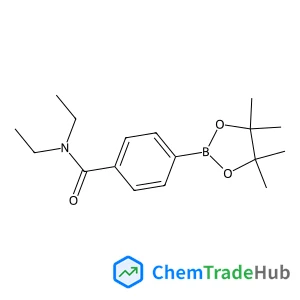
N,N-Diethyl-4-(4,4,5,5-tetramethyl-1,3,2-dioxaborolan-2-yl)benzamide
CAS Number:
325142-99-2
Molecular Formula:
C17H26BNO3
Peter D. Roselt
Indirect radiolabelling has for a long time been the mainstay strategy for radiofluorination of biomolecules. Acylation of biomolecules through the use of an 18F-labelled activated ester is a standard method for indirect radiolabelling. However, the preparation of 18F-labelled activated esters is typically a complex and multistep procedure. Herein, we describe the use of 4-nitrophenyl (PNP) activated esters to rapidly prepare 18F-labelled acylation synthons in one step. Furthermore, we present a comparative study of PNP activated esters and the commonly utilised 2,3,5,6-tetrafluorphenyl (TFP) activated esters under direct radiofluorination conditions and demonstrate their relative acylation behaviour. We demonstrate the superiority of PNP esters under direct radiofluorination conditions with favourable acylation kinetics.
Edvinas Radiunas, Manvydas Dapkevičius, Steponas Raišys, Saulius Juršėnas, Augustina Jozeliūnaitė, Tomas Javorskis, Ugnė Šinkevičiūtė, Edvinas Orentas, Karolis Kazlauskas
DOI: 10.1039/D0CP00144A
Bhaskar Rana, John M. Herbert
DOI: 10.1039/D0CP05216G
Michael Gradzielski
DOI: 10.1039/D0CP01076F
Zhibo Ma
DOI: 10.1039/C9CP06893G
Pascal Didier, Jagannath Kuchlyan, Lara Martinez-Fernandez, Pauline Gosset, Jérémie Léonard, Yitzhak Tor, Roberto Improta, Yves Mély
DOI: 10.1039/C9CP06931C
Hongxing Hao, Qing Xie, Jingwen Ai, Yuan Wang, Hongtao Bian
DOI: 10.1039/D0CP00974A
Silvia Di Fonzo, Jussara Amato, Federica D’Aria, Marco Caterino, Francesco D’Amico, Alessandro Gessini, John W. Brady, Bruno Pagano, Concetta Giancola
DOI: 10.1039/D0CP01022G
Tran Thi Thu Hanh, Nguyen Minh Phi, Nguyen Van Hoa
DOI: 10.1039/D0CP00016G
D. G. Kellerman, M. O. Kalinkin, N. I. Medvedeva, A. P. Tyutyunnik
DOI: 10.1039/D0CP05185C
Zhaolong Sun, Mingchao Yang, Xueting Wang, Peng Wang, Chunling Zhang, Nan Gao, Hongdong Li
DOI: 10.1039/D0CP00121J
This compound is mainly used as an intermediate in the synthesis of antipsychoti...
Waste containing 1-(D-Ribofuranosyl)-1,4-dihydro-3-pyridinecarboxamide (CAS: 191...
2-Methyl-2-propanyl 3-bromo-3-(hydroxymethyl)-1-azetidinecarboxylate (CAS: 20079...
N-(4-Chloro-2-pyridinyl)acetamide (CAS: 245056-66-0) is a chemical compound with...
5-Chloro-2-hydroxybenzoic acid, also known as 5-chlorosalicylic acid, is an arom...
When handling 1,1-Dichloro-1-fluoroethane (CAS: 1717-00-6), it is important to u...
Fmoc-(2S,3R)-3-phenylpyrrolidine-2-carboxylic acid is a white crystalline solid ...
4-Amino-5-bromo-2-pyridinecarboxylic acid is primarily used as a precursor in th...
Handling this compound should be done with personal protective equipment (PPE) i...
When handling 8-bromo-2,2-dimethyl-3,4-dihydro-2H-1,4-benzoxazin-3-one, use prop...
![4-Chloro-3-(trifluoromethyl)-1H-pyrrolo[2,3-b]pyridine structure](https://static.chemtradehub.com/structs/869/869335-75-1-a9d0.webp "4-Chloro-3-(trifluoromethyl)-1H-pyrrolo[2,3-b]pyridine structure")





