












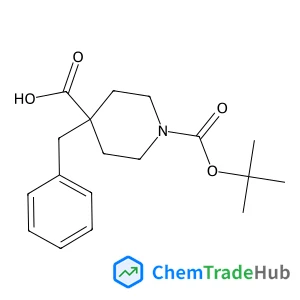
4-Benzyl-1-(tert-butoxycarbonyl)piperidine-4-carboxylic acid
CAS Number:
170838-87-6
Molecular Formula:
C18H25NO4
Qun Xu, Tian Li, Hekai Chen, Jun Kong, Liwei Zhang
In anti-tumour therapy, the toll-like receptor 2/4 (TLR2/4) signalling pathway has been a double-edged sword. TLR2/4 agonists are commonly considered adjuvants for immune stimulation, whereas TLR2/4 antagonists demonstrate more feasibility for anti-tumour therapy under specific chronic inflammatory situations. In individuals with cancer retaliatory proliferation and metastasis after surgery, blocking the TLR2/4 signalling pathway may produce favourable prognosis for patients. Therefore, here, we developed a small-molecule co-inhibitor that targets the TLR2/4 signalling pathway. After high-throughput screening of a compound library containing 14 400 small molecules, followed by hit-to-lead structural optimisation, we finally obtained the compound TX-33, which has effective inhibitory properties against the TLR2/4 signalling pathways. This compound was found to significantly inhibit multiple pro-inflammatory cytokines released by RAW264.7 cells. This was followed by TX-33 demonstrating promising efficacy in subsequent anti-tumour experiments. The current results provide a novel understanding of the role of TLR2/4 in cancer and a novel strategy for anti-tumour therapy.
Maxim V. Shugaev, Chengping Wu, Leonid V. Zhigilei
DOI: 10.1039/D0CP00608D
Hui Zhou, Dong Wang, Xue-Qing Gong
DOI: 10.1039/D0CP00204F
Žiga Medoš, Sergej Friesen, Richard Buchner, Marija Bešter-Rogač
DOI: 10.1039/D0CP00877J
Mustafa Sayin, Alexei Nefedov, Michael Zharnikov
DOI: 10.1039/D0CP00906G
Q. S. Fu, X. H. Chen, C. Chakrabarti, C. L. Li, J. Zheng, P. J. Wang, H. X. Yin, Y. Qiu, B. Meng, S. L. Yuan
DOI: 10.1039/C9CP06444C
Pascal Didier, Jagannath Kuchlyan, Lara Martinez-Fernandez, Pauline Gosset, Jérémie Léonard, Yitzhak Tor, Roberto Improta, Yves Mély
DOI: 10.1039/C9CP06931C
David I. Ramírez-Palma, Cesar R. García-Jacas, Pablo Carpio-Martínez, Fernando Cortés-Guzmán
DOI: 10.1039/D0CP00300J
Abida Sultana, Jintana Meesungnoen, Jean-Paul Jay-Gerin
DOI: 10.1039/D0CP00601G
D. G. Kellerman, M. O. Kalinkin, N. I. Medvedeva, A. P. Tyutyunnik
DOI: 10.1039/D0CP05185C
Jeremias Sibold, Vera E. Tewaag, Thomas Vagedes, Ingo Mey
DOI: 10.1039/D0CP00335B
This compound is mainly used as an intermediate in the synthesis of antipsychoti...
Waste containing 1-(D-Ribofuranosyl)-1,4-dihydro-3-pyridinecarboxamide (CAS: 191...
2-Methyl-2-propanyl 3-bromo-3-(hydroxymethyl)-1-azetidinecarboxylate (CAS: 20079...
N-(4-Chloro-2-pyridinyl)acetamide (CAS: 245056-66-0) is a chemical compound with...
5-Chloro-2-hydroxybenzoic acid, also known as 5-chlorosalicylic acid, is an arom...
When handling 1,1-Dichloro-1-fluoroethane (CAS: 1717-00-6), it is important to u...
Fmoc-(2S,3R)-3-phenylpyrrolidine-2-carboxylic acid is a white crystalline solid ...
4-Amino-5-bromo-2-pyridinecarboxylic acid is primarily used as a precursor in th...
Handling this compound should be done with personal protective equipment (PPE) i...
When handling 8-bromo-2,2-dimethyl-3,4-dihydro-2H-1,4-benzoxazin-3-one, use prop...
![4-Chloro-3-(trifluoromethyl)-1H-pyrrolo[2,3-b]pyridine structure](https://static.chemtradehub.com/structs/869/869335-75-1-a9d0.webp "4-Chloro-3-(trifluoromethyl)-1H-pyrrolo[2,3-b]pyridine structure")





