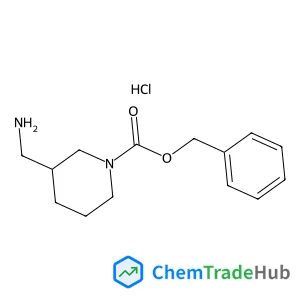
Benzyl 3-(aminomethyl)piperidine-1-carboxylate hydrochloride
CAS Number:
1186663-23-9
Molecular Formula:
C14H21ClN2O2
Daniel Zehm, André Laschewsky, Michael Gradzielski, Hua Liang, Jürgen P. Rabe, Jean-François Lutz
The combination of two techniques of controlled free radical polymerization, namely the reversible addition fragmentation chain transfer (RAFT) and the atom transfer radical polymerization (ATRP) techniques, together with the use of a macromonomer allowed the synthesis of symmetrical triblock copolymers, designed as amphiphilic dual brushes. One type of brush was made of poly(n-butyl acrylate) as soft hydrophobic block, i.e. characterized by a low glass transition temperature, while the other one was made of hydrophilic poly(ethylene glycol) (PEG). The new triblock polymers represent “giant surfactants” according to their molecular architecture. The hydrophobic and hydrophilic blocks microphase separate in the bulk. In aqueous solution, they aggregate into globular micellar aggregates, their size being determined by the length of the stretched polymer molecules. As determined by the combination of various scattering techniques for the dual brush copolymer, a rather compact structure is formed, which is dominated by the large hydrophobic poly(n-butyl acrylate) block. The aggregation number for the dual brush is about 10 times larger than for the “semi-brush” precursor copolymer, due to the packing requirements for the much bulkier hydrophobic core. On mica surfaces the triblock copolymers adsorb with worm-like backbones and stretched out side chains.
Benjamin J. Bergner, Christine Hofmann, Adrian Schürmann, Daniel Schröder, Klaus Peppler, Peter R. Schreiner, Jürgen Janek
DOI: 10.1039/C5CP04505C
Anne Knorr, Koichi Fumino, Anne-Marie Bonsa
DOI: 10.1039/C5CP03412D
Yicong Ma, Sajal K. Ghosh, Sambhunath Bera, Zhang Jiang, Christian M. Schlepütz, Evguenia Karapetrova, Laurence B. Lurio, Sunil K. Sinha
DOI: 10.1039/C5CP04703J
Sara Del Galdo, Paolo Marracino, Marco D'Abramo, Andrea Amadei
DOI: 10.1039/C5CP05891K
Federico A. O. Rasse-Suriani, M. Paula Denofrio, Juan G. Yañuk, M. Micaela Gonzalez, Ezequiel Wolcan, Marco Seifermann, Rosa Erra-Balsells, Franco M. Cabrerizo
DOI: 10.1039/C5CP05866J
C. C. Papadopoulou, S. Kaziannis, C. Kosmidis
DOI: 10.1039/C5CP04346H
David Zanuy, Jordi Poater, Miquel Solà, Ian W. Hamley
DOI: 10.1039/C5CP04269K
S. Ali, V. S. Myasnichenko, E. C. Neyts
DOI: 10.1039/C5CP06153A
Arnar Hafliðason, Huasheng Wang, Ágúst Kvaran
DOI: 10.1039/C5CP06097D
S. Balaji, K. Kannan, I. S. Moon
DOI: 10.1039/C5CP04151A
3-Fluoro-2-methylbenzylamine is an organic compound with the CAS number 771573-3...
Tert-butyl 2-(oxetan-3-ylidene)acetate is considered safe for its intended uses ...
Proper personal protective equipment (PPE) such as gloves, goggles, and a lab co...
2-Ethyl-4-methyl-1,3-thiazole is commonly synthesized via the reaction of thiour...
This compound should be stored in a cool, dry place away from direct sunlight an...
L-Lysine Acetate Salt (CAS: 52315-92-1) is subject to various regulatory guideli...
6-Fluoro-3-hydroxy-2-pyrazinecarboxamide (CAS: 259793-96-9) is generally conside...
1,1'-Sulfonylbis(1H-imidazole) is a crystalline solid with a molecular weight of...
4-Methyl-7-nitro-1H-indole-3-carbonitrile (CAS: 289483-82-5) is primarily used i...
Waste containing 5-Bromo-3-indolyl-beta-galactoside (CAS: 97753-82-7) should be ...

Polymer Chemistry welcomes submissions in all areas of polymer science that have a strong focus on macromolecular chemistry. Manuscripts may cover a broad range of fields, yet no direct application focus is required.