












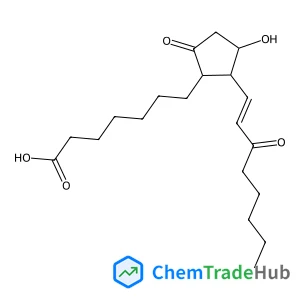
(11alpha,13E)-11-Hydroxy-9,15-dioxoprost-13-en-1-oic acid
CAS Number:
22973-19-9
Molecular Formula:
C20H32O5
Yicong Ma, Sajal K. Ghosh, Sambhunath Bera, Zhang Jiang, Christian M. Schlepütz, Evguenia Karapetrova, Laurence B. Lurio, Sunil K. Sinha
Ternary lipid mixtures incorporating cholesterol are well-known to phase separate into liquid-ordered (Lo) and liquid-disordered (Ld) phases. In multilayers of these systems, the laterally phase separated domains register in columnar structures with different bilayer periodicities, resulting in hydrophobic mismatch energies at the domain boundaries. In this paper, we demonstrate via synchrotron-based X-ray diffraction measurements that the system relieves the hydrophobic mismatch at the domain boundaries by absorbing larger amounts of inter-bilayer water into the Ld phase with lower d-spacing as the relative humidity approaches 100%. The lamellar repeat distance of the Ld phase swells by an extra 4 Å, well beyond the equilibrium spacing predicted by the inter-bilayer forces. This anomalous swelling is caused by the hydrophobic mismatch energy at the domain boundaries, which produces a surprisingly long-range effect. We also demonstrate that the d-spacings of the lipid multilayers at 100% relative humidity do not change when bulk water begins to condense on the sample.
Beatriz Lantaño, Sebastián Barata-Vallejo, Al Postigo
DOI: 10.1039/C8OB01653D
Haichao Huang, Hailong Wang, Chao Gong, Zhenjing Zhuang, Wenmin Feng, Si-Hai Wu, Lianhui Wang
DOI: 10.1039/D1QO01478A
Madhu Ramesh, Pandeeswar Makam, Chandrashekhar Voshavar, Harshavardhan Khare, Kolla Rajasekhar, Suryanarayanarao Ramakumar, Thimmaiah Govindaraju
DOI: 10.1039/C8OB01691G
Arthur H. G. David, Pablo García–Cerezo, Araceli G. Campaña, Francisco Santoyo–González, Victor Blanco
DOI: 10.1039/D1QO01491A
Ben Bradshaw, David Collison, C. David Garner, John A. Joule
DOI: 10.1039/B209217D
Han Xu, Feng Sha, Qiong Li, Xin-Yan Wu
DOI: 10.1039/C8OB01970C
Huanyu Shan, Rihuang Pan, Xufeng Lin
DOI: 10.1039/C8OB01785A
Saumitra Sengupta, Goverdhan Mehta
DOI: 10.1039/C8OB01388H
Hideto Miyabe, Kayoko Fujii, Takeaki Naito
DOI: 10.1039/B208823A
6-(3-Fluorophenyl)picolinic acid is generally considered safe for laboratory use...
(3R)-3-Pyrrolidinol is used in the pharmaceutical industry as a precursor for dr...
When handling (4R,5R)-4,5-Diethoxycarbonyl-2,2-dimethyldioxolane (CAS: 59779-75-...
1-(6-Chloroimidazo[1,2-b]pyridazin-3-yl)ethanone is often synthesized via a mult...
The market for N-Ethyl-3,4-dimethylbenzylamine (CAS: 39180-83-1) remains steady,...
Tert-butyl 3-(pyrrolidin-1-yl)azetidine-1-carboxylate is a chemical compound wit...
1-Bromo-3-chloro-2,4-dimethoxybenzene (CAS: 1228956-93-1) falls under the classi...
The safety of 8-Bromo-2-methyl-3,4-dihydroisoquinolin-1(2H)-one (CAS: 1368622-07...
Benzyl [(3S)-2,6-dioxo-3-piperidinyl]carbamate is generally safe when handled wi...
1-{[4-(4,4,5,5-Tetramethyl-1,3,2-dioxaborolan-2-yl)phenyl]sulfonyl}pyrrolidine s...

Physical Chemistry Chemical Physics (PCCP) is an international journal co-owned by 19 physical chemistry and physics societies from around the world. This journal publishes original, cutting-edge research in physical chemistry, chemical physics and biophysical chemistry. To be suitable for publication in PCCP, articles must include significant innovation and/or insight into physical chemistry; this is the most important criterion that reviewers and Editors will judge against when evaluating submissions. The journal has a broad scope and welcomes contributions spanning experiment, theory, computation and data science. Topical coverage includes spectroscopy, dynamics, kinetics, statistical mechanics, thermodynamics, electrochemistry, catalysis, surface science, quantum mechanics, quantum computing and machine learning. Interdisciplinary research areas such as polymers and soft matter, materials, nanoscience, energy, surfaces/interfaces, and biophysical chemistry are welcomed if they demonstrate significant innovation and/or insight into physical chemistry. Joined experimental/theoretical studies are particularly appreciated when complementary and based on up-to-date approaches.
![2-Methyl-2-propanyl [(2S)-1-hydroxy-3-(4-hydroxyphenyl)-2-propanyl]carbamate structure](https://static.chemtradehub.com/structs/833/83345-46-4-eec2.webp "2-Methyl-2-propanyl [(2S)-1-hydroxy-3-(4-hydroxyphenyl)-2-propanyl]carbamate structure")
![Benzyl spiro[indole-3,4'-piperidine]-1(2H)-carboxylate hydrochloride (1:1) structure](https://static.chemtradehub.com/structs/159/159635-46-8-8de0.webp "Benzyl spiro[indole-3,4'-piperidine]-1(2H)-carboxylate hydrochloride (1:1) structure")




