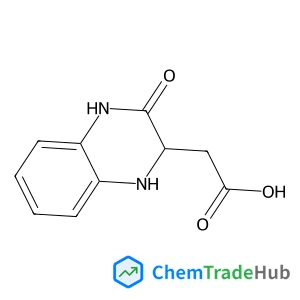
(3-Oxo-1,2,3,4-tetrahydro-2-quinoxalinyl)acetic acid
CAS Number:
136584-14-0
Molecular Formula:
C10H10N2O3
I. Panas
A complete water oxidation and oxygen evolution reaction (OER) cycle is monitored by means of density functional theory (DFT). A biomimetic model catalyst, comprising a μ-OH bridged Mn(III–V) dimer truncated by acetylacetonate ligand analogs and hydroxides is employed. The reaction cycle is divided into four electrochemical hydrogen abstraction steps followed by a series of chemical steps. The former employ the tyrosine/tyrosyl redox couple acting as electron and proton sink, thus determining the reference potential. Stripping hydrogen from water leads to the formation of two highly unstable Mn(V)O/Mn(IV)–O˙ moieties, which subsequently combine to form a μ-peroxy O–O bond. O2 evolution results from subsequent consecutive replacement of the remaining Mn–O bonds by water. A Zener “spintronic” type mechanism for virtually barrierless O2 evolution is found. The applicability of DFT is discussed and extended to include the rate-limiting steps in the OER. Rather than attempting to compute transition states where KS-DFT is unreliable, an upper bound for the activation barrier of the O–O bond formation step is estimated from the hessians of the relevant intermediates.
Dilek Yalcin, Andrew J. Christofferson, Calum J. Drummond, Tamar L. Greaves
DOI: 10.1039/D0CP00201A
Miroslav Menšík, Petr Toman, Cheng-Han Chung, Chimed Ganzorig, Jiří Pfleger
DOI: 10.1039/C9CP06477J
Stéphane Pasquiers, Nicole Blin-Simiand, Lionel Magne, Nguyen-Thi Van-Oanh, Sébastien Thomas
DOI: 10.1039/C9CP06958E
Samuel Moxon, Adam R. Symington, Joshua S. Tse, James Dawson, Joseph M. Flitcroft, Stephen C. Parker, David J. Cooke, Robert M. Harker, Marco Molinari
DOI: 10.1039/D0CP00021C
Michael Gradzielski
DOI: 10.1039/D0CP01076F
Pascal Didier, Jagannath Kuchlyan, Lara Martinez-Fernandez, Pauline Gosset, Jérémie Léonard, Yitzhak Tor, Roberto Improta, Yves Mély
DOI: 10.1039/C9CP06931C
Benjamin A. Link, Ammon J. Sindt, Linda S. Shimizu, Thanh D. Do
DOI: 10.1039/C9CP06938K
Björn Kriete, Carolien J. Feenstra, Maxim S. Pshenichnikov
DOI: 10.1039/D0CP01734E
Mengjian Wu, Zhaoxia Wu, Shangwu Ding, Zhong Chen, Xiaohong Cui
DOI: 10.1039/D0CP00429D
This compound is mainly used as an intermediate in the synthesis of antipsychoti...
Waste containing 1-(D-Ribofuranosyl)-1,4-dihydro-3-pyridinecarboxamide (CAS: 191...
2-Methyl-2-propanyl 3-bromo-3-(hydroxymethyl)-1-azetidinecarboxylate (CAS: 20079...
N-(4-Chloro-2-pyridinyl)acetamide (CAS: 245056-66-0) is a chemical compound with...
5-Chloro-2-hydroxybenzoic acid, also known as 5-chlorosalicylic acid, is an arom...
When handling 1,1-Dichloro-1-fluoroethane (CAS: 1717-00-6), it is important to u...
Fmoc-(2S,3R)-3-phenylpyrrolidine-2-carboxylic acid is a white crystalline solid ...
4-Amino-5-bromo-2-pyridinecarboxylic acid is primarily used as a precursor in th...
Handling this compound should be done with personal protective equipment (PPE) i...
When handling 8-bromo-2,2-dimethyl-3,4-dihydro-2H-1,4-benzoxazin-3-one, use prop...

Physical Chemistry Chemical Physics (PCCP) is an international journal co-owned by 19 physical chemistry and physics societies from around the world. This journal publishes original, cutting-edge research in physical chemistry, chemical physics and biophysical chemistry. To be suitable for publication in PCCP, articles must include significant innovation and/or insight into physical chemistry; this is the most important criterion that reviewers and Editors will judge against when evaluating submissions. The journal has a broad scope and welcomes contributions spanning experiment, theory, computation and data science. Topical coverage includes spectroscopy, dynamics, kinetics, statistical mechanics, thermodynamics, electrochemistry, catalysis, surface science, quantum mechanics, quantum computing and machine learning. Interdisciplinary research areas such as polymers and soft matter, materials, nanoscience, energy, surfaces/interfaces, and biophysical chemistry are welcomed if they demonstrate significant innovation and/or insight into physical chemistry. Joined experimental/theoretical studies are particularly appreciated when complementary and based on up-to-date approaches.